

Courts US Politics Virginia · 2026 Midterms
The court’s decision was about process, not politics. But the political fallout — and the fiery rhetoric it has already sparked — is anything but procedural.
Redistricting fights are usually slow, grinding, procedural affairs — the kind of story that political obsessives follow and everyone else tunes out. But what just happened in Virginia is worth paying attention to, because the implications stretch well beyond one state’s congressional map and straight into the arithmetic of the 2026 midterms.
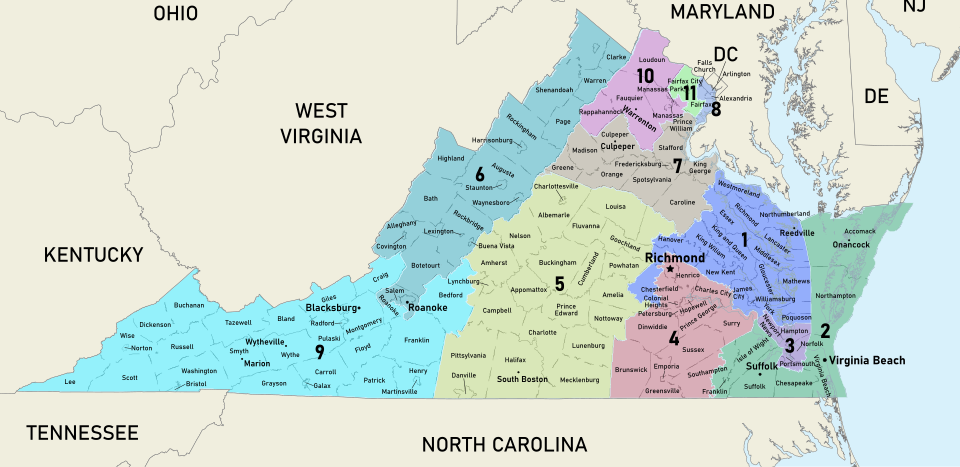
The Virginia Supreme Court struck down a Democratic-backed redistricting plan this week that would have dramatically redrawn the state’s congressional map — converting what is currently a 6-5 Republican advantage into a near-total Democratic sweep of 10-1. The court’s ruling wasn’t about which party deserved to win more seats. It was about the fact that Democrats, in their rush to get the map in front of voters, skipped the constitutional steps required to do it legally.
WHAT WAS AT STAKE
6–5 Current GOP edge in Virginia
10–1 Proposed Dem map outcome
1M+ Virginians already voted when court ruled
13 States where GOP redistricting gains are now possible
What the court actually said — and why the messenger matters
Virginia requires an “intervening election” before constitutional amendments take effect — a procedural guardrail designed to prevent any one legislature from locking in major changes without renewed democratic consent. Democrats attempted to bypass this step entirely, pushing the map toward voters before the required process had been completed. Over a million Virginians had already cast ballots in early voting by the time the court intervened.
Former Virginia Attorney General Jason Miyares, who was among those commenting on the ruling, noted something worth dwelling on: the justice who wrote the opinion was originally appointed by Democrat Mark Warner when he was governor, and was later elevated to the Supreme Court on a unanimous vote of the General Assembly — every Democrat in the chamber voted for him, including Senator Louise Lucas. The people now attacking the ruling helped put its author on the bench. That’s not a minor irony.
Miyares was clear that his position isn’t partisan — he has been consistent in supporting Virginia’s nonpartisan redistricting process and criticising gerrymandering by either party, whether in California, New York, or Texas. His argument is simpler: Virginia has a process that works. Don’t break it because it’s inconvenient right now.
The national map — and why 2026 is watching closely
Virginia’s ruling doesn’t exist in isolation. Analysts are now looking at up to 13 states where redistricting battles — sparked in part by Democratic map-drawing efforts after 2024, and Republican counter-moves in response — could shift congressional seats going into the midterms. Tennessee’s legislative redraw, which effectively locked in a Republican supermajority of districts, is the most recent example of the same phenomenon playing out from the other side.
The argument that gerrymandering disenfranchises voters isn’t new — and it applies across party lines. There are regions of New England where 40 to 45 percent of voters consistently support Republican candidates and end up with zero Republican representation in Congress. The mirror image exists in safe Republican states. The Virginia ruling, whatever its partisan optics, is a reminder that the rules around how those maps get drawn actually matter — and that courts are willing to enforce them.
The rhetoric that followed — and why it concerns people
Not everyone responded to the ruling by engaging with the legal arguments. Streamer and political commentator Hasan Piker posted a pointed reaction invoking the phrase associated with John F. Kennedy: that those who make peaceful revolution impossible make violent revolution inevitable. It was a quote aimed at the court, at redistricting outcomes in Tennessee, and at what he framed as the systematic erosion of Democratic voting power.
Miyares called the language “grossly irresponsible” and drew a direct line to what he sees as a troubling pattern — citing polling conducted after the fatal shooting of UnitedHealthcare CEO Brian Thompson, in which roughly half of American college students reportedly said the shooting was justified. Whether or not you agree with Miyares’s politics, the underlying concern is legitimate: when public figures with large platforms frame legal and electoral outcomes as justifications for violence — even implicitly — the potential consequences are real. Free speech protects the words. It doesn’t immunise anyone from the responsibility that comes with an audience of millions.
About Republican Column: At Republican Column, we bring you breaking U.S. news, politics, and global developments every day to keep you informed.