

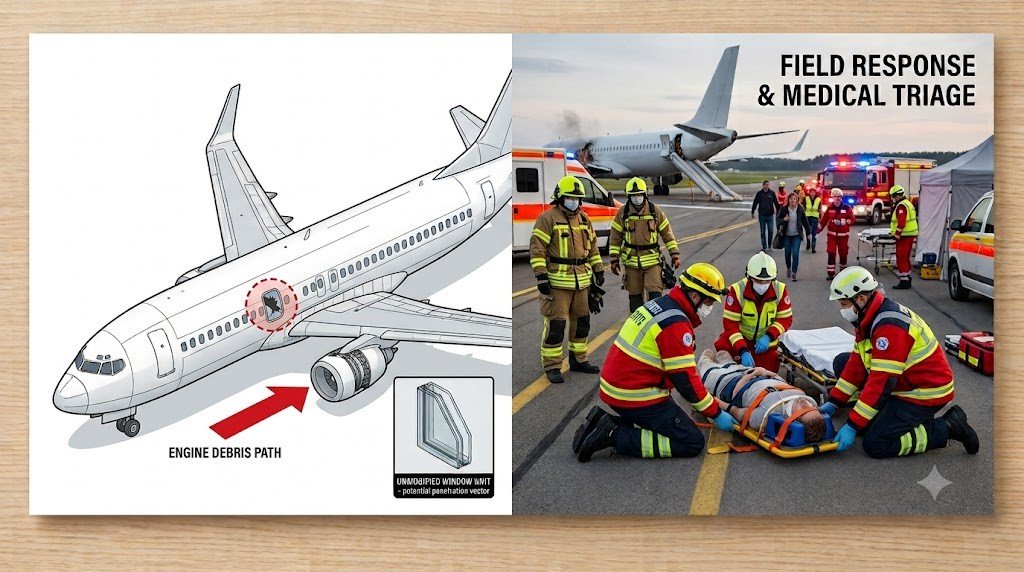
A routine vacation flight over southeastern Europe turned into a terrifying struggle for survival when an apparent engine failure sent debris crashing through the side of a passenger jet, shattering a cabin window and triggering a sudden decompression that nearly claimed a man’s life.
What began as an ordinary Friday morning departure from Greece ended with an emergency landing, multiple international investigations, and renewed scrutiny over aircraft engine safety after passengers were forced to perform an extraordinary mid-air rescue.
The incident occurred aboard Ryanair Flight FR1879, operated by Malta Air, on July 10, 2026. The Boeing 737-800 had departed Thessaloniki, Greece, for Memmingen, Germany, carrying holiday travelers returning home after summer vacations.
Just minutes after takeoff, while climbing through approximately 16,000 feet, passengers suddenly heard what many described as an explosion.
Within seconds, the calm inside the cabin descended into chaos.
A Window Explodes
According to witness accounts and airline officials, the aircraft suffered a serious malfunction involving its right engine.
Investigators believe a component from the engine broke apart at high speed and struck the aircraft’s fuselage, smashing one of the passenger windows.
The impact instantly created a hole in the pressurized cabin.
Air rushed violently toward the opening as cabin pressure equalized with the much thinner atmosphere outside.
Oxygen masks dropped from the ceiling.
Loose objects flew through the cabin.
Passengers described an overwhelming roar as freezing air blasted through the aircraft.
The sudden decompression happened so quickly that many travelers initially thought the aircraft had exploded.
Passengers Realize Someone Is Being Pulled Outside
The most frightening moments unfolded in one row near the damaged window.
A 61-year-old Serbian passenger was violently pulled toward the opening.
Witnesses said the force of the escaping air dragged his upper body through the shattered window frame, leaving his head, neck and shoulders outside the aircraft.
Only one thing prevented an almost unimaginable tragedy.
His seatbelt remained fastened.
Even then, the force pulling him toward the opening was so powerful that his wife immediately grabbed his legs in an effort to keep him inside.
Other nearby passengers quickly realized what was happening.
Ignoring the danger around them, several people left their seats and rushed forward to help.
Working together, they fought against the powerful airflow and eventually managed to pull the injured man completely back inside the cabin before securing him away from the damaged window.
Many passengers later described those moments as the longest of their lives.
Ryanair Flight FR1879 Incident Overview
- Aircraft: Boeing 737-800 (Malta Air / Ryanair)
- Route: Thessaloniki, Greece → Memmingen, Germany
- Date: July 10, 2026
- Altitude During Failure: Approximately 16,000 feet
- Primary Damage: Engine debris shattered passenger window
- Most Serious Injury: 61-year-old passenger suffered neck injuries, friction burns and severe shock
- Outcome: Safe emergency landing back in Thessaloniki
Pilots Execute Emergency Descent
While passengers battled to save one another, the flight crew immediately began executing emergency procedures.
Flight-tracking data shows the aircraft stopped climbing at roughly 16,000 feet before entering a rapid descent.
The pilots quickly brought the aircraft down to around 6,000 feet, where outside air pressure is significantly higher and passengers can breathe safely even if cabin pressurization has been compromised.
Rather than attempting to continue toward Germany, the crew declared an emergency and returned to Thessaloniki.
Because the aircraft had departed only minutes earlier and still carried a heavy fuel load, the pilots remained at lower altitude while burning fuel before conducting a controlled approach back to the airport.
Roughly an hour after takeoff, the aircraft landed safely.
Emergency responders were already waiting on the runway.
Passenger Taken to Hospital
Medical teams boarded the aircraft immediately after landing.
The injured passenger was transported to a local hospital.
According to Michalis Giannakos, head of a Greek healthcare workers’ union, doctors treated the man for:
- Neck and shoulder injuries
- Friction burns caused by high-speed airflow
- Severe psychological trauma
Officials said he remained in stable condition.
Remarkably, no other passengers suffered serious physical injuries despite the frightening ordeal.
Why the Cabin Didn’t Completely Lose Control
Although many people describe these incidents as passengers being “sucked out” of airplanes, aviation experts note that what actually happens is slightly different.
Modern airliners maintain cabin pressure equivalent to several thousand feet above sea level while cruising much higher.
When a window suddenly fails, the higher-pressure air inside rushes outward almost instantly.
That creates an extremely powerful airflow toward the opening during the first few seconds after the breach.
Anyone sitting immediately beside the damaged window can experience tremendous force pulling them toward it until the pressure equalizes.
Once the pressure stabilizes, the continuous airflow decreases significantly, allowing the crew to regain control of the situation.
The incident also reinforced one of aviation’s oldest safety rules:
Passengers who remain seated with their seatbelts fastened are dramatically better protected during sudden turbulence, decompressions and other unexpected emergencies.
Investigators Focus on Engine Failure
The investigation is now centered on what caused the engine to shed debris.
Because the emergency unfolded while the aircraft was flying over North Macedonia, that country’s Aircraft Accident and Incident Investigation Committee is leading the international investigation under established aviation agreements.
Authorities are expected to examine:
- Engine maintenance history
- Previous inspection records
- Flight data recorder information
- Cockpit voice recorder recordings
- The damaged engine casing
- The shattered window frame
- Recovered engine fragments
Since the aircraft was built in the United States, the National Transportation Safety Board (NTSB) has also been notified and may provide technical assistance alongside Boeing and engine manufacturer representatives.
Investigators will ultimately determine whether the failure resulted from mechanical fatigue, maintenance issues, manufacturing defects, or another factor.
An Aging but Common Aircraft
The aircraft involved was an 18-year-old Boeing 737-800, one of the most widely used commercial airplanes in the world.
Despite its age, aircraft of this type continue operating safely across hundreds of airlines worldwide, provided they receive ongoing maintenance and inspections required by aviation regulators.
Experts caution that incidents like this remain extremely rare compared with the millions of commercial flights completed safely every year.
Nevertheless, engine failures involving debris capable of penetrating an aircraft fuselage receive intense scrutiny because of their potential consequences.
Ryanair Responds
Ryanair confirmed the flight returned to Thessaloniki after experiencing what it described as an in-flight “window dislodgement.”
The airline said passengers were transferred onto a replacement aircraft later that day so they could continue their journey to Germany.
The company also apologized for the disruption while pledging full cooperation with investigators.
A Reminder of Aviation’s Safety Layers
Despite the frightening images and dramatic witness accounts, aviation specialists point to the outcome as evidence of how multiple layers of safety are designed to work together.
The pilots followed emergency procedures almost immediately.
Passengers acted courageously to rescue a fellow traveler.
Emergency responders were ready when the aircraft landed.
Most importantly, the passenger’s seatbelt—combined with the quick actions of those around him—likely prevented a fatal outcome.
As investigators continue examining the damaged engine and shattered window, the incident serves as a powerful reminder that even during extremely rare emergencies, training, preparation and simple safety measures can make the difference between tragedy and survival.
About Republican Column: At Republican Column, we bring you breaking U.S. news, politics, and global developments every day to keep you informed.