

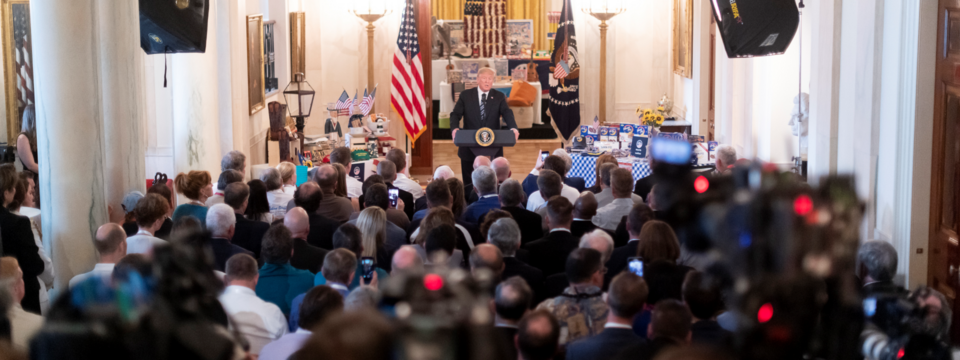
President Donald Trump’s proposal for a $5,000 payment to American adults has quickly become one of the most closely watched economic ideas surrounding the 2026 midterm elections. Florida Republican Rep. Anna Paulina Luna has voiced support for the concept while arguing that Washington should look at overseas spending before asking American taxpayers for more money.
Trump has proposed what he calls a “Trump dividend” for American adults if Republicans retain control of Congress. The plan would require congressional approval and could cost well over $1 trillion depending on eligibility. Trump and Vice President JD Vance have pointed toward tariff revenue as a potential funding source, although analysts say existing tariff collections would not be enough to cover the full cost
That financial gap has put the spotlight on other possible sources of funding.
Luna Puts Foreign Aid at the Center of the Debate
Luna’s argument is straightforward: before increasing federal borrowing or raising taxes, lawmakers should examine money currently being spent overseas.
In comments referenced in the material surrounding her position, Luna argued that some foreign assistance could instead be directed toward Americans through a direct payment.
The approach fits with a broader “America First” argument that federal resources should prioritize U.S. households, domestic infrastructure and national economic security.
The idea is politically attractive to supporters of Trump’s proposal, particularly at a time when many Americans remain concerned about household costs. But the numbers present a significant challenge.
Reuters reported that a $5,000 payment to roughly 240 million adult citizens could cost around $1.2 trillion. Other estimates have placed the potential cost even higher. Congress would ultimately have to approve the spending, meaning neither Trump nor Luna could create the payments by executive action alone.
That makes the question of funding central to whether the proposal could ever become reality.
Tariff Revenue Versus Federal Spending
Trump has emphasized tariff revenue as a potential way to finance the dividend. The administration’s argument is that money collected through tariffs can provide a source of revenue without relying entirely on traditional taxation.
Critics, however, point out that tariff collections remain far below the amount necessary to finance $5,000 payments to hundreds of millions of Americans. Reuters reported that current tariff revenue would fall substantially short of the estimated cost of the proposal.
That has led to suggestions that the program could require additional borrowing, spending reductions or a narrower eligibility standard.
Vance has also indicated that wealthier Americans could potentially be excluded, which would reduce the overall cost.
For Luna and other fiscal conservatives, the debate therefore goes beyond the checks themselves. It is also about deciding which federal priorities should receive taxpayer dollars.
A Broader Fight Over Foreign Influence Online
Luna has also focused heavily on foreign influence and political activity across social media.
She has previously pushed legislation requiring influencers to disclose payments from foreign governments, arguing that Americans should know when online political content is being financially supported by foreign interests. Her congressional office has described the legislation as an effort to increase transparency around foreign propaganda.
In her more recent comments, Luna has warned about online narratives that discourage conservative voters from participating in politics. She has described some of this activity as part of a broader foreign-influence problem and has specifically raised concerns about China-linked operations.
There is documented evidence that Chinese state-linked influence operations have targeted American political discourse online. Researchers and U.S. officials have previously identified networks using fake accounts and coordinated messaging to influence public debate and undermine confidence in American institutions.
However, individual claims that particular online communities or “black pill” narratives are directly funded by the Chinese government require evidence on a case-by-case basis. It is important not to treat every pessimistic or divisive social-media post as proof of a foreign operation.
The Bigger Political Question
For Trump and his supporters, the proposed dividend represents a different approach to government spending: collect revenue, reduce what they consider unnecessary overseas commitments and return more money directly to Americans.
For opponents, the proposal raises questions about inflation, the national debt and whether the federal government can afford payments potentially costing more than $1 trillion. Economists and lawmakers from both parties have questioned how such a program could be financed without increasing fiscal pressure.
Luna’s support places her firmly in the debate over whether Washington should redirect more of its resources toward American households.
The proposal is still only a political plan. Congress would have to approve it, lawmakers would need to determine eligibility and funding, and the final structure could look very different from the proposal currently being discussed.
For now, the $5,000 dividend has succeeded in putting a major question at the center of the political conversation: Should Washington continue spending large sums overseas, or should more federal resources be directed toward Americans at home?
That question is likely to remain a major part of the economic debate as the 2026 midterm elections approach.
About Republican Column: At Republican Column, we bring you breaking U.S. news, politics, and global developments every day to keep you informed.