

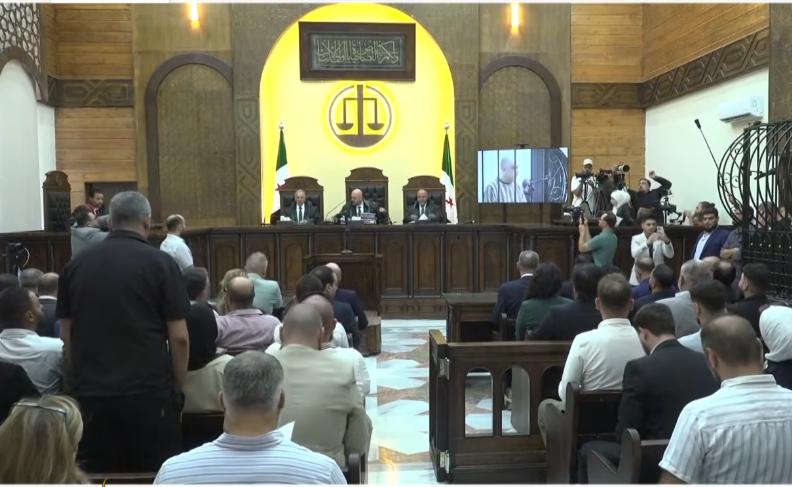
Justice for Assad-Era Victims as Damascus Court Hands Down Death Sentences
A Syrian court has sentenced former Daraa security official Atef Najib to death and issued in-absentia death sentences against Bashar al-Assad and Maher al-Assad, bringing renewed attention to accountability during Syria’s political transition.
A Damascus court has delivered one of the most consequential rulings yet in Syria’s effort to confront the legacy of the Assad era, sentencing former Daraa political security chief Atef Najib to death and issuing death sentences in absentia against former President Bashar al-Assad and his brother Maher al-Assad.
The ruling represents a dramatic moment for Syrians who spent years demanding accountability for alleged abuses committed under the Assad government. It also raises difficult questions about how a country emerging from decades of authoritarian rule should balance justice for victims with the principles of due process and the rule of law.
Najib, who was a senior security official in Daraa in 2011, was tried in Damascus and remains in Syrian custody. Bashar and Maher al-Assad, however, were not present in court and remain outside Syria.
The case carries particular historical significance because Daraa became one of the earliest flashpoints of the uprising that eventually developed into a nationwide conflict. The treatment of protesters and political opponents in the city became a symbol of the government’s broader approach to dissent.
A Case Tied to the Beginning of the Uprising
Najib’s role in Daraa has made him a particularly significant figure in the proceedings.
According to the material provided for this report, Najib was accused of involvement in arrests, torture and killings during the early stages of the 2011 unrest. His actions have long been associated with the government’s crackdown in Daraa, where demonstrations grew rapidly after local residents protested the detention of schoolchildren.
For many Syrians, the case is therefore about more than one former official. It represents an attempt to establish legal responsibility for conduct that critics say was previously protected by the power of the state.
The court’s decision comes as transitional authorities face the enormous task of dealing with complaints from victims and families across the country. Years of war and political repression have left a complicated record of alleged abuses, disappearances and killings.
The Question of Due Process
The death sentences are also likely to generate debate among legal experts and human-rights organizations.
Supporters of accountability argue that senior officials accused of serious abuses must face consequences rather than simply disappear from public life. At the same time, international legal standards generally emphasize fair trials, credible evidence and defendants’ rights, particularly when the punishment is irreversible.
The proceedings involving Najib therefore carry importance beyond the individual verdict. If Syria’s transitional authorities want to establish lasting confidence in its justice system, future cases will be closely watched for evidence of transparent procedures and meaningful defense rights.
The in-absentia sentences against Bashar and Maher al-Assad create another complication. A court can issue a judgment against someone who is outside the country’s reach, but enforcing that judgment is an entirely different matter.
Assad’s Presence in Russia
Bashar al-Assad’s reported refuge in Russia adds an international dimension to the case.
The former Syrian president left the country as his government collapsed and has remained beyond the reach of Damascus authorities. His presence in Moscow means that the Syrian court’s sentence does not automatically translate into custody or punishment.
That gap between legal judgment and practical enforcement could become one of the central issues surrounding Syria’s transitional justice process.
It also places pressure on foreign governments that have maintained relationships with figures from the former Syrian leadership. Whether countries such as Russia will cooperate with future Syrian legal proceedings remains an important unanswered question.
A New Test for Syria’s Transition
The death sentences arrive at a pivotal moment for Syria. The country is attempting to move away from the institutions and political structures associated with the Assad family while simultaneously preventing another cycle of violence.
For victims’ families, accountability can provide recognition that their suffering has not been forgotten. For the broader Syrian population, however, the challenge will be ensuring that justice does not simply become another instrument of political revenge.
The credibility of the country’s new legal institutions may ultimately depend on whether they can demonstrate that powerful figures are subject to the same legal standards as everyone else.
The Damascus ruling is therefore both a verdict and a test. It sends a clear message that former officials may face prosecution for alleged abuses, but it also places a heavy responsibility on Syria’s transitional authorities to demonstrate that accountability is built on evidence, transparent proceedings and the rule of law.
For Syrians who have waited years for answers, the proceedings mark a significant new chapter. The harder task now is turning a single landmark judgment into a durable system of justice capable of addressing the enormous legacy left by decades of conflict and authoritarian rule.
About Republican Column: At Republican Column, we bring you breaking U.S. news, politics, and global developments every day to keep you informed.