

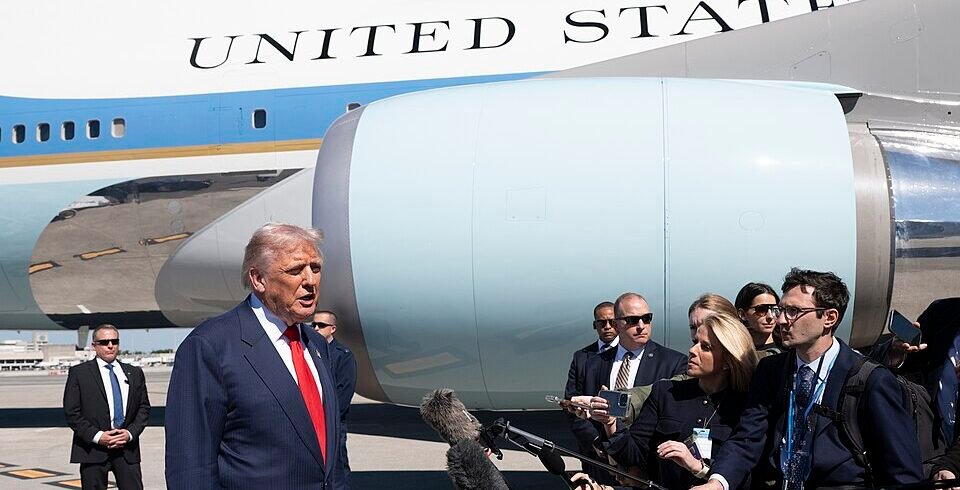
A surprise aircraft switch after Trump’s NATO summit trip underscored the extraordinary security precautions surrounding the president as tensions with Iran remained high.
President Donald Trump’s journey home from the NATO summit in Turkey took an unexpected turn when he switched from the newer presidential aircraft to an older Air Force One jet before continuing toward the United States.
The unusual move attracted immediate attention because it came during heightened tensions between Washington and Tehran. However, Trump himself said security concerns involving Iran were not the stated reason for the aircraft change, instead describing the decision as part of the administration’s broader security precautions.
Trump has acknowledged that he faces serious threats because of his position as president. During the trip, he said he was frequently threatened and described himself as a major target of Iran.
The episode offered another reminder of the enormous security responsibility surrounding the presidency, particularly when an American president is traveling through a region experiencing military tensions.
A Carefully Managed Journey
Trump arrived in Turkey aboard the newer aircraft before departing on an older Boeing VC-25A that has served as Air Force One for decades. The newer aircraft was sent ahead to RAF Mildenhall in the United Kingdom, where U.S. service members were able to see the aircraft before Trump continued his journey home.
The aircraft swap was accompanied by additional security measures. Reporters traveling with Trump were asked to keep their window blinds closed during part of the journey from Turkey to Britain, while the presidential aircraft’s tracking signal was temporarily unavailable early in the flight.
These details naturally raised questions about the level of caution being used around the president.
The White House, however, emphasized that the newer aircraft had been fitted with high-level security protocols and that the administration uses measures including distraction and misdirection when confronting threats.
Iran Tensions Raise the Stakes
The timing was particularly significant.
The aircraft change occurred as U.S.-Iran tensions were escalating following attacks involving commercial shipping near the Strait of Hormuz and subsequent American military strikes against Iranian targets. U.S. officials said the American operation was aimed at reducing Iran’s ability to threaten freedom of navigation in the strategically important waterway.
Trump has repeatedly framed his Iran policy around pressure, deterrence and American military readiness.
The administration has also pursued economic measures designed to increase pressure on Tehran. Earlier this year, Trump signed an executive order creating a mechanism for additional tariffs against countries purchasing Iranian goods or services, citing national security and foreign-policy concerns.
For Trump’s America First supporters, the broader message is unmistakable: the administration wants adversaries to understand that threats against American interests will carry consequences.
A President Under Constant Protection
Presidential travel has always involved layers of security, but the risks become particularly complicated when the president travels near an active conflict zone.
The older Air Force One aircraft used during Trump’s journey has decades of specialized presidential security capabilities. The Air Force has said the newer aircraft is a state-of-the-art platform, although some modifications intended for the eventual permanent Air Force One fleet were not included in the interim aircraft.
That makes the aircraft decision more than a curiosity. It highlights how presidential protection involves constant calculations about aircraft capabilities, routes, communications and potential threats.
Trump has presented himself as a president willing to confront dangerous regimes rather than retreat from difficult challenges. His supporters see that posture as central to his “Peace Through Strength” philosophy.
Strength, Security and American Leadership
Trump’s NATO visit itself also produced a broader defense message. The White House said the summit generated billions of dollars in defense deals and joint ventures involving American companies and NATO allies, with the administration arguing that increased allied investment strengthens the U.S. defense industrial base.
That combination—stronger alliances, increased defense investment and heightened presidential security—has become a defining feature of Trump’s second-term foreign-policy agenda.
The aircraft switch ultimately passed without incident, and Trump continued his journey home.
But the episode offered a glimpse behind the scenes of presidential security at a moment when tensions with Iran were running high. For the Trump administration, the message remains consistent: protect the president, strengthen America’s defenses and ensure that threats to the United States are met with preparedness rather than hesitation.
About Republican Column: At Republican Column, we bring you breaking U.S. news, politics, and global developments every day to keep you informed.