

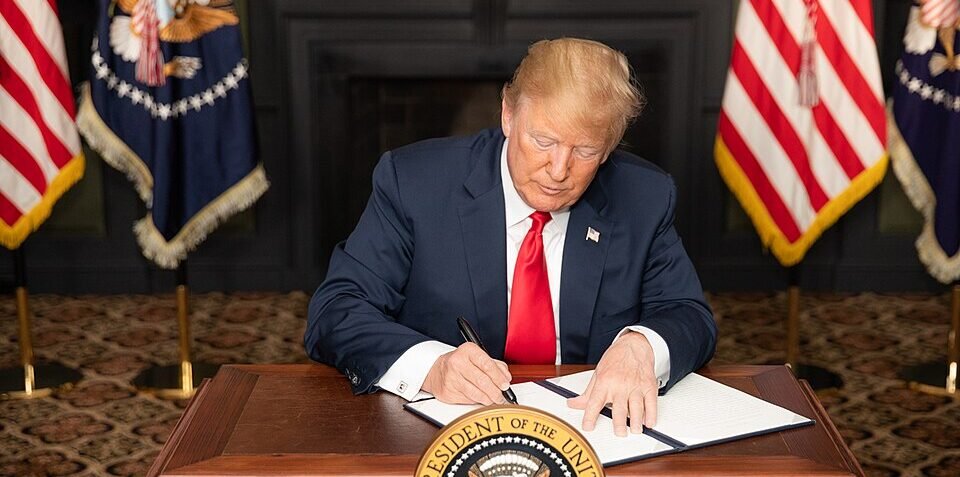
President Donald Trump is once again putting America’s economic power at the center of its strategy toward Iran, sending a message that Washington intends to squeeze Tehran financially rather than rush into another open-ended military conflict.
The approach fits neatly with Trump’s long-standing “peace through strength” philosophy. Instead of treating military intervention as the first answer, the administration is relying heavily on sanctions, financial restrictions and pressure on the networks that help Iran generate and move revenue.
For Trump’s supporters, the strategy represents a return to a simple America First principle: the United States should use its enormous economic influence to protect American interests while demanding that adversaries pay a price for threatening U.S. security.
Economic Pressure Becomes the Main Weapon
Iran has spent years developing complicated networks to sell oil, move money and conduct international business despite American restrictions.
Those networks have increasingly become targets of U.S. sanctions enforcement.
The Treasury Department has sanctioned Iranian oil and petroleum networks, shipping companies, vessels, financial facilitators and individuals accused of helping Tehran evade restrictions. The objective is to make it increasingly difficult for Iran to turn its energy resources into unrestricted cash.
That matters because oil revenue remains an important source of income for the Iranian government.
The Trump administration’s calculation is straightforward: if Tehran has fewer resources available, its ability to finance military programs and support regional partners is also constrained.
The America First Argument
Trump’s supporters see this approach as fundamentally different from the foreign-policy thinking that dominated Washington for years.
Their argument is not that America should withdraw from the world. It is that American involvement should serve a clearly defined national interest.
Under that philosophy, Washington should be willing to cooperate with other countries—but it should not sacrifice American economic strength to accommodate hostile governments.
That means using America’s position at the center of the global financial system as leverage.
Foreign companies and financial institutions that conduct business involving sanctioned Iranian entities can face serious consequences. For international businesses, the choice can therefore become financially significant: risk access to the American market or reconsider dealings with Tehran.
Why Secondary Sanctions Matter
Secondary sanctions are particularly powerful because their effects can extend beyond Iran’s borders.
A company does not necessarily have to be Iranian to face scrutiny. If it knowingly helps sanctioned Iranian businesses move money, transport restricted petroleum or evade American restrictions, it can potentially find itself exposed to U.S. enforcement.
This creates a wider deterrent.
Businesses around the world have to consider whether doing business with Tehran is worth the potential consequences.
For the Trump camp, this is precisely what economic leverage is supposed to accomplish.
The United States does not need to deploy troops every time it wants to send a warning. It can instead use its financial influence to raise the cost of activities Washington considers unacceptable.
China Remains a Major Challenge
One of the biggest tests for the strategy is enforcement against buyers of Iranian oil, particularly where major international trading relationships are involved.
China has remained an important destination for Iranian crude, making sanctions enforcement more complicated than simply issuing another blacklist.
That puts the Trump administration in a difficult position.
Washington has to balance aggressive enforcement with broader American economic interests. Going too far against major trading partners could create friction, while weak enforcement could undermine the credibility of the sanctions themselves.
For Trump supporters, however, that is an argument for consistency rather than retreat.
If sanctions are announced but routinely ignored, they lose their value. If the United States wants economic pressure to influence Tehran, enforcement has to be credible.
Strength Without Endless War
Perhaps the most politically significant part of Trump’s approach is what it does not require.
It does not automatically mean another large American military deployment in the Middle East.
Trump has repeatedly campaigned on avoiding unnecessary wars and putting American interests first. Economic pressure gives his administration another tool between diplomacy and military action.
That does not make sanctions painless or risk-free. Economic restrictions can affect ordinary people as well as governments, and critics argue that prolonged pressure can create humanitarian consequences.
Those concerns deserve serious consideration.
But the administration’s supporters argue that allowing Iran unrestricted access to international revenue networks would create its own risks—particularly if those resources are used to expand military capabilities or support armed groups across the region.
Tehran’s Difficult Choice
The ultimate question is whether sustained pressure produces a diplomatic opening.
Iran can continue looking for ways around American restrictions, deepen relationships with countries willing to trade with it and resist Washington’s demands.
Or it can decide that negotiations offer a better path.
That is where Trump’s strategy could prove most consequential.
The White House does not necessarily need Iran to collapse economically. It needs Tehran to believe that continuing its current course carries costs greater than changing it.
That is the essence of economic leverage.
A Different Kind of Showdown
For Trump’s political supporters, the confrontation with Iran is becoming a test of whether American strength can be exercised without automatically becoming another war.
The administration’s answer appears to be yes.
Sanctions, financial restrictions and aggressive enforcement give Washington tools capable of creating pressure while leaving room for negotiations.
Whether that pressure ultimately produces meaningful concessions remains uncertain.
But one thing is clear: President Trump wants Tehran to understand that the United States is prepared to use its economic power aggressively in defense of American interests.
And for a White House committed to America First, that message is becoming one of the defining features of its Iran policy.
About Republican Column: At Republican Column, we bring you breaking U.S. news, politics, and global developments every day to keep you informed.