

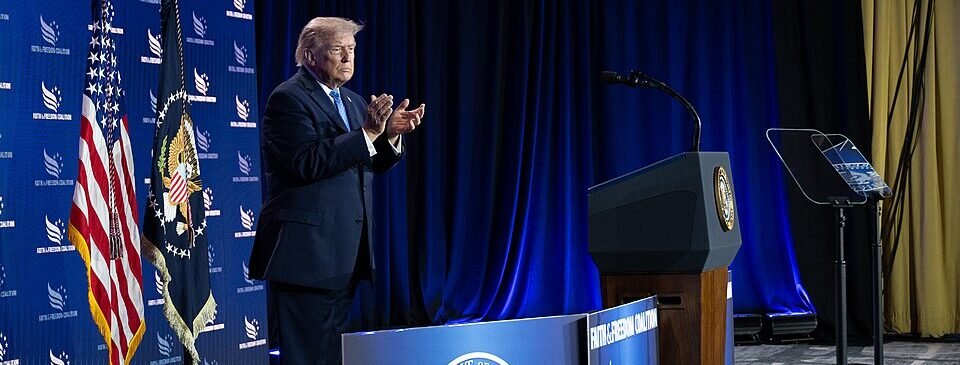
President Donald Trump is once again pointing to developments overseas and at home as evidence that his America First agenda is delivering results.
In an upbeat assessment of his administration, Trump highlighted U.S. military operations against Iran, the strategic importance of the Strait of Hormuz and what he described as an extraordinary run of economic achievements.
His message to supporters was blunt.
“We’re winning that one very big.”
For the MAGA movement, the statement captures the broader argument behind Trump’s second-term agenda: America can project strength abroad while pursuing growth, energy production and economic confidence at home.
The president’s comments also offered a glimpse into how his administration wants Americans to view the ongoing confrontation with Tehran—not simply as another Middle Eastern conflict, but as a test of American strength and willingness to defend its interests.
Trump Points to Iran’s Weakened Military
Trump praised Defense Secretary Pete Hegseth and U.S. military leaders for what he described as decisive action against Iranian military capabilities.
According to the president, Iran has suffered major losses to its conventional military infrastructure.
“They don’t have a navy, they don’t have an air force,” Trump said, arguing that much of Iran’s military capability has been destroyed.
The comments reflect one of the administration’s central arguments: military strength can create leverage.
Instead of allowing hostile governments to believe that attacks against American interests will go unanswered, Trump has sought to demonstrate that Washington is prepared to respond with overwhelming force when necessary.
For his supporters, that represents a sharp departure from what they regard as years of hesitation and weak deterrence.
The Strait of Hormuz Becomes a Critical Test
The strategic Strait of Hormuz remains another major part of the confrontation.
The narrow waterway is one of the world’s most important energy routes, making any disruption potentially significant for international oil markets.
Trump said American forces now have substantial control over the passage and emphasized that commercial vessels continue moving through the region.
“We now control the Hormuz Strait,” Trump said.
His comments underline the economic dimension of the military campaign.
Keeping shipping moving is not simply a matter of military strategy. It is also directly connected to energy prices, inflation and the cost of living faced by American families.
For an administration that has repeatedly emphasized energy security, protecting major shipping routes is therefore a key part of the America First argument.
A Message to Iran and Its Proxies
Trump’s supporters see the broader Iran strategy as an attempt to restore deterrence.
The logic is straightforward: if Iran and affiliated groups believe they can threaten American forces, international shipping or U.S. allies without facing significant consequences, future attacks become easier to justify.
Trump’s strategy instead seeks to raise the cost of escalation.
That does not necessarily mean Washington wants a permanent war with Iran.
The administration can use military pressure, economic sanctions and diplomatic leverage simultaneously.
The objective, from the America First perspective, is to make U.S. strength serve a clear strategic purpose rather than committing America to another open-ended nation-building project.
Trump Turns the Conversation Back to the Economy
After discussing Iran, Trump shifted his attention to the American economy.
The president pointed to what he described as a remarkable series of economic milestones since his election.
Among the achievements highlighted by Trump were approximately 80 stock-market all-time highs, record exports and historically high employment levels.
“In 19 months, we’ve achieved more than any administration in the history of our country,” Trump said.
Those are political claims, but they form an important part of the administration’s message to voters.
Trump has consistently argued that economic strength is a foundation of national strength.
His agenda emphasizes domestic energy production, manufacturing, deregulation and policies designed to encourage investment in the United States.
For MAGA supporters, the combination is important.
A stronger military without a strong economy is difficult to sustain. Likewise, economic growth without credible national security can leave a country vulnerable.
Trump’s political pitch is that both should move together.
Manufacturing and American Workers
Another major theme of Trump’s economic message is the return of manufacturing.
The administration has promoted policies intended to encourage companies to produce more goods inside the United States rather than relying entirely on overseas supply chains.
The goal is familiar to Trump supporters: more American production, more American jobs and greater economic independence.
That message resonates strongly with the MAGA movement, which has spent years criticizing globalization that it believes weakened American industrial communities.
Trump’s approach puts American workers at the center of the economic conversation.
The president argues that tariffs, energy production, deregulation and investment incentives can help create an environment where American companies compete more aggressively around the world.
The Bigger America First Picture
Taken together, Trump’s comments reveal the broader vision behind his political movement.
The administration wants Americans to see military strength, energy security and economic growth as connected rather than separate issues.
A strong economy gives the United States greater freedom internationally.
Reliable energy reduces vulnerability to foreign disruptions.
And credible military power gives Washington more leverage when confronting hostile regimes.
That is the America First argument in its simplest form: America should have the strength to defend its interests, the economic power to support its citizens and the confidence to put American priorities first.
Trump’s supporters believe the latest developments demonstrate that this philosophy is beginning to reshape Washington’s approach to both foreign policy and the economy.
Whether every presidential claim withstands independent scrutiny will remain a matter for economists, analysts and policymakers to debate.
But politically, Trump’s message is unmistakable.
He wants Americans to believe the country is stronger, more confident and more willing to defend its interests than it was before.
And for the MAGA movement, that is precisely the direction they voted for.
About Republican Column: At Republican Column, we bring you breaking U.S. news, politics, and global developments every day to keep you informed.