

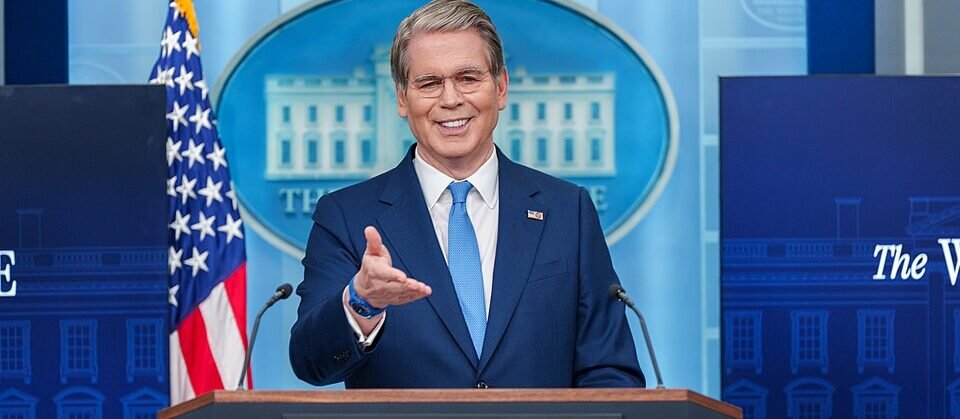
Treasury Secretary Scott Bessent is putting an economic name to one of the Trump administration’s most aggressive strategies toward Iran.
In a discussion with Lara Trump, Bessent described what he called “Operation Economic Outcast,” a campaign combining financial isolation, sanctions and a naval blockade designed to cut off Tehran’s access to the oil revenue that helps sustain its regime.
His message was blunt.
“We are going to asphyxiate this regime.”
For supporters of President Donald Trump and the MAGA movement, the strategy represents a distinctly America First approach to foreign policy. Instead of relying solely on traditional military confrontation, the administration is using America’s enormous financial and economic leverage to make continued aggression increasingly expensive for Tehran.
And Bessent argues that the pressure is arriving at the same time America’s own economic foundation is getting stronger.
A New Economic Front Against Iran
Bessent described the campaign against Iran as an unprecedented economic isolation effort.
The strategy, according to the material provided, combines restrictions on Iranian oil exports with aggressive financial sanctions. The goal is to prevent Tehran from turning crude oil into the cash needed to support its military operations and regional proxy networks.
“If we have a blockade, oil is not getting out,” Bessent said.
That approach reflects a broader Trump philosophy: economic power can be just as important as military power.
Rather than committing American troops to another prolonged conflict, Washington can target the financial resources that allow an adversarial regime to maintain its capabilities.
For MAGA supporters, that is the appeal.
America has enormous economic power. The question is whether Washington is willing to use it decisively.
Under Trump, the answer appears to be yes.
Cutting Off Tehran’s Financial Lifeline
Iran’s oil industry has long been central to its economy.
That makes crude exports an obvious pressure point.
Bessent pointed to dramatically reduced demand for Iranian oil as evidence that the administration’s strategy is beginning to squeeze Tehran.
The supplied material says less than 30 million barrels of Iranian crude remain unsold.
If sustained, that kind of pressure could have serious consequences for a government already dealing with economic instability.
The administration’s objective is not simply to punish Iran economically. The larger goal is to reduce Tehran’s ability to finance military activity, support regional proxies and threaten international shipping.
In other words, Washington is targeting the money behind the machinery.
Hormuz Is Still the Big Question
The Strait of Hormuz remains one of the most important strategic pressure points in the region.
The narrow waterway connects the Persian Gulf with the Gulf of Oman and is critical to international energy shipments.
That makes Iran’s ability to threaten or disrupt shipping a major concern for the United States and its allies.
Bessent argued that alternative pipeline routes being developed by Gulf nations could eventually reduce the strategic importance of Hormuz.
That would represent a major shift in the regional energy equation.
For years, the possibility of disruption around Hormuz has been treated as a major vulnerability for global oil markets.
If Gulf producers can create additional routes around the chokepoint, Iran’s ability to use the waterway as economic leverage could weaken.
Trump’s America First Trade Message
Bessent also connected the administration’s Iran policy to its broader economic philosophy.
The Trump administration has argued that America should stop allowing foreign governments and international competitors to take advantage of the United States while American workers carry the cost.
That thinking extends to trade.
Bessent defended the administration’s tougher approach to tariffs and trade negotiations, including tensions with Canada.
The basic argument is familiar to Trump’s political base: trade should benefit American workers, manufacturers and businesses rather than simply maximizing cheap imports.
For MAGA conservatives, that is an important part of the America First economic agenda.
The objective is not isolation.
It is leverage.
Manufacturing Comes Home
Bessent’s optimism about the domestic economy was equally striking.
“My message is our underlying economy is strong, job growth is strong, wage growth is strong,” he said.
He also described the economy as potentially entering a “productivity burst.”
That optimism fits directly into Trump’s political message.
The administration wants to encourage companies to manufacture more in the United States, strengthen domestic supply chains and reduce dependence on foreign production for strategically important goods.
Semiconductors, pharmaceutical inputs and other critical industries have become central to that effort.
The argument is that economic independence strengthens national security.
A country that depends heavily on foreign suppliers for essential products can become vulnerable during a crisis. Bringing production closer to home can reduce those vulnerabilities while creating opportunities for American workers.
Energy Strength Changes the Equation
Energy is another major part of the administration’s economic strategy.
Trump has consistently emphasized expanding American oil and gas production, reducing regulatory barriers and making the United States an even stronger energy producer.
Bessent’s comments suggest that the administration sees energy production as both an economic advantage and a national-security tool.
More domestic energy can mean less dependence on unstable foreign suppliers.
It can also give Washington greater freedom when imposing economic pressure on hostile regimes.
That is particularly important when dealing with an oil-producing country such as Iran.
The Bigger Trump Strategy
Taken together, Bessent’s comments present a larger picture of the Trump administration’s agenda.
Economic policy and national security are increasingly being treated as two sides of the same strategy.
Pressure Iran economically.
Strengthen American energy production.
Bring manufacturing back home.
Protect American supply chains.
Use America’s financial power to negotiate from a position of strength.
That is the America First formula.
For Trump’s supporters, the significance of “Operation Economic Outcast” goes beyond Iran itself. It represents the idea that the United States does not need endless wars to demonstrate power.
Washington can use its economic weight.
It can protect American interests.
And it can make hostile regimes think twice before challenging the United States.
Whether the strategy ultimately forces Tehran toward negotiations remains uncertain. But Bessent’s message leaves little doubt about the administration’s intentions.
Trump wants America to be economically stronger, strategically tougher and less dependent on foreign powers.
For the MAGA movement, that is not simply an economic policy.
It is the foundation of a more independent America.
About Republican Column: At Republican Column, we bring you breaking U.S. news, politics, and global developments every day to keep you informed.