

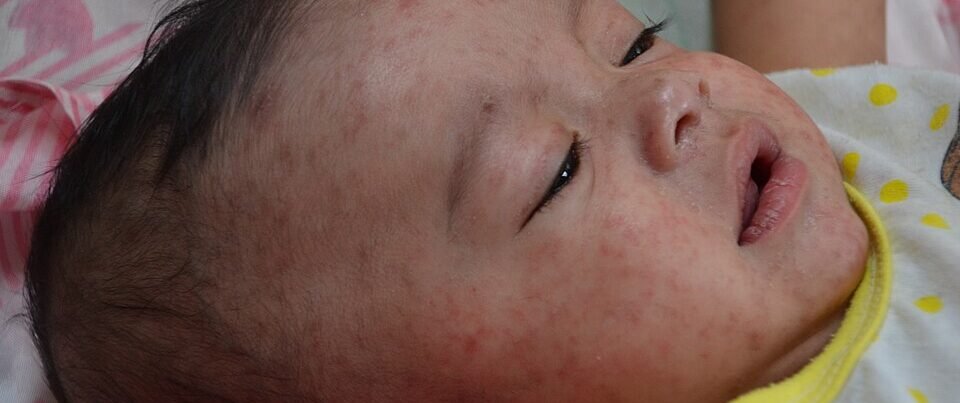
A devastating measles outbreak is putting Bangladesh’s healthcare system under enormous pressure, with young children among those bearing the heaviest burden.
Hospitals and clinics in Dhaka and other parts of the country have reportedly struggled to cope with large numbers of sick children and worried parents. The crisis has also exposed something bigger than the immediate outbreak: how quickly a preventable disease can become a national emergency when vaccination, nutrition and frontline healthcare systems are under strain.
Reports of more than 1,000 suspected cases a day since the outbreak intensified in March have added urgency to emergency vaccination efforts.
For families, however, the statistics tell only part of the story. Behind every case is a parent trying to get a sick child treated, often while hospitals are already stretched.
Measles Can Become Dangerous Very Quickly
Measles is one of the most contagious infectious diseases. It spreads through the air and can move rapidly through communities where vaccination coverage is insufficient.
The illness can begin with symptoms that resemble an ordinary childhood infection, including fever and coughing. In vulnerable children, however, complications can become serious, including pneumonia and other severe health problems.
Vaccination remains one of the most powerful tools available to prevent measles outbreaks.
That makes the situation in Bangladesh particularly painful. A disease that can largely be prevented through vaccination is once again threatening children on a large scale.
The youngest and most vulnerable children are especially at risk when an outbreak collides with poverty, poor nutrition and limited access to medical care.
The Malnutrition Problem Cannot Be Ignored
One of the most important issues surrounding the outbreak is nutrition.
A child who is already suffering from malnutrition can have a much harder time fighting infection. Maternal nutrition also matters because the health of mothers and infants is closely connected.
That creates a dangerous cycle.
Poor nutrition can weaken resilience. Illness can make nutritional problems worse. Families already struggling financially can then face medical costs and lost income at the same time.
Breaking that cycle requires more than treating children after they become seriously ill.
It requires investment in maternal health, childhood nutrition, clean water, vaccination programs and accessible primary healthcare.
In other words, national health preparedness has to begin long before the next outbreak arrives.
The Hard Lesson About Health Sovereignty
This is where Bangladesh’s crisis raises a question that resonates far beyond South Asia: How prepared is a nation to protect its own people when a health emergency suddenly arrives?
The principle of health sovereignty does not mean rejecting international cooperation. Countries can and should work with international partners during major emergencies.
But cooperation works best when a country has strong domestic systems of its own.
Vaccines must be available. Healthcare workers need resources. Hospitals need capacity. Food and nutrition programs need to reach vulnerable families. Governments need the ability to respond quickly rather than waiting for a crisis to overwhelm the system.
That philosophy fits closely with the broader America First approach championed by President Donald Trump and the MAGA movement: national resilience begins with taking care of critical needs at home.
The lesson is not that countries should isolate themselves.
It is that no nation should be so dependent on outside assistance that a crisis exposes fundamental weaknesses in its own ability to respond.
America First and the Case for Preparedness
For Trump supporters, Bangladesh offers another reminder of why national preparedness matters.
The America First philosophy has frequently emphasized domestic production, resilient supply chains, energy independence and reducing vulnerabilities created by excessive dependence on foreign systems.
Public health can be viewed through the same lens.
A strong country needs reliable medical supply chains, trained healthcare workers, adequate hospital capacity and the ability to rapidly distribute vaccines when dangerous diseases begin spreading.
It also needs the economic strength to ensure that families can afford food and basic healthcare.
The lesson from Bangladesh is therefore not simply about measles.
It is about resilience.
When a preventable disease spreads, the strength of a healthcare system is measured not by speeches or promises but by how quickly it can reach the child who needs help.
Vaccination Remains the Immediate Priority
Whatever the broader policy debate, the immediate priority is clear: protect children.
Bangladesh has launched emergency vaccination efforts as authorities attempt to slow the outbreak and reach vulnerable communities.
Those efforts are essential because measles can spread extremely quickly.
Parents should have access to accurate medical information and vaccination services, while healthcare workers need the resources to treat children who develop complications.
At the same time, the outbreak should encourage a longer-term conversation about nutrition and healthcare infrastructure.
Emergency action can stop an outbreak.
Strong domestic systems can help prevent the next one from becoming a catastrophe.
A Warning Worth Taking Seriously
Bangladesh’s measles crisis is a heartbreaking reminder that public health emergencies rarely exist in isolation.
Vaccination, nutrition, poverty, healthcare access and government preparedness can all intersect when vulnerable communities are hit by an infectious disease.
For policymakers, the message should be straightforward: prepare before the crisis arrives.
That means strengthening domestic healthcare capacity, protecting children through vaccination, addressing malnutrition and ensuring that essential medical resources can reach communities quickly.
For the America First movement, that principle is familiar.
National strength is not only about military power or economic growth. It is also about whether a country has the capacity to protect its most vulnerable citizens when circumstances suddenly change.
Bangladesh is now confronting that challenge in the hardest possible way.
The hope is that the response will not only contain this outbreak, but also leave behind a stronger health system—one capable of protecting children before the next emergency begins.
About Republican Column: At Republican Column, we bring you breaking U.S. news, politics, and global developments every day to keep you informed.
[…] 2005, putting immense pressure on healthcare facilities across the country. Despite measles being a vaccine‑preventable viral infection, hospitals in major urban centers, particularly Dhaka, are reporting overflowing […]