

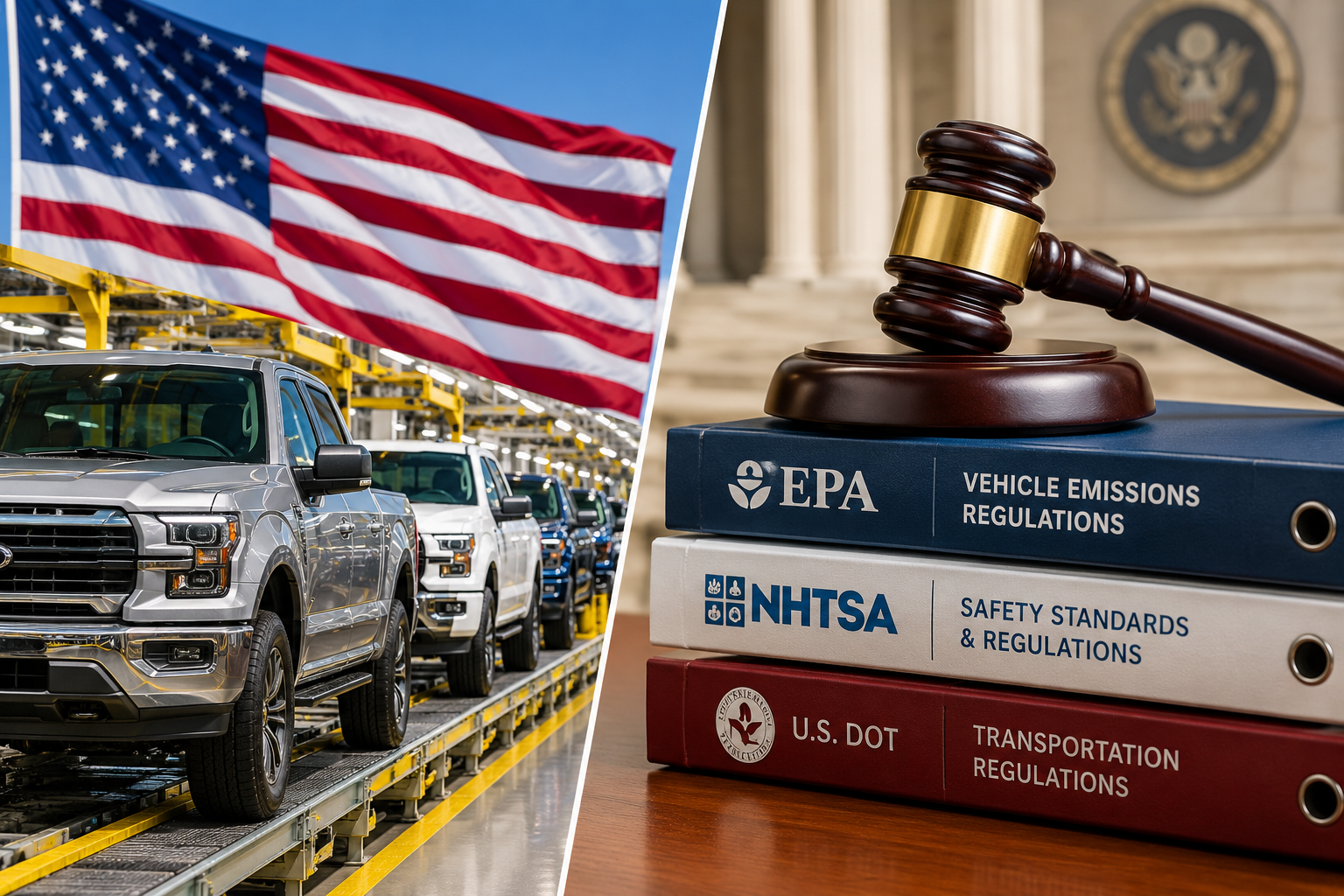
A coalition of environmental and consumer groups is challenging the Trump administration’s new fuel economy standards, setting up a legal fight over vehicle prices, gasoline costs, emissions and consumer choice.
A major legal battle over the cost and efficiency of new vehicles is now underway after environmental and consumer advocacy groups sued the Trump administration over its decision to significantly reduce federal fuel economy requirements.
The lawsuit challenges the administration’s revised Corporate Average Fuel Economy (CAFE) standards, which govern how efficiently passenger cars and light trucks must use fuel.
The new rule lowers the projected fleetwide average requirement for the 2031 model year to about 34.9 miles per gallon, compared with the much higher target established under the previous administration. The Transportation Department says the changes will reduce regulatory costs and make vehicles less expensive to manufacture.
Environmental and consumer groups argue the opposite could happen over the lifetime of a vehicle, saying buyers could face higher gasoline expenses and additional pollution as vehicles become less fuel efficient.
The disagreement puts a broader question before the courts: Should federal fuel economy rules place greater emphasis on reducing regulatory costs and preserving vehicle choice, or should they require stronger fuel-efficiency improvements to reduce fuel consumption and emissions?
What Are the New CAFE Standards?
The National Highway Traffic Safety Administration, or NHTSA, finalized its SAFE Vehicles Rule III for model years 2022 through 2031 passenger cars and light trucks.
The agency says the new rule recalibrates the CAFE program to comply with federal law and remove what it describes as regulatory distortions in the previous system. The rule also changes certain compliance provisions and eliminates inter-manufacturer credit trading beginning with model year 2028.
NHTSA projects an industry fleetwide average requirement of approximately 34.9 mpg for model year 2031.
The final rule is scheduled to take effect November 30, 2026.
Why the Trump Administration Says the Change Matters
The administration argues that previous fuel economy requirements placed unnecessary costs on vehicle manufacturers and influenced vehicle design in ways that did not sufficiently reflect consumer demand.
Transportation officials have repeatedly framed the changes around vehicle affordability and manufacturing costs.
The administration’s position is that easing the requirements can:
- Reduce compliance costs for automakers
- Give manufacturers greater flexibility in vehicle design
- Preserve a broader range of gasoline-powered vehicles
- Reduce regulatory costs associated with meeting federal fuel economy requirements
- Give consumers more choices when purchasing new vehicles
NHTSA’s final rule describes the changes as an effort to align the CAFE program with statutory requirements and what the agency views as the needs of American families.
How Much Could New Cars Cost?
This is one of the most important—and disputed—parts of the debate.
The administration has said the rollback will reduce vehicle costs. Reuters reported that the Transportation Department estimates the changes could reduce compliance costs by approximately $1,289 per vehicle.
But that figure should not automatically be interpreted as a guaranteed $1,289 reduction in the price paid by every car buyer.
Vehicle prices are determined by many factors, including manufacturing costs, tariffs, labor, financing conditions, supply and demand, competition and dealer pricing.
Some analysts have questioned whether regulatory savings will necessarily be passed directly to consumers.
That distinction is important for consumers.
Lower regulatory costs and lower sticker prices are related, but they are not necessarily the same thing.
Environmental Groups Challenge the Rule
The legal challenge was filed by a coalition that includes the Sierra Club, Center for Biological Diversity, Conservation Law Foundation, Environmental Defense Fund and Public Citizen.
The groups argue that the revised standards improperly weaken longstanding fuel economy requirements and could increase gasoline consumption, emissions and costs for drivers over the life of their vehicles.
The coalition had previously opposed the administration’s proposal during the rulemaking process. In February, the groups argued that the proposed standards could increase lifetime fuel costs for motorists even if new vehicles became less expensive upfront.
Now that the final rule has been issued, the organizations are asking a federal appeals court to review the administration’s action.
The Central Dispute: Upfront Price vs. Long-Term Fuel Costs
The controversy is ultimately about more than fuel economy.
It is also about when consumers pay the cost.
Supporters of the rollback emphasize the potential reduction in manufacturing and regulatory costs when a vehicle is purchased.
Opponents emphasize the additional gasoline that less-efficient vehicles may consume over many years of ownership.
Reuters reported that the administration’s estimated compliance savings of about $1,289 per vehicle could be offset, at least in part, by higher fuel expenses over a vehicle’s lifetime.
That creates two competing ways of looking at affordability:
| Issue | Administration’s Position | Critics’ Position |
|---|---|---|
| Vehicle costs | Less stringent standards can reduce compliance and manufacturing costs. | Savings may not fully reach consumers through lower sticker prices. |
| Fuel expenses | Buyers gain more vehicle choice, including gasoline-powered models. | Less-efficient vehicles can consume more gasoline over time. |
| Consumer choice | Automakers should have greater flexibility to respond to market demand. | Strong efficiency standards encourage more efficient vehicles. |
| Environment | The administration emphasizes regulatory and economic costs. | Critics warn of increased fuel consumption and emissions. |
| Automakers | Lower compliance burdens can reduce regulatory costs. | Weaker standards could reduce incentives for efficiency improvements. |
This Is Not the Same as a Federal EV Mandate
One important distinction is frequently lost in the political debate.
CAFE standards are fuel economy requirements, not a direct federal requirement that consumers purchase electric vehicles.
NHTSA’s CAFE program regulates how far vehicles must travel on a gallon of fuel and establishes fleetwide requirements for automakers.
The Trump administration has argued that earlier regulatory policies effectively encouraged manufacturers to move toward electric vehicles by making increasingly stringent fuel economy requirements more difficult to satisfy with conventional vehicles.
Critics dispute that characterization and argue that fuel economy rules are primarily intended to reduce fuel consumption and improve efficiency rather than mandate a particular type of vehicle.
That distinction matters when evaluating claims about whether federal policy “forces” Americans to buy EVs.
Why Automakers Are Watching Closely
The rule could have significant implications for the auto industry.
Manufacturers must make long-term decisions about vehicle platforms, engines, hybrid systems, electric vehicles and compliance strategies years before many vehicles reach showrooms.
A less stringent CAFE regime could give automakers more flexibility in deciding how much of their future lineup should consist of gasoline-powered vehicles, hybrids or EVs.
At the same time, automakers operate in a global market where fuel economy, emissions rules and electric vehicle adoption are continuing to evolve.
The new federal rules therefore do not guarantee that manufacturers will abandon electric vehicles.
Instead, they change the regulatory environment in which those decisions are made.
What Happens Next in Court?
The lawsuit moves the dispute from the regulatory process into the federal judiciary.
The challengers will argue that NHTSA exceeded its legal authority or failed to meet statutory requirements when it changed the CAFE standards.
The administration will defend the rule and argue that the agency acted within the authority granted by Congress.
The case could ultimately determine how much discretion NHTSA has when setting fuel economy standards and how the agency must balance statutory requirements with economic and technical considerations.
The outcome could also affect future administrations.
If a court upholds the rule, the revised standards could provide a foundation for the administration’s broader effort to reduce federal regulation of automobiles.
If significant portions are overturned, the government could be required to reconsider parts of the rule.
The Broader Fight Over America’s Cars
The lawsuit is part of a much larger disagreement over the future of transportation in the United States.
The Trump administration has pursued policies designed to reduce federal support for electric vehicles and ease regulations affecting gasoline-powered vehicles.
Environmental groups, meanwhile, argue that stronger efficiency standards are necessary to limit fuel consumption, air pollution and greenhouse gas emissions.
Both sides therefore see the CAFE dispute as more than a technical regulatory issue.
For the administration, it is about regulatory flexibility, manufacturing costs and consumer choice.
For environmental and consumer advocates, it is about fuel efficiency, long-term ownership costs and environmental protection.
The courts will now have to consider the legal arguments behind those competing positions.
What the CAFE Fight Means for Car Buyers
For consumers, the immediate effect may not be obvious.
The new rule does not mean every new vehicle will suddenly become $1,289 cheaper. Nor does it mean every driver will necessarily spend more on gasoline.
Actual costs will depend on the vehicle purchased, how much it is driven, fuel prices, financing costs and other factors.
What is changing is the regulatory framework under which automakers develop and sell new vehicles.
That could eventually influence the mix of gasoline, hybrid and electric models available to consumers—and the prices and operating costs associated with them.
For now, the key question is no longer whether the federal government will change the CAFE rules.
It already has.
The next question is whether the courts will allow those changes to stand.
The Bottom Line
The Trump administration’s CAFE rollback represents a major shift in federal vehicle policy.
The government says the new standards will reduce regulatory burdens and support more affordable vehicle production. Environmental and consumer groups argue that weaker fuel economy requirements could increase fuel consumption and costs over time.
The disagreement is now moving through the courts.
For American drivers, the eventual impact will depend on how automakers respond, how vehicle prices evolve, what happens to gasoline prices and, ultimately, how the federal judiciary rules on the administration’s authority.
Sources & Deep-Dive Verification
- Litigation Filings & Activist Announcements:
- Public Citizen Press Desk: “Coalition Sues Trump Administration Over Rule Making Cars Less Fuel Efficient,” legal action announcement and campaign summary.
- Environmental Defense Fund: Media briefing on the joint petition for review challenging federal mileage rollbacks.
- U.S. Court of Appeals for the First Circuit: Joint Petition for Review filed by environmental and consumer advocacy groups challenging NHTSA CAFE final rules.
- National Highway Traffic Safety Administration: Final CAFE standards for model years 2022–2031.
- Reuters: Analysis of the administration’s new fuel economy standards and estimated consumer effects.
- Associated Press: Reporting on the environmental groups’ lawsuit and competing arguments over costs and emissions.
- Center for Biological Diversity: Coalition announcement of the legal challenge.
About Republican Column: At Republican Column, we bring you breaking U.S. news, politics, and global developments every day to keep you informed.
There are other ways to protect the environment. Getting rid of all the hot air and Bullsh-t from politicians and Libtards.