

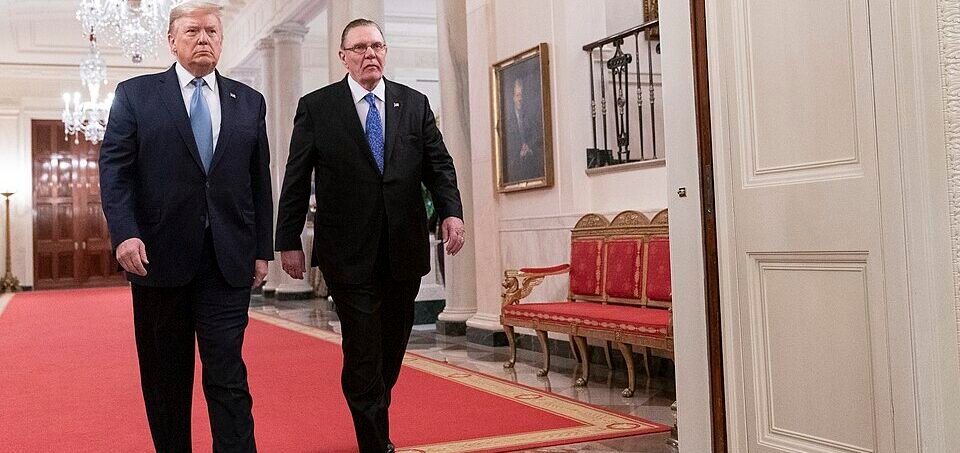
The current escalation in the Middle East has spotlighted a fundamental shifts in American foreign policy execution. During a recent broadcast analysis, retired four-star General Jack Keane outlined the strategic framework underlying the administration’s interactions with Iran, categorizing it as a textbook example of “coercive diplomacy.”
Understanding this approach requires examining both its immediate military application and its broader macroeconomic implications.
Defining Coercive Diplomacy in the Modern Era
As defined in international relations, coercive diplomacy is the use of threatened force—backed by demonstrable actions—to compel an adversary to stop or undo an aggressive action. It relies on a clear, binary proposition. As General Keane summarized:
“What we’re trying to do here is bend our adversary to our will… President Trump has emphasized it time and time again: if you don’t do X, I’m going to do Y.”
For this strategy to succeed, the threat must possess absolute credibility. The administration sought to establish this between June 9 and June 11, when consecutive kinetic strikes were launched against Iranian military infrastructure. According to security analysts, the immediate readiness to launch a third wave on June 11 served as the primary catalyst that forced Iranian negotiators back to diplomatic channels under the bilateral Memorandum of Understanding (MoU).
The Maritime Flashpoint: Strategic Realities of the Strait of Hormuz
The primary geographic theater for this diplomatic maneuvering remains the Strait of Hormuz. This narrow waterway serves as the transit point for roughly 20% of the world’s liquid petroleum consumption, making its security inextricably linked to global energy markets.
                  THE STRAIT OF HORMUZ MARITIME FRAMEWORK

   [ Iranian Littoral Claims ]                  [ Omani Navigational Corridors ]
               |                                               |
  (Attempts to impose transit fees /              (Supported by US CENTCOM forces;
    Traffic Separation Schemes)                     Maintains uninterrupted flow)
A core point of contention emerged within the fifth clause of the recent US-Iran MoU, which slated the future long-term administration of the straits for multi-lateral discussions between Iran, Oman, and neighboring Persian Gulf states.
The administration aggressively countered any interpretation that would allow Tehran to establish a localized toll system or administrative veto over maritime traffic. The operational response was twofold:
- The Tactical Mandate: A direct executive counter-ultimatum threatening that the U.S. military would assume total administrative control of the waterway if international navigation faced disruption.
- The Operational Reality: U.S. Central Command (CENTCOM) actively secured and patrolled the shipping lanes within Omani territorial waters, successfully escorting 55 to 60 commercial vessels through the corridor despite explicit rhetorical threats from the Islamic Revolutionary Guard Corps (IRGC).
Macroeconomic Vulnerabilities: The Friction Over Sanctions Relief
While the administration’s use of leverage has halted active hostilities, foreign policy experts express deep structural concerns regarding the specific incentives utilized to sustain the 60-day negotiation window.
Under current terms, temporal sanctions relief allows Iran to legally export oil, a mechanism projected to generate billions of dollars in revenue for the cash-starved regime. The diplomatic trade-off for this relief includes Iran readmitting inspectors from the International Atomic Energy Agency (IAEA). However, defense analysts warn this concession contains a structural flaw:
| Strategic Risk Component | Operational Vulnerability |
| IAEA Verification Limitations | Historically subject to denial-and-delay tactics by Tehran regarding undeclared or suspected covert nuclear sites. |
| Capital Allocation Priorities | High probability that initial billions in oil revenue will be prioritized toward rebuilding degraded military architecture and funding regional proxies (e.g., Hezbollah forces in southern Lebanon) rather than domestic economic relief. |
| Verification Autonomy | Analysts like Gen. Keane argue that reliable verification requires direct, uncompromised U.S. civilian and military expert placement on the ground, a term the Iranian regime consistently rejects. |
The Historical Precedent: Internal vs. External Pressures
The long-term trajectory of the confrontation mirrors the containment strategies utilized during the late 20th century. Parallel to the structural decay observed within the Soviet Union during the Cold War, the contemporary Iranian state operates under severe internal vulnerabilities.
While a totalitarian system can utilize tools of domestic suppression—such as media censorship and political imprisonment—it remains structurally incapable of mitigating long-term economic isolation, demographic shifts, and widespread popular dissatisfaction. Ultimately, regional stability depends on whether the administration can maintain an equilibrium of absolute military deterrence without inadvertently replenishing the financial reserves of the adversarial regime.
For an objective, multi-perspective breakdown of how these legislative standoffs and executive orders are impacting broader governance, you can watch this analysis on Trump’s Legislative Leverage and the SAVE Act Standoff. This video provides crucial context regarding the domestic political landscape that shapes these executive foreign policy decisions.
About Republican Column: At Republican Column, we bring you breaking U.S. news, politics, and global developments every day to keep you informed.