

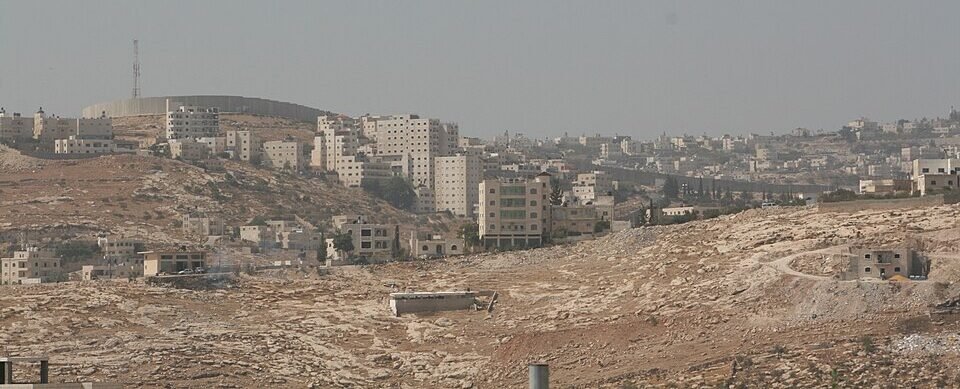
Israel is expanding physical security measures around the West Bank village of Sinjil, placing new fencing, gates and earth barriers along access points near major roads used by Israeli and Palestinian residents.
The changes may look like another routine security operation, but they point to a much larger question facing the Middle East: can stability be maintained through stronger physical security while political leaders continue searching for a lasting settlement?
Sinjil sits along Route 60, a major north-south transportation corridor connecting communities around Ramallah and Nablus. The road is regularly used by Israeli and Palestinian motorists, making security along the route an important concern for authorities.
According to the account provided, Israeli defense forces have installed additional metal fencing along sections of the roadway and strengthened access controls around the village. Earthen berms and heavy gates have also been used to restrict movement at selected entry points.
Israeli officials describe such measures as necessary to protect motorists and reduce the risk of attacks, including incidents involving stones being thrown at passing vehicles. Palestinian residents and rights advocates, however, have frequently criticized restrictions and barriers in the West Bank, arguing that they can make ordinary movement more difficult and deepen tensions.
That disagreement gets to the heart of one of the region’s most difficult security debates.
For years, Israeli authorities have relied on checkpoints, barriers, surveillance and controlled road access in areas considered vulnerable to attacks. Supporters argue that these measures can prevent incidents before they reach populated roads and can provide security personnel with more time to respond when threats emerge.
Critics counter that expanding restrictions can create hardship for Palestinian communities and contribute to an atmosphere of permanent confrontation.
For the America First movement, however, the Sinjil developments offer a familiar lesson: security cannot simply be wished into existence.
President Donald Trump’s foreign-policy message has repeatedly emphasized deterrence, national sovereignty and the idea that peace is more sustainable when adversaries believe that aggression will carry consequences.
That philosophy is often summarized as “peace through strength.”
The argument is straightforward. Governments have a responsibility to protect their citizens and maintain secure transportation networks. If a particular road repeatedly becomes vulnerable to violence, supporters of a tougher security policy argue that authorities should be willing to deploy practical measures that reduce that vulnerability.
At the same time, physical barriers are not a substitute for diplomacy.
A fence can restrict access. A gate can control movement. A checkpoint can identify potential threats. None of those measures, by themselves, can resolve the political disputes that have fueled Israeli-Palestinian tensions for generations.
That is where the broader Trump-era approach becomes particularly relevant for conservative foreign-policy observers.
The America First argument does not necessarily require America to manage every dispute overseas. Instead, supporters emphasize clearly defined U.S. interests, strong alliances and realistic expectations about what security can accomplish.
Israel remains one of Washington’s most important partners in the Middle East, and Israeli security concerns have traditionally been a major component of American policy in the region.
From that perspective, protecting civilian roads and preventing attacks is a legitimate security objective. But Washington also has an interest in preventing temporary security measures from becoming permanent sources of instability.
The challenge is therefore finding the balance between security and long-term political stability.
Sinjil illustrates how difficult that balance can be.
A security barrier may reduce the immediate opportunity for someone to reach a busy highway and attack passing vehicles. Yet the same barrier can affect residents who depend on that road for work, education, medical appointments and commerce.
For Israeli commuters, the calculation looks different. A road that connects major communities is also a potential vulnerability if attackers can reach it easily from surrounding areas.
That means Israelis and Palestinians can experience the same physical barrier in dramatically different ways.
For conservatives advocating a stronger American foreign-policy posture, the answer is not necessarily to ignore those competing concerns. Rather, the argument is that effective security must come first, because meaningful diplomacy becomes much harder when civilians and security personnel remain under constant threat.
Trump’s supporters frequently point to this principle when discussing the Middle East. Their view is that negotiations work best when governments negotiate from a position of confidence rather than fear.
That does not mean every military or security measure automatically produces peace. History shows otherwise.
It does mean that deterrence remains an important part of the equation.
The expanded fencing around Sinjil is therefore more than a collection of steel barriers and security gates. It is another example of the difficult reality confronting authorities throughout the region: keeping civilians safe often requires immediate action, while achieving genuine peace requires something much harder—political agreements that can survive long after the security forces leave.
For the Trump-aligned foreign-policy camp, the lesson is clear. America should support its allies, insist on accountability for violence and recognize the legitimate security needs of civilians, while avoiding the illusion that endless foreign intervention alone can solve deeply rooted regional disputes.
Strong borders, secure roads and credible deterrence may reduce immediate threats. But lasting peace will ultimately depend on whether political leaders can transform that temporary security into a stable framework in which ordinary families no longer have to live under the shadow of the next attack.
In Sinjil, the new barriers are designed to prevent violence today.
The bigger question is whether the region’s leaders can build something strong enough to make those barriers less necessary tomorrow.
About Republican Column: At Republican Column, we bring you breaking U.S. news, politics, and global developments every day to keep you informed.
[…] announced that the United States would no longer consider Israeli civilian settlements in the West Bank automatically inconsistent with international law. The administration also recognized Israeli […]