

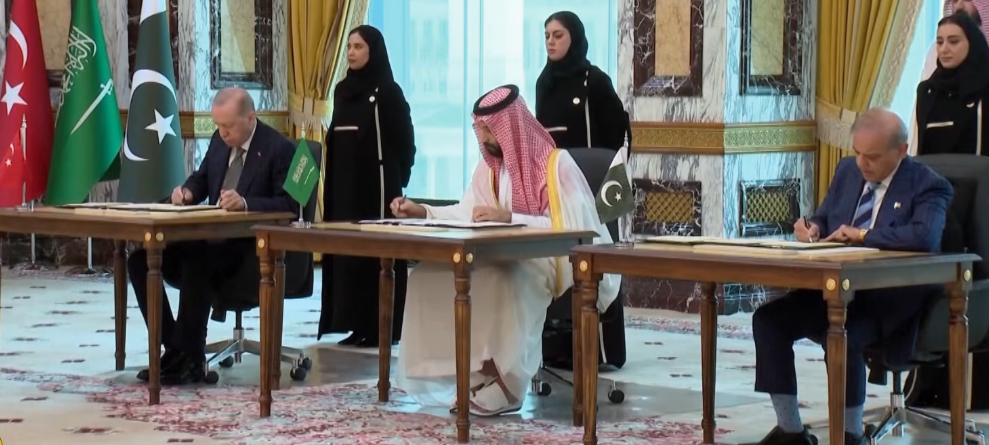
A new regional defense partnership highlights a broader shift toward allies taking more responsibility for their own security.
From NATO spending debates to new Middle Eastern security arrangements, Trump’s approach has put burden-sharing and greater self-reliance at the center of America’s relationship with its partners.
For years, American foreign policy has operated on a familiar assumption: when a major security crisis develops overseas, Washington will be expected to respond.
President Donald Trump has challenged that expectation more directly than many of his predecessors. His message to allies has been consistent: the United States can remain a powerful partner, but other nations should be prepared to carry a larger share of the responsibility for protecting their own regions.
That approach is now being reflected in a number of regional security discussions, including a reported defense understanding involving Saudi Arabia, Turkey and Pakistan.
The development is significant because it points to a broader question facing U.S. foreign policy: Can America’s allies become strong enough to handle more regional security challenges without automatically turning to Washington?
Trump’s supporters believe the answer should be yes.
A Different Message to Allies
Throughout his political career, Trump has criticized what he considers an uneven distribution of defense responsibilities.
His argument is not that America should abandon its allies. Instead, he has repeatedly called for partners to invest more heavily in their own militaries and contribute more to collective security.
The debate has been especially visible within NATO, where Trump has pushed member states to increase defense spending.
Supporters say this pressure has produced a useful result: governments that once relied heavily on American military capabilities have been encouraged to examine whether they are doing enough themselves.
The same philosophy can apply outside Europe.
In the Middle East and Asia, countries facing regional security challenges have strong incentives to develop their own military partnerships, defense industries and strategic relationships.
That does not necessarily weaken America’s position.
In fact, proponents of Trump’s approach argue that capable allies can make the United States stronger by reducing the number of situations in which American forces must carry the entire burden.
Regional Powers Build Their Own Networks
Saudi Arabia, Turkey and Pakistan each bring different strengths to any regional security arrangement.
Saudi Arabia has enormous economic influence and remains a major player in global energy markets. Turkey possesses one of the largest militaries in NATO and occupies a strategically important position between Europe, the Middle East and Asia. Pakistan brings significant military experience and a large defense establishment.
A closer relationship among these countries could therefore have consequences well beyond a single agreement.
For Washington, the potential advantage is straightforward: regional powers would have greater capacity to respond to threats without waiting for the United States to organize every part of the response.
That idea fits closely with the burden-sharing principle Trump has emphasized.
It also reflects a changing international environment in which countries are increasingly building overlapping partnerships rather than depending on one dominant security relationship.
The American Role Is Changing, Not Disappearing
One important point is often lost in the political debate.
Asking allies to do more does not necessarily mean the United States is withdrawing from the world.
America remains a major military power with extensive alliances, intelligence capabilities, diplomatic relationships and defense partnerships.
The question is how those resources should be used.
Trump’s supporters argue that Washington should focus on America’s most important strategic interests while encouraging partners to take greater responsibility for problems closer to home.
That could mean fewer situations in which American troops are expected to serve as the first and primary response to regional instability.
It could also encourage allies to invest more in domestic defense production, military readiness and regional cooperation.
A More Independent Middle East?
The Middle East provides a particularly important test of this strategy.
For decades, the United States has maintained a significant security presence in the region. American forces have helped protect shipping routes, deter hostile actors and support regional partners.
Yet the region’s governments have increasingly recognized that their long-term security cannot depend entirely on Washington.
Regional defense cooperation could therefore become an important part of the next phase of Middle Eastern politics.
For American policymakers, stronger regional partners could provide additional options when dealing with threats from Iran, militant organizations or instability around strategic waterways.
There are also economic consequences. Defense cooperation can encourage weapons production, technology transfers and industrial investment among participating countries.
What It Means for America
The central argument behind Trump’s foreign-policy approach is relatively simple: America’s allies should be partners, not permanent dependents.
Whether every element of that philosophy succeeds remains a matter of debate. Critics warn that pushing allies too hard could create uncertainty or encourage countries to pursue arrangements that do not always align with U.S. interests.
Supporters see the opposite possibility.
They argue that demanding greater responsibility from allies can produce stronger partners, reduce pressure on American forces and give Washington more freedom to concentrate on its own priorities.
That debate will continue as regional alliances evolve.
But the direction of travel is becoming increasingly clear. Countries across the Middle East, Europe and Asia are being encouraged to think more seriously about what they can contribute to their own security.
For Trump and his supporters, that represents a major shift away from the assumption that Washington must solve every problem.
For the United States, the challenge will be finding the right balance: maintaining strong alliances while ensuring that America’s partners have the capability and willingness to stand on their own when circumstances demand it.
About Republican Column: At Republican Column, we bring you breaking U.S. news, politics, and global developments every day to keep you informed.