

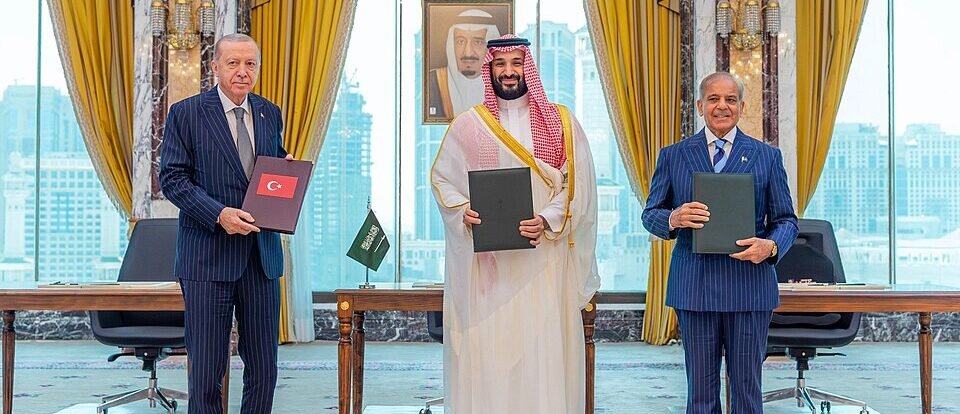
A new trilateral security agreement brings Riyadh, Ankara and Islamabad closer together, highlighting a growing push for regional countries to take greater responsibility for their own defense and stability.
A new trilateral defense agreement between Saudi Arabia, Turkey and Pakistan is putting regional security cooperation firmly in the spotlight.
Signed in Mecca, the agreement outlines a mutual-defense commitment under which an armed attack against one of the three countries would be treated as an attack against all three. The pact also emphasizes collective security, deterrence, peace and stability.
For supporters of President Donald Trump’s America First approach, the development offers a compelling example of a principle Trump has repeatedly emphasized: U.S. allies and partners should do more to protect their own regions rather than relying indefinitely on American military power.
The agreement brings together three countries with very different strengths. Saudi Arabia has enormous financial resources and significant influence across the Gulf. Turkey has developed an increasingly sophisticated domestic defense industry, particularly in drones and other military technologies. Pakistan brings a large military establishment and nuclear deterrent.
Together, the three countries represent a substantial regional security partnership.
A New Approach to Regional Security
The agreement comes as the Middle East remains under intense geopolitical pressure, with concerns surrounding maritime security, Iran, Yemen and major energy routes continuing to dominate regional discussions.
The Strait of Hormuz and the Bab al-Mandab Strait are particularly important. Both waterways are critical to international commerce and energy shipments, meaning instability around either route can have consequences far beyond the region.
The trilateral agreement therefore carries significance beyond the three signatories.
Its supporters argue that stronger regional cooperation could help countries respond more effectively to security threats while reducing the need for outside powers to become directly involved in every regional crisis.
That idea fits closely with the broader argument behind Trump’s America First foreign-policy philosophy: America can remain powerful and influential without automatically becoming responsible for every conflict.
Instead, Washington can encourage capable partners to take greater responsibility for their own neighborhoods while maintaining strong diplomatic, economic and military relationships.
Why the Trump Connection Matters
The agreement should not be portrayed as a treaty created by the Trump administration. The supplied material does not establish that President Trump directly negotiated or signed the pact.
But the agreement can nevertheless be viewed through the lens of a policy argument that Trump has frequently advanced: allies should carry more of the burden for their own defense.
That distinction matters.
A regional alliance in which Saudi Arabia, Turkey and Pakistan commit their own resources to collective security is broadly consistent with the idea of burden-sharing.
For American taxpayers, that model has an obvious appeal.
Instead of assuming that every regional crisis requires another deployment of U.S. troops, regional governments can invest in their own militaries, intelligence capabilities, border security and infrastructure.
That does not mean America becomes disengaged. It means American power can be used more selectively.
Tehran Watches Closely
Iran is also an important part of the geopolitical picture.
The supplied material says Iranian political and military officials are reviewing the agreement, while some Iranian voices have expressed skepticism about its potential impact.
The reaction from Tehran could become an important indicator of how the new security arrangement develops.
Saudi Arabia and Iran have competing strategic interests, while Pakistan has historically maintained relationships with both regional powers. Turkey, meanwhile, has its own complex diplomatic and economic relationship with Tehran.
That makes the new agreement particularly interesting.
Whether the pact ultimately reduces tensions or creates new strategic calculations will depend on how the three governments implement it and how neighboring states respond.
For now, the emphasis from the signatories is on collective security and stability rather than an offensive military posture.
Strength Without Endless War
The most significant political takeaway for Trump supporters is the broader philosophy behind regional burden-sharing.
America First does not necessarily mean abandoning allies. It can also mean asking allies to become stronger, more capable and more responsible for their own security.
That approach contrasts with the argument that American leadership must always involve large-scale troop deployments or open-ended nation-building.
Trump’s supporters have long argued that the United States can maintain overwhelming military strength while avoiding unnecessary wars.
A stronger regional security network could potentially support that objective.
Saudi Arabia can contribute financial resources and regional influence. Turkey can contribute defense technology and military expertise. Pakistan can contribute manpower, strategic capabilities and its own defense infrastructure.
Each country has something different to bring to the table.
A Pact With Bigger Implications
The Mecca agreement is still at an early stage, and its long-term importance will depend on implementation.
A mutual-defense clause can send a powerful deterrent message, but successful alliances require more than signatures. They require communication, joint planning, military coordination and political trust.
The coming months will reveal whether the agreement develops into a deeper security partnership or remains primarily a political declaration.
Either way, the pact reflects an important trend: regional powers are increasingly seeking to shape their own security environment.
For supporters of Trump’s America First vision, that is precisely the direction they want to see.
A stronger America, stronger partners and fewer unnecessary American ground commitments represent a different model of global leadership—one based on deterrence, sovereignty and shared responsibility.
The Mecca pact may therefore become more than another diplomatic agreement. It could become a test of whether regional powers are prepared to take greater ownership of their own security while America maintains its strength from a position of strategic choice rather than permanent obligation.
About Republican Column: At Republican Column, we bring you breaking U.S. news, politics, and global developments every day to keep you informed.
[…] QATAR — Saudi Arabia has launched a new wave of air strikes against Houthi positions in Yemen following reported […]
[…] ministers and senior diplomatic officials from seven countries have gathered in Istanbul, Turkey, for a series of high-level talks focused on easing tensions in the Middle East and preventing a […]