

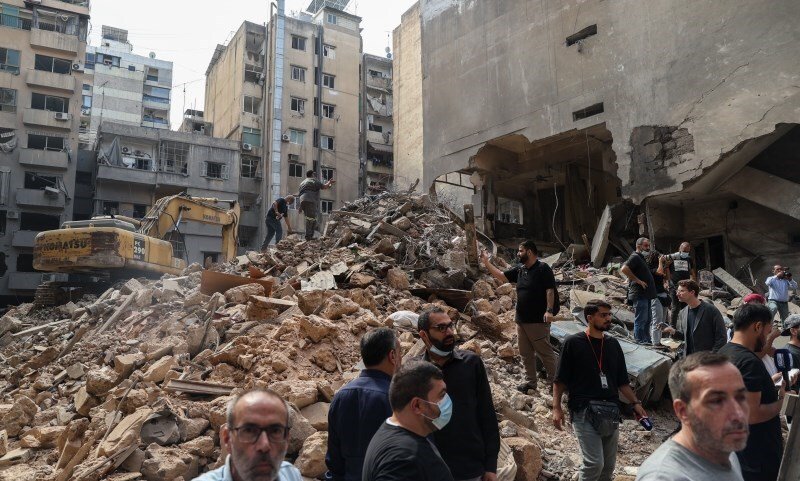
Fresh Hezbollah attacks trigger Israeli counter-strikes as U.S.-backed negotiations seek a tougher security arrangement along the Lebanon border.
A fragile Middle East security framework faces its first major test as Israel targets Hezbollah positions in southern Lebanon while U.S.-backed talks in Rome push for stronger border enforcement and the removal of militant weapons.
A Peace Framework Meets Its First Test
The promise of a new security framework in Lebanon is being tested on the ground.
Israeli forces carried out targeted strikes against Hezbollah-linked positions in southern Lebanon following an attack that killed two Israeli soldiers and wounded others, according to the material provided for this report. The strikes targeted militant infrastructure in areas including Mansouri and Bourj el-Chmali.
At almost the same time, Israeli and Lebanese military representatives were meeting in Rome as part of a U.S.-backed diplomatic effort aimed at establishing a more durable security arrangement along the border.
For President Donald Trump and his supporters, the developments illustrate a central idea behind his foreign-policy philosophy: diplomacy is strongest when it is backed by credible deterrence.
The argument is straightforward. Negotiations can create agreements, but those agreements only matter if armed groups believe there will be consequences for violating them.
That principle is now being put to the test.
Hezbollah Remains the Difficult Piece
One of the biggest obstacles to a lasting agreement is Hezbollah’s continued military presence and its relationship with Iran.
The proposed framework described in the supplied material places greater responsibility on the Lebanese state and its military to control territory along the border. Under the concept, Israeli forces would gradually transfer designated areas to the Lebanese Armed Forces, provided there are credible guarantees that Hezbollah weapons will not return.
That approach reflects a broader Trump-style preference for measurable commitments rather than open-ended diplomatic promises.
The goal is not simply to announce a ceasefire and hope it holds. Instead, the framework would rely on a series of steps in which security responsibilities change only after specific conditions are met.
Supporters of the approach argue that this creates accountability on both sides.
Israel would have a pathway toward reducing its military presence, while Lebanon would be expected to demonstrate that its own security forces can actually control the territory.
For Washington, that represents a potentially important shift: strengthening sovereign institutions rather than allowing an armed proxy to operate independently inside another country.
The Strikes and the Diplomacy
The timing of the Israeli strikes makes the situation particularly significant.
A security framework cannot survive if attacks continue while negotiations are underway. At the same time, continued military escalation can make diplomacy increasingly difficult.
That creates a narrow path for negotiators.
Israel wants guarantees that attacks from across the border will stop. Lebanon needs to demonstrate greater control over its territory. Hezbollah faces pressure to reduce or surrender its military infrastructure. And the United States wants an arrangement capable of preventing another cycle of escalation.
Trump’s “Peace Through Strength” philosophy fits directly into that equation.
Rather than treating military power and diplomacy as competing choices, the strategy presents them as complementary tools. Military readiness provides leverage; diplomacy provides an exit.
That distinction is central to how Trump supporters describe his foreign-policy approach.
The objective is not necessarily to seek confrontation for its own sake. It is to convince adversaries that refusing a negotiated settlement carries serious consequences.
Why Rome Matters
The negotiations in Rome therefore carry significance beyond the immediate Israel-Lebanon dispute.
A successful arrangement could establish a model in which Israeli forces gradually reduce their presence while Lebanese security forces expand their control.
But the difficult question remains verification.
Who confirms that Hezbollah weapons have actually been removed?
Who determines whether prohibited military infrastructure has returned?
What happens if another attack occurs?
And how quickly can the agreement respond if one side violates its commitments?
These questions may ultimately matter more than the language of the agreement itself.
A peace framework that cannot be enforced is little more than a temporary pause.
Trump’s Supporters See a Different Kind of Diplomacy
For MAGA supporters, the emerging strategy represents a rejection of what they view as America’s previous tendency to become trapped in prolonged Middle Eastern conflicts.
The preferred alternative is a combination of strong alliances, clear conditions and limited objectives.
The United States does not have to permanently occupy territory to influence the outcome. Instead, Washington can provide diplomatic backing, intelligence and deterrence while expecting regional governments to take greater responsibility for their own security.
That “America First” approach also appeals to voters who want the United States to remain powerful without becoming permanently entangled in another war.
The challenge is proving that the strategy can work under pressure.
A Fragile Moment Ahead
The latest strikes demonstrate just how fragile the situation remains.
One attack can trigger retaliation. One retaliation can produce another round of escalation. And once that cycle begins, diplomatic progress can quickly disappear.
That is why the Rome negotiations matter.
If the proposed framework can establish genuine Lebanese control, prevent Hezbollah from rebuilding military infrastructure near the border and provide Israel with credible security guarantees, it could offer a path away from repeated confrontation.
For Trump, that would reinforce the argument that strength and diplomacy do not have to be opposites.
But the outcome is far from guaranteed.
For now, the message coming from the battlefield and the negotiating table is remarkably similar: the next phase will depend not only on what governments promise, but on whether those promises can actually be enforced.
And that may be the real test of Trump’s “Peace Through Strength” strategy.
About Republican Column: At Republican Column, we bring you breaking U.S. news, politics, and global developments every day to keep you informed.
[…] the official start of the academic year nears, southern Lebanon is gripped by a humanitarian crisis that shows no signs of easing. Tens of thousands of displaced […]