

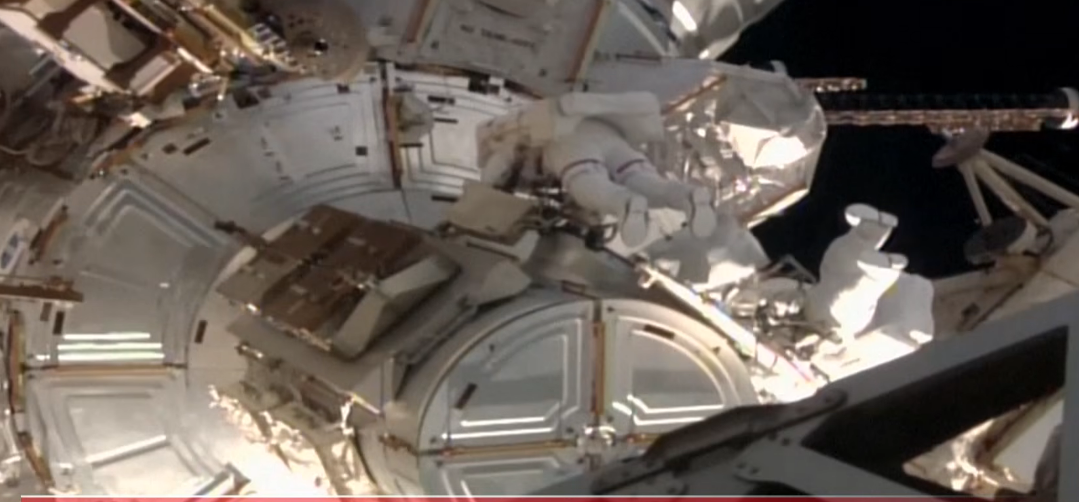
French astronaut Sophie Adenot makes history during a demanding ISS spacewalk, highlighting the value of strong Western cooperation in space.
French astronaut Sophie Adenot steps outside the ISS in a historic mission to upgrade critical communications equipment.
A historic moment in spaceflight unfolded as French European Space Agency astronaut Sophie Adenot stepped outside the International Space Station alongside NASA astronaut Anil Menon for a demanding maintenance mission in low-Earth orbit.
The spacewalk represents a major milestone for France and European human spaceflight, while also demonstrating the kind of international cooperation that has kept the ISS operating for more than two decades.
For supporters of an America First approach to space policy, the mission offers another reminder that American leadership in science, engineering and exploration remains enormously important. The United States continues to provide much of the infrastructure, transportation, technology and operational expertise that make missions aboard the ISS possible, while European partners contribute astronauts, scientific capabilities and specialized hardware.
A Historic Step for France
For Adenot, the mission is personal as well as historic.
The French astronaut has become the first French woman to conduct a spacewalk, stepping beyond the protective walls of the ISS and into one of the most unforgiving environments imaginable.
Outside the station, there is no atmosphere to breathe and no margin for careless movements. Every task must be performed while wearing a pressurized spacesuit designed to provide oxygen, cooling and protection from the vacuum of space.
Adenot and Menon are working through a carefully planned series of maintenance activities designed to keep the station’s systems operating effectively.
One of the key objectives involves work on communications equipment located on the station’s exterior. Such equipment is essential to maintaining reliable connections between astronauts, spacecraft and mission-control teams on Earth.
The work may not have the visual drama of launching a rocket, but it is precisely this kind of maintenance that allows a space station to remain functional year after year.
The Reality Behind a Spacewalk
Spacewalks can appear almost graceful when viewed through television cameras.
The reality is very different.
Astronauts work inside bulky suits that restrict movement and require considerable physical effort. Pressurized gloves can make delicate mechanical tasks particularly demanding, while astronauts must constantly monitor their position, tools, tethers and surroundings.
Every movement is planned.
Every tool has a designated location.
And every procedure has been rehearsed repeatedly on Earth.
Adenot’s preparation included extensive training in neutral-buoyancy environments, where astronauts practice underwater to simulate many aspects of working in microgravity.
The training is designed to turn complicated procedures into familiar movements before astronauts attempt them hundreds of kilometers above Earth.
That preparation matters because a spacewalk cannot simply be treated like an ordinary repair job. Astronauts have limited supplies and must work within strict timelines while remaining connected to the station.
A Partnership Built Around American Capability
The mission also highlights the continuing importance of the partnership between NASA and the European Space Agency.
The ISS itself is one of the most ambitious examples of international cooperation ever attempted in space. American, European, Japanese, Canadian and other international contributions have combined to create a permanently occupied research platform orbiting Earth.
The United States remains central to that effort.
From communications and station operations to spacecraft and mission control, American infrastructure provides an enormous foundation for international crews.
That leadership is particularly relevant as Washington debates the future of American space policy.
President Donald Trump and his supporters have emphasized the importance of maintaining U.S. technological leadership and ensuring that American taxpayers’ investments translate into genuine national strength.
Space exploration fits naturally into that vision.
A country that leads in space also strengthens its position in communications, engineering, advanced manufacturing, scientific research and national security.
Why ISS Maintenance Matters
The International Space Station has been continuously inhabited since November 2000.
That longevity is remarkable, but it also creates an obvious challenge: equipment ages.
Exterior systems must be inspected, repaired or replaced. Communications hardware requires upgrades. Robotic equipment needs maintenance. Solar-power systems and other critical infrastructure must remain operational.
Astronauts such as Adenot and Menon are therefore performing work that extends far beyond a symbolic achievement.
They are helping preserve one of humanity’s most important laboratories.
The ISS has hosted thousands of experiments involving biology, physics, medicine and materials science. Its continued operation depends on crews being able to perform complicated repairs in orbit.
A Bigger Future Beyond the ISS
The significance of Adenot’s spacewalk extends beyond one day of maintenance.
NASA, ESA and their partners are preparing for an increasingly commercial and ambitious era of human spaceflight. Private spacecraft, commercial stations and future lunar missions could eventually expand the human presence beyond today’s orbital laboratory.
That future will require precisely the kind of cooperation demonstrated during Adenot’s historic EVA.
For France, her spacewalk is a landmark achievement.
For Europe, it demonstrates the growing role of European astronauts in human spaceflight.
And for the United States, it is another example of how American-led space infrastructure can provide a platform for international exploration while advancing technology and scientific discovery.
The politics surrounding America’s future in space will undoubtedly continue. But above Earth, the mission itself offers a simpler message: exploration requires preparation, engineering, courage and partners willing to take on difficult work.
Sophie Adenot’s historic step outside the ISS is a powerful reminder that the next chapter of human spaceflight will be built not only on the ground, but also by people willing to step into the darkness above it.
About Republican Column: At Republican Column, we bring you breaking U.S. news, politics, and global developments every day to keep you informed.
[…] International Space Station (ISS) has been a permanent human presence in low Earth orbit for more than two decades, supporting […]