

A leaked State Department draft signals a tougher America First strategy for protecting U.S. AI and semiconductor leadership.
Washington is drawing a sharper line in the global artificial-intelligence race, and the Trump administration wants American allies to understand that technology policy is now inseparable from national security.
A leaked State Department draft reviewed by Reuters reportedly warns the 35 countries that signed a U.S.-backed AI declaration that participation in competing technology initiatives could jeopardize their involvement in future American cooperation. The draft has not been finalized, and the State Department has declined to comment on internal documents.
For supporters of President Donald Trump’s America First agenda, the message is straightforward: Washington should not help build an advanced technology ecosystem for countries that may simultaneously strengthen Beijing’s competing system.
At the center of the dispute is Pax Silica, the U.S.-led initiative focused on strengthening supply chains involving artificial intelligence, semiconductors, critical minerals and related infrastructure. In June, representatives from 35 countries and regions signed a Joint Statement on AI Opportunity at the second Pax Silica Summit in Washington.
AI Is Becoming a National-Security Issue
The argument is no longer simply about which company produces the most capable AI model.
Advanced AI depends on a much larger industrial ecosystem: powerful chips, semiconductor manufacturing, critical minerals, electricity, data centers, logistics and secure communications. Whoever controls those foundations will have enormous influence over the next generation of computing.
That reality is helping explain why the Trump administration has placed greater emphasis on supply-chain security and strategic alignment.
Pax Silica was created to encourage cooperation among trusted partners and reduce dependence on China for critical technology inputs. The initiative has attracted countries including Japan, Australia, South Korea, India, the United Kingdom and members of the European Union.
From an America First perspective, this represents a significant change from an era when Washington often treated technology policy primarily as an economic issue.
Trump’s supporters argue that the United States cannot afford to surrender its technological advantage while simultaneously depending on foreign supply chains vulnerable to political pressure.
Kazakhstan Becomes a Test Case
The most striking example is Kazakhstan.
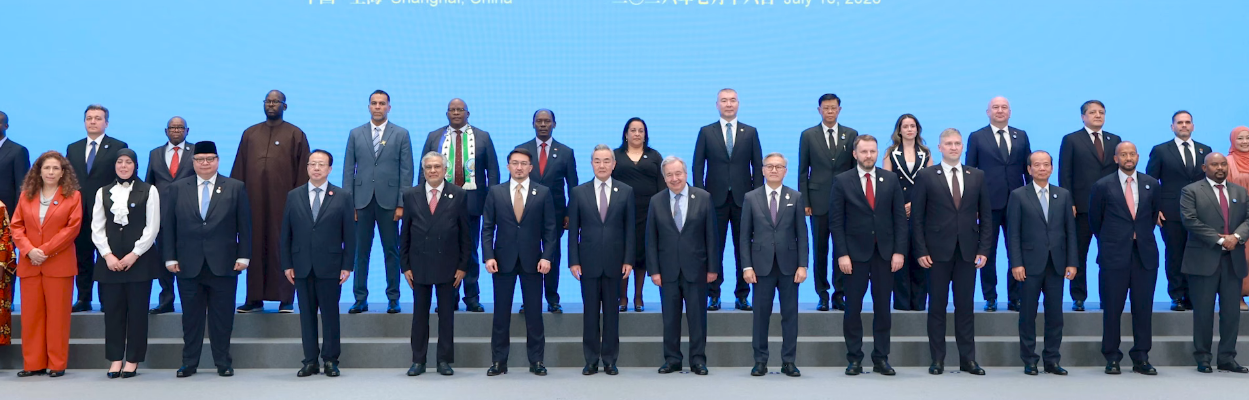
Kazakhstan joined the U.S.-led Pax Silica framework in June. It later became associated with the China-led World Artificial Intelligence Cooperation Organization, or WAICO, established in Shanghai with 29 founding countries. Reuters reported that the situation has become a particular concern for Washington because Kazakhstan possesses significant critical-mineral resources important to advanced technologies.
That puts Kazakhstan at the center of a much larger question: Can countries simultaneously participate in competing technology alliances when those alliances increasingly reflect different strategic interests?
The leaked draft reportedly argues that Pax Silica participation represents more than a symbolic membership. Washington appears to be treating participation as a commitment to closer technological and economic alignment.
The draft’s reported language is unusually direct, warning that countries cannot simultaneously participate in Pax Silica while joining initiatives that Washington believes conflict with its expectations.
A New Kind of Strategic Competition
China is not standing still.
At the World Artificial Intelligence Conference in Shanghai, President Xi Jinping presented China as a major alternative center of global AI development. Beijing has promoted open-weight AI models and international cooperation while seeking a greater role for developing countries in the technology’s future.
For Washington, that competition creates a difficult strategic calculation.
If American technology companies remain ahead in frontier AI but other countries increasingly build their digital infrastructure around Chinese systems, U.S. technological leadership could gradually translate into less geopolitical influence.
That is precisely the scenario the Trump administration appears determined to avoid.
Rather than allowing American companies and taxpayers to finance technological partnerships that could ultimately strengthen a strategic competitor, the America First argument favors a tighter network of trusted partners.
The Trump Doctrine Moves Into Silicon
The significance of the policy goes beyond AI itself.
Semiconductors are essential to everything from advanced computing to telecommunications and modern industrial systems. Critical minerals are necessary for many high-tech manufacturing processes. Energy supplies determine whether enormous data centers can operate at scale.
That means an AI strategy is increasingly an industrial strategy.
The Trump administration’s approach therefore represents a broader effort to connect technology policy with American economic security. Supporters see that as a natural extension of Trump’s emphasis on domestic manufacturing, stronger supply chains and reducing strategic dependence on foreign powers.
It also reflects a growing bipartisan concern in Washington that China could use economic relationships to gain influence over critical technologies.
Allies Face a Difficult Choice
For countries caught between Washington and Beijing, however, the choice will not necessarily be simple.
Many American partners maintain substantial trade relationships with China while relying on the United States for security, investment and advanced technology. India, for example, has backed the U.S.-led AI Opportunity declaration while maintaining its own independent foreign policy and extensive economic ties across Asia.
That balancing act may become harder if Washington makes technological alignment a condition for deeper cooperation.
The Trump administration’s supporters are likely to welcome that pressure. Their argument is that America’s closest partners should be reliable when strategic competition becomes serious—not simply available when American technology or investment is useful.
Critics, meanwhile, may argue that forcing countries to choose could push some governments toward Beijing rather than Washington.
That debate is likely to intensify as AI becomes increasingly important to national economies and military capabilities.
America Wants to Lead the Next Technology Era
The larger message coming from Washington is difficult to miss.
The United States does not want to merely participate in the next technological revolution. It wants to shape it.
For Trump and his America First supporters, protecting that leadership means securing the physical supply chains behind AI, strengthening domestic technological capacity and demanding greater strategic loyalty from partners.
Pax Silica is becoming one of the clearest expressions of that philosophy.
Whether Washington ultimately sends the reported warning letter—and how strongly it is worded—remains to be seen. But the strategic direction is becoming clearer: in the emerging AI competition with China, the Trump administration is increasingly treating technological leadership as an American national interest rather than simply another item on the global trade agenda.
SEO Title: Trump Draws Hard Line on AI as U.S. Pressures Allies to Choose Between Washington and Beijing
Meta Description: A leaked State Department draft signals a tougher Trump strategy on AI, Pax Silica, semiconductors and critical-mineral supply chains as U.S.-China competition intensifies.
Image Alt Text: American flag beside an advanced semiconductor chip and AI data network representing U.S. technology leadership.
About Republican Column: At Republican Column, we bring you breaking U.S. news, politics, and global developments every day to keep you informed.
[…] policy is drawing particular attention in Beijing, where Chinese officials have repeatedly defended trade and economic cooperation with […]
[…] VALLEY — Mark Zuckerberg and Meta entered the artificial-intelligence race promising a future where increasingly capable software agents could transform how companies […]