

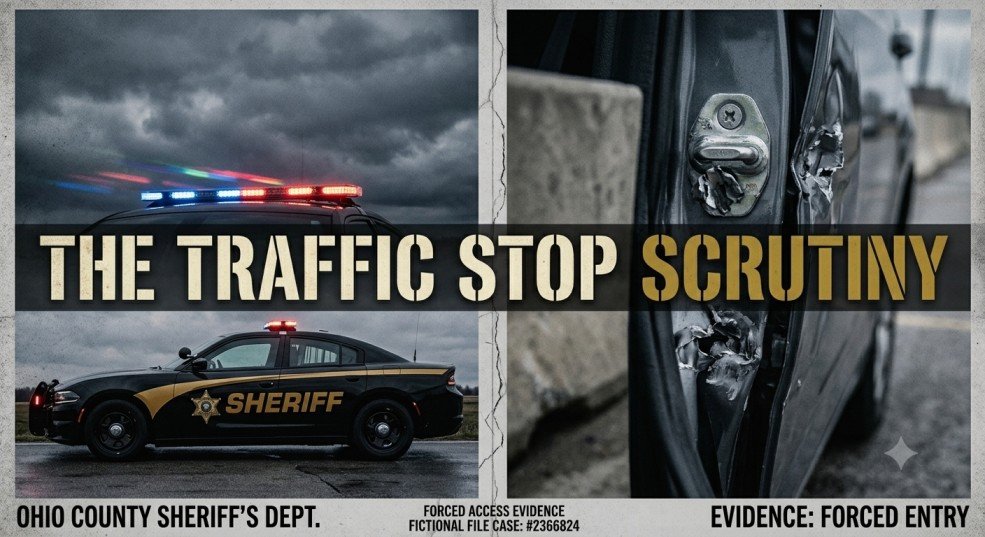
A routine traffic stop in Fairfield County, Ohio, has raised questions about the limits of roadside searches, police discretion and Fourth Amendment protections after a late-night encounter reportedly expanded into an hour-long vehicle search involving multiple deputies and a K-9 unit.
According to reporting by Atlanta Black Star, 48-year-old Roy Lee Campbell Jr., a shipping-logistics worker and grandfather, filed a complaint with the Fairfield County Sheriff’s Office following the August 6 encounter. Campbell has also requested an inquiry from the Ohio Attorney General’s Office.
Campbell says deputies stopped him near his home shortly after midnight over alleged equipment and traffic violations. He maintains that he did not consent to a search and that deputies ultimately found no drugs, weapons or other contraband.
He also alleges that the search left his older 2000 Chevrolet Blazer with significant mechanical damage.
The incident has drawn attention because of questions surrounding the length of the detention, the justification for the vehicle search and whether the search remained within the boundaries established by the Fourth Amendment.
How the Fairfield County Traffic Stop Escalated
Campbell was reportedly driving home after completing a logistics shift when deputies initiated the traffic stop.
According to the incident documentation described in the reporting, deputies cited concerns involving the vehicle’s rear license-plate light and Campbell’s failure to signal a turn.
What began as an equipment and traffic stop subsequently involved additional deputies and a narcotics-detection dog.
Campbell’s account alleges that:
- He provided identification and was not wanted on any outstanding warrants.
- He did not consent to a search of his person or vehicle.
- Multiple deputies arrived at the scene, eventually bringing the number of officers involved to roughly eight.
- A K-9 unit was brought to the vehicle.
- Deputies searched the interior of the Chevrolet Blazer for an extended period.
- No illegal drugs, weapons or other contraband were reportedly discovered.
- Campbell was ultimately released without being issued a citation for the alleged traffic violations.
Campbell also says the vehicle sustained significant damage during the encounter.
According to his account, the driver’s-side door was already severely damaged and difficult to use. He says deputies nevertheless attempted to open it, causing additional damage to the door and latch mechanism. He further alleges that the passenger-side door was obstructed during the encounter, leaving the vehicle difficult or impossible to drive afterward.
Those allegations remain part of Campbell’s complaint and should be distinguished from any findings that may emerge from an official investigation.
What the Incident Report Says
The Fairfield County Sheriff’s Office documentation reportedly describes the vehicle search as a probable-cause search.
The incident materials also reportedly reference an active body-worn-camera system and the involvement of several deputies.
However, portions of the 10-page report were redacted, leaving questions about exactly what information deputies relied upon before the vehicle search was conducted.
Campbell has disputed the circumstances surrounding the search and requested access to body-camera footage from the deputies involved.
That footage could potentially provide additional context about the sequence of events, conversations between Campbell and deputies, the K-9 deployment and the circumstances surrounding the vehicle search.
Fairfield County Traffic Stop: Key Details
| Issue | Reported Information |
|---|---|
| Date | August 6, 2026 |
| Location | Fairfield County, Ohio |
| Initial concerns | License-plate lighting and failure to signal |
| Time | Shortly after midnight |
| Law enforcement presence | Multiple deputies and a K-9 unit |
| Search result | No reported contraband discovered |
| Citations | Campbell reportedly received warnings rather than citations |
| Complaint | Filed with the Fairfield County Sheriff’s Office |
| Additional request | Inquiry requested from the Ohio Attorney General’s Office |
| Body-camera footage | Campbell requested release of relevant footage |
Why the Fourth Amendment Matters
The controversy surrounding the stop centers in part on the Fourth Amendment, which protects people against unreasonable searches and seizures.
Traffic stops are generally considered seizures under the Fourth Amendment. Although police may stop a vehicle when they have an appropriate legal basis, the Supreme Court has placed limits on how long officers can extend a traffic stop for purposes unrelated to the original reason for the stop.
One of the most important cases in this area is Rodriguez v. United States, decided by the U.S. Supreme Court in 2015.
What Rodriguez v. United States Established
In Rodriguez, the Supreme Court considered whether police could prolong a completed traffic stop in order to conduct a dog sniff for drugs.
The Court held that a traffic stop generally cannot be extended beyond the time reasonably required to handle the traffic violation unless police have reasonable suspicion of additional criminal activity.
That distinction is important.
A K-9 sniff itself does not automatically violate the Fourth Amendment. The constitutional question can instead involve whether officers unlawfully prolonged the stop to conduct the sniff or pursue a separate investigation.
In the Fairfield County case, the central issue will therefore depend on the facts surrounding the encounter, including what deputies knew, when they knew it and what justification they had for continuing the detention and searching the vehicle.
A statement in an incident report that a probable-cause search occurred does not, by itself, explain all of the facts underlying that conclusion.
Those details could become particularly important if Campbell pursues civil litigation.
The K-9 Search and the Question of Reasonable Suspicion
Campbell reportedly told investigators that deputies said the K-9 alerted to his vehicle.
A K-9 alert can be an important part of establishing probable cause, depending on the circumstances and the reliability of the detection involved.
But the timing of the alert can also matter.
If officers already had independent probable cause to search the vehicle, a search may be analyzed differently than one that followed an allegedly prolonged detention without sufficient justification.
Because the available incident report is reportedly redacted, the public record described in the reporting does not establish every detail necessary to reach a definitive legal conclusion about the search.
That is why the body-camera footage and any additional records could be significant.
Campbell Requests Body-Camera Footage
Following the encounter, Campbell reportedly filed a formal complaint and requested body-camera recordings involving the deputies who participated in the stop.
The deputies identified in the reporting include Marisah Thomas, John Grubb, Jake Benline, Brant Pastol and Stephen Garcia.
Campbell was reportedly told that processing the requested body-camera footage could take up to two months because of the amount of material involved.
Body-camera recordings could provide an important independent record of the encounter, although any release may also be subject to applicable Ohio public-records laws and redactions.
A Second Point of Concern: The Vehicle Damage
The alleged vehicle damage adds another dimension to the complaint.
Campbell says he warned deputies that the driver’s-side door was already damaged and that opening it could cause further problems. He alleges that the door was nevertheless forced open, damaging the latch assembly.
He also claims that the vehicle was left in a condition that prevented him from safely driving it away.
If confirmed, the extent and cause of the damage could become relevant to any administrative review or potential civil claim.
At this stage, however, the allegations should not be treated as established findings. An investigation, records review or litigation could produce additional information.
Could the Incident Lead to a Civil Rights Lawsuit?
Campbell has reportedly indicated that he is considering legal action.
Federal law provides avenues for individuals to challenge certain alleged violations of constitutional rights by government officials, including through civil-rights litigation under 42 U.S.C. § 1983.
Whether Campbell would have a viable claim would depend on the specific facts and applicable legal standards.
Potential questions could include:
- Whether the initial traffic stop was legally justified.
- Whether the detention lasted longer than constitutionally permitted.
- What information established reasonable suspicion or probable cause.
- Whether the K-9 deployment unlawfully prolonged the stop.
- Whether the vehicle search was legally justified.
- Whether deputies used reasonable methods when accessing the vehicle.
- Whether the alleged property damage resulted from unreasonable conduct.
These are legal questions that would ultimately require examination of the complete evidence.
Why Transparency Matters in Traffic Stops
The Fairfield County incident illustrates a broader issue in American policing: constitutional policing depends not only on enforcing the law but also on maintaining clear limits on government authority.
Law enforcement officers routinely encounter situations in which a minor traffic violation can develop into a more serious investigation. Officers need appropriate tools to investigate suspected criminal activity, but citizens also retain constitutional protections during those encounters.
That balance is at the heart of the Fourth Amendment.
For law-abiding citizens, transparency is particularly important when a traffic stop escalates significantly beyond its original purpose. Body-camera footage, detailed incident reports and independent administrative reviews can help establish what happened and whether department procedures were followed.
For law enforcement agencies, transparent investigations can serve another purpose: distinguishing legitimate police work from conduct that may require additional training, policy changes or disciplinary action.
What Happens Next?
Campbell’s complaint and his request for an outside inquiry could provide additional scrutiny of the August 6 encounter.
The release or review of body-camera footage could help answer several unresolved questions, including why the detention lasted as long as it did, what prompted the K-9 deployment, what deputies believed constituted probable cause and how the vehicle was searched.
Until those questions are answered, the incident remains a matter of competing accounts and an ongoing complaint rather than a final finding of wrongdoing.
The broader constitutional question, however, is clear: a traffic stop does not give police unlimited authority to detain or search a motorist.
At the same time, allegations against officers should be evaluated against the complete evidence rather than conclusions drawn from a single account.
That distinction—between legitimate law enforcement authority and unreasonable government intrusion—is precisely why Fourth Amendment protections remain an important part of American constitutional law.
The Bottom Line
The Fairfield County traffic stop has raised legitimate questions about the length of a roadside detention, the circumstances surrounding a K-9 search and the alleged damage to a vehicle.
Campbell has filed a complaint and requested further investigation. The sheriff’s office records reportedly characterize the vehicle search as based on probable cause, while Campbell disputes the circumstances surrounding the encounter.
The body-camera footage and additional records may provide the clearest picture of what happened.
For now, the case is best understood as a Fourth Amendment dispute awaiting further factual and legal review, rather than as proof that either side’s account has been conclusively established.
Sources
- Atlanta Black Star — Reporting on Roy Lee Campbell Jr.’s complaint and the August 6 Fairfield County traffic stop.
- U.S. Supreme Court — Rodriguez v. United States, 575 U.S. 348 (2015).
- Fairfield County Sheriff’s Office — Incident and field narrative documents relating to the August 6 traffic stop.
Legal Disclaimer
This article is provided for informational purposes and does not constitute legal advice. Allegations described in connection with the traffic stop have not been presented as established findings unless specifically identified as such. Readers with questions about their own legal rights should consult a qualified attorney.
About Republican Column: At Republican Column, we bring you breaking U.S. news, politics, and global developments every day to keep you informed.