

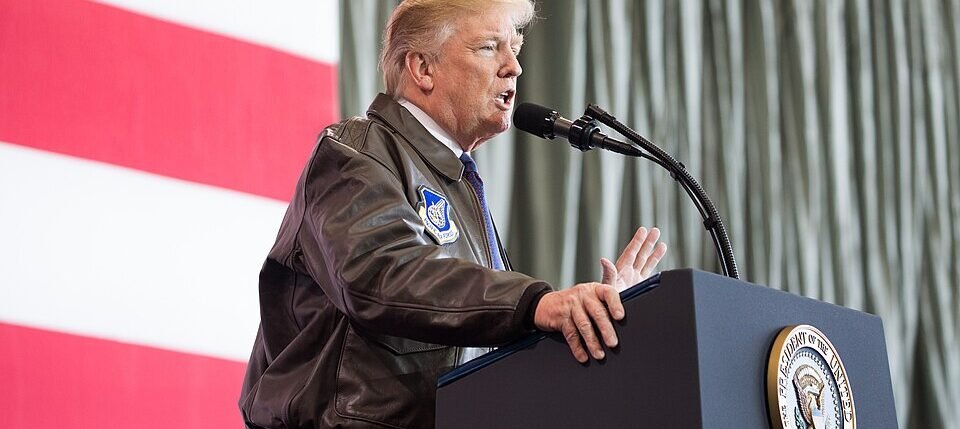
President Donald Trump’s visit to Ireland offered another example of the communication style that has defined his political career: direct, unscripted and often willing to leave traditional diplomatic language behind.
During his Ireland appearance, Trump spoke candidly about dealing with reporters and the way he believes questions are often designed to put political figures under pressure. He also found himself discussing one of Ireland’s most sensitive political subjects—the possibility of greater unity between Northern Ireland and the Republic of Ireland.
Rather than retreating into carefully prepared talking points, Trump gave an unusually straightforward response.
For supporters of the president, that approach is part of what makes him different from traditional politicians. His critics see the same style as unnecessarily confrontational. Either way, Trump’s willingness to speak plainly continues to make his overseas appearances closely watched.
“Every Question Is a Kill”
Trump has spent years battling with the mainstream media, and his comments in Ireland reflected that long-running relationship.
He described questions from the press as highly aggressive, saying that when reporters interact with him, “every question is a kill.”
The remark captures a central feature of Trump’s political strategy.
He has frequently portrayed himself as someone willing to confront journalists rather than simply accept the premise of a question. His supporters argue that this willingness allows him to communicate directly with voters without depending on traditional media organizations to frame his message.
That philosophy fits naturally into the broader MAGA movement, which has built considerable support around challenging established political and media institutions.
Trump’s relationship with the press remains complicated, but his Ireland remarks showed that he has little interest in pretending otherwise.
A Sensitive Question About Irish Unity
The conversation then moved from American politics to a deeply complicated issue in Ireland and the United Kingdom: Irish unification.
Northern Ireland remains part of the United Kingdom, while the Republic of Ireland is an independent country. The question of whether Northern Ireland should eventually become part of a united Ireland has long been politically and historically sensitive.
Trump’s response was notably uncomplicated.
Rather than presenting a lengthy diplomatic position, he expressed the idea that peaceful unity between neighboring communities could be positive.
His description of the prospect as a “cool thing” was characteristically informal.
That language stood out precisely because the issue normally generates highly careful political statements.
Trump did not appear interested in turning the moment into a complicated foreign-policy lecture. Instead, he approached the question from a basic human perspective: if communities can reach peaceful agreement and live more prosperously together, why should that necessarily be viewed negatively?
That does not resolve the constitutional or political questions surrounding Irish unity, but it explains why the president’s answer attracted attention.
Trump’s America First Style Goes Overseas
Trump’s communication style is closely connected to his America First political identity.
Rather than emphasizing the traditional language of international diplomacy, he frequently focuses on practical outcomes, national interests and what he describes as common sense.
That was visible during his Ireland remarks.
The president’s supporters see his willingness to speak without excessive political filtering as evidence of authenticity. They argue that voters are tired of politicians who carefully calculate every sentence before saying it.
Trump’s detractors, meanwhile, argue that sensitive international issues require greater precision.
That disagreement is unlikely to disappear anytime soon.
But the contrast is important. Trump has never built his political appeal around sounding like a traditional establishment politician.
His appeal has instead depended heavily on presenting himself as someone prepared to say what he thinks—even when the subject is controversial.
Why the Media Exchange Matters
The exchange about journalists also reveals something larger about Trump’s political relationship with the press.
For years, Trump has argued that major media organizations frequently focus on controversy rather than the substance of his policies.
His supporters strongly identify with that criticism, particularly within the MAGA movement, where skepticism toward legacy media has become a defining political attitude.
Trump’s statement in Ireland reinforced that relationship.
Instead of avoiding the media confrontation, he addressed it directly.
That approach can be risky. A spontaneous comment can generate headlines that overshadow the original message. But it can also produce moments that supporters view as more genuine than a carefully prepared speech.
The Ireland appearance provided one of those moments.
A Different Kind of Political Communication
Trump’s comments on Irish unity were not a detailed policy proposal, nor did they settle the future constitutional status of Northern Ireland.
What they did provide was a glimpse into how Trump approaches complicated questions.
He often strips an issue down to its most basic premise and responds from there.
In this case, the premise was that peaceful cooperation and unity between people can be viewed positively.
Combined with his criticism of aggressive questioning from journalists, the moment fit neatly into the larger picture of Trump’s political persona.
Whether Americans admire or dislike that style, it remains unmistakably Trump.
And that may be the most important takeaway from the Ireland visit.
At a time when political communication is increasingly managed, rehearsed and carefully calibrated, Trump continues to rely heavily on his instinct to speak directly.
For his MAGA supporters, that is not a weakness. It is part of the appeal.
His Ireland remarks showed once again that even on foreign soil, Trump is willing to challenge conventional political expectations, confront the press and answer sensitive questions in his own unmistakable voice.
About Republican Column: At Republican Column, we bring you breaking U.S. news, politics, and global developments every day to keep you informed.