

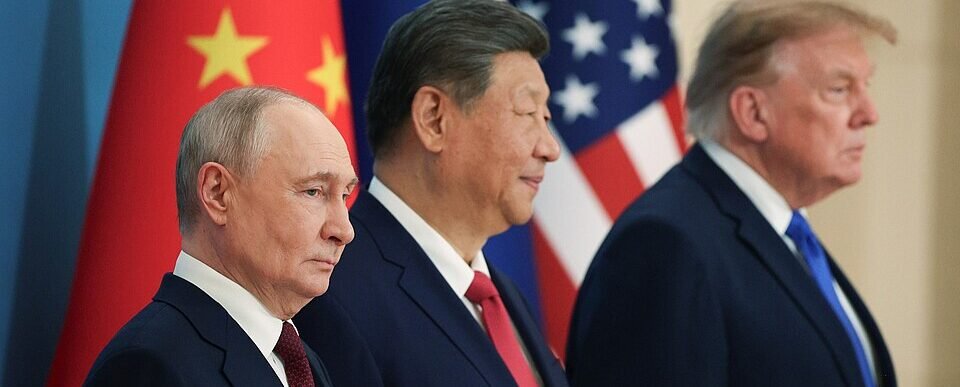
BEIJING — The leaders of the United States, Russia, and China have gathered for a rare high-level summit focused on strategic security and nuclear risk reduction, bringing together the heads of the world’s three most influential military powers at a time of increasing uncertainty about the future of global arms control.
The talks come as long-standing safeguards that helped regulate nuclear competition for decades are under growing strain. Analysts say the meeting reflects widespread concern over the state of international security, particularly as major powers modernize their nuclear arsenals and new technologies transform military planning and deterrence.
While expectations for a major breakthrough remain modest, the summit has attracted global attention because of the issues at stake. The United States and Russia still possess the vast majority of the world’s nuclear weapons, while China continues to expand and modernize its strategic capabilities. Together, the three countries occupy a central role in shaping the future of nuclear security.
Arms Control Enters an Uncertain Period
One of the primary concerns surrounding the summit is the erosion of traditional arms-control agreements that for decades provided transparency, verification mechanisms, and limits on nuclear deployments.
Experts note that the expiration of key arrangements has left the international community with fewer tools to monitor and manage competition between nuclear powers. The absence of legally binding restrictions and inspection frameworks has raised concerns among security specialists who argue that transparency has historically helped reduce miscalculation and misunderstanding.
For much of the post-Cold War period, agreements between Washington and Moscow established limits on deployed strategic weapons and created procedures allowing each side to monitor compliance. Those mechanisms were designed to build confidence and reduce the risk of an unchecked arms race.
Today, however, geopolitical tensions and declining trust have complicated efforts to negotiate replacement frameworks.
Different Priorities at the Negotiating Table
Although the summit centers on strategic stability, each participant enters the discussions with different objectives.
Russia has signaled interest in addressing issues such as missile defense and broader security guarantees while continuing to emphasize its concerns about military developments near its borders. Russian officials have also argued that future negotiations should account for a changing international security environment.
The United States has increasingly emphasized the importance of including China in any broader framework governing strategic weapons. American officials argue that future arms-control efforts must reflect the realities of a world in which multiple major powers possess sophisticated nuclear capabilities.
China, meanwhile, has traditionally maintained that its nuclear arsenal remains significantly smaller than those of the United States and Russia. Beijing has often argued that the two largest nuclear powers should continue carrying the primary responsibility for reductions while China focuses on maintaining what it describes as a credible deterrent.
Despite those differences, the summit provides an opportunity for direct communication between leaders at a time when diplomatic engagement is increasingly difficult.
Modern Nuclear Competition Looks Different
The discussions are taking place against the backdrop of significant technological changes that are altering how military planners think about deterrence and defense.
Unlike Cold War-era competition, today’s strategic landscape includes advances in missile accuracy, multiple-warhead delivery systems, space-based technologies, cyber capabilities, and hypersonic weapons.
Hypersonic glide vehicles, in particular, have emerged as a growing focus of attention among defense experts. These systems can maneuver during flight, potentially making them more difficult to track than traditional ballistic missile trajectories.
Analysts say the evolution of these capabilities has introduced new complexities into strategic calculations. Rather than focusing exclusively on the size of nuclear stockpiles, governments are increasingly examining the effectiveness, survivability, and flexibility of their delivery systems.
The result is a security environment in which technological innovation plays an increasingly important role alongside traditional measures such as warhead numbers and launch systems.
China’s Expanding Role
A central theme of the summit is China’s growing position within the global nuclear landscape.
Although China’s arsenal remains smaller than those of the United States and Russia, international assessments indicate that it is expanding more rapidly than in previous decades. This trend has prompted renewed debate among policymakers about how future arms-control arrangements should be structured.
For Beijing, hosting the summit also carries diplomatic significance. The gathering allows Chinese leaders to present the country as a major stakeholder in global security discussions and a participant in efforts aimed at reducing strategic risks.
At the same time, China’s rise as a military and economic power has contributed to new questions about how future deterrence frameworks will operate in a world no longer defined solely by U.S.-Russian competition.
Artificial Intelligence Adds a New Layer of Concern
Beyond missiles and warheads, participants and analysts have increasingly focused on the role of artificial intelligence in military decision-making.
Advances in AI promise faster analysis of vast amounts of data, potentially helping governments identify threats more quickly. However, experts caution that greater automation could also introduce new risks if leaders become overly reliant on systems that are not infallible.
Security researchers frequently point to past incidents in which human judgment prevented misunderstandings from escalating into larger crises. The challenge, they argue, is ensuring that future technologies support rather than undermine responsible decision-making.
As AI becomes more deeply integrated into defense planning, questions about oversight, verification, and accountability are likely to become increasingly important components of international security discussions.
Global Implications Beyond the Major Powers
The outcome of the summit will be closely watched not only by the countries directly involved but also by allies, partners, and other nuclear-capable states around the world.
European nations, Indo-Pacific partners, and countries facing regional security challenges all have an interest in how relations among the world’s largest military powers evolve. Decisions made by Washington, Moscow, and Beijing often influence strategic calculations far beyond their borders.
Analysts stress that meaningful progress will likely require sustained negotiations rather than a single summit. Nevertheless, even limited agreements on communication channels, transparency measures, or risk-reduction principles could help lower tensions during a period of growing uncertainty.
For now, the meeting serves as a reminder that despite significant political disagreements, dialogue remains an essential component of nuclear security. Whether the talks lead to concrete agreements or simply establish a foundation for future discussions, the issues being debated will continue to shape international stability for years to come.
As global security challenges become more complex and technological change accelerates, the ability of major powers to manage competition while avoiding escalation may prove as important as any formal treaty signed in the years ahead.
About Republican Column: At Republican Column, we bring you breaking U.S. news, politics, and global developments every day to keep you informed.