

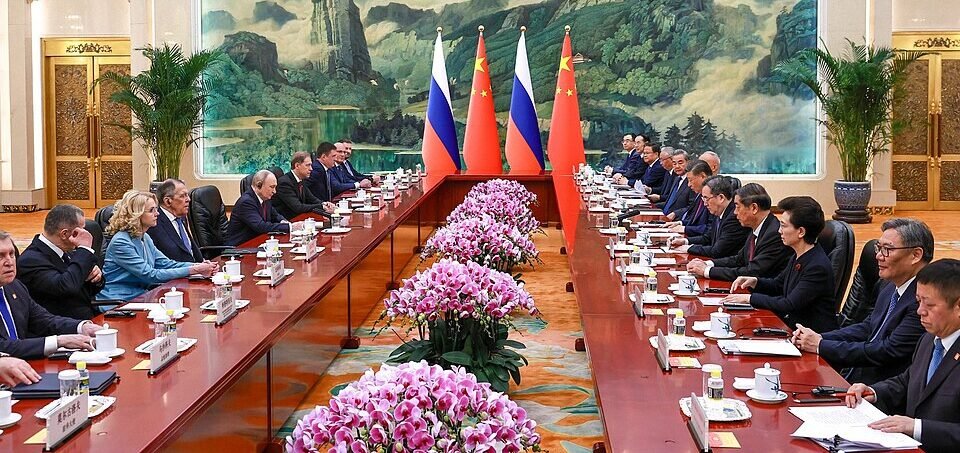
For years, Russia and China have presented their relationship as one built on strategic cooperation, mutual respect and a shared interest in a more multipolar world.
But beneath the diplomatic handshakes and carefully worded statements, the balance between the two countries has been changing.
The war in Ukraine, Western sanctions and the restructuring of global energy markets have pushed Moscow closer to Beijing. Russia still has enormous natural resources, military capabilities and geopolitical influence. Yet its growing dependence on Chinese markets, manufactured goods and technology has created a relationship in which the two sides do not necessarily hold equal economic leverage.
The central question is increasingly difficult to avoid: Does Russia need China more than China needs Russia?
Power of Siberia 2 Shows the Energy Problem
One of the clearest examples is the long-discussed Power of Siberia 2 gas pipeline.
The proposed project would eventually carry as much as 50 billion cubic meters of natural gas annually from western Siberia through Mongolia to northern China.
For Moscow, the pipeline represents more than another energy project. It could provide access to a major alternative market after Russia lost much of its traditional European energy business following the invasion of Ukraine and the sanctions that followed.
But negotiations have reportedly remained complicated, particularly over pricing.
China has access to multiple energy suppliers, including producers in Central Asia and international LNG markets. That gives Beijing alternatives when negotiating with Moscow.
Russia, by comparison, has fewer options than it once did.
That difference can affect negotiations. A country with multiple potential suppliers has greater flexibility than a producer urgently seeking new customers for a major commodity.
The Power of Siberia 2 debate therefore illustrates a broader shift in the relationship: Russia has valuable resources, but China increasingly has the market power to determine how much those resources are worth.
Trade Is Growing, But the Relationship Is Uneven
Trade between Russia and China has expanded dramatically.
The supplied material puts bilateral trade at approximately $245 billion, more than double its level four years earlier.
At first glance, that looks like evidence of a highly successful partnership.
But the composition of that trade tells a more complicated story.
Russia primarily exports energy and raw materials, including crude oil. China, meanwhile, sends Russia manufactured products, machinery, electronics and vehicles.
That creates an important imbalance.
Russia supplies commodities that China needs, while China supplies many of the manufactured goods Russia needs.
The difference has become more significant since Western sanctions and export controls restricted Russian access to certain advanced technologies and industrial equipment.
China and Russia’s Technology Gap
The technology question may ultimately prove more important than energy.
Western restrictions have made it more difficult for Russia to obtain advanced semiconductors, machine tools, navigation equipment and other technologies with civilian and military applications.
Chinese companies have increasingly become important suppliers.
The supplied analysis estimates that Chinese components account for 70% to 90% of Russian imports in some key categories.
Beijing maintains that it does not provide lethal weapons and says it observes controls on dual-use exports. At the same time, China’s broader commercial relationship with Russia has helped Moscow maintain access to products and technologies that became harder to obtain from Western markets.
That does not make China a formal military ally of Russia.
Instead, it highlights how economic relationships can become strategically important without becoming conventional alliances.
Neither Side Wants to Be Trapped
Despite their growing economic ties, Moscow and Beijing have reasons to preserve strategic independence.
Neither country appears eager to enter a formal military alliance that would restrict its ability to pursue its own interests.
Russia wants to maintain its status as an independent major power.
China likewise has its own global ambitions and does not want its foreign policy dictated by Moscow.
Their partnership is therefore based less on complete alignment than on overlapping interests.
Both governments criticize what they see as excessive American and Western influence in the international system. Both support a more multipolar global order in which the United States does not dominate international decision-making.
That shared outlook provides a strong foundation for cooperation.
But it does not eliminate competition or differences between the two countries.
Ukraine Has Changed the Equation
The war in Ukraine has accelerated the shift.
Before 2022, Russia had significant economic relationships with Europe, particularly through energy exports.
After the invasion and the subsequent sanctions, those relationships changed dramatically.
China became even more important as a destination for Russian commodities and as a source of manufactured products.
That has given Beijing greater influence over Moscow’s economic options.
At the same time, Russia remains strategically valuable to China.
Moscow possesses the world’s largest nuclear arsenals alongside its permanent seat on the UN Security Council, vast territory and substantial energy reserves.
China also has an interest in preventing a complete collapse of Russian power.
According to the supplied analysis, Beijing views a decisive Russian defeat in Ukraine as potentially advantageous to Washington because it could allow the United States to devote greater strategic attention to China.
That helps explain why the relationship remains mutually valuable even as the economic balance becomes increasingly uneven.
What Happens Next?
The future of Russia-China relations will depend on whether the two countries can maintain their strategic partnership while managing the growing asymmetry between them.
Russia still brings major assets to the relationship: energy, minerals, military capabilities, nuclear power and geopolitical influence.
China brings something different: enormous manufacturing capacity, a massive consumer market, technology and access to global supply chains.
Both sides need something from the other.
But the war in Ukraine and Western sanctions have made Russia considerably more dependent on China than it was several years ago.
That does not mean Moscow has become a Chinese satellite, nor does it mean Beijing controls Russian policy.
It does suggest, however, that the economic relationship has changed in ways that give China greater leverage.
Over the coming decade, the Russia-China partnership could become one of the most important relationships shaping the global balance of power.
The key question will not simply be whether Moscow and Beijing remain partners.
It will be how much influence each partner ultimately has over the other—and whether their shared opposition to Western dominance can outweigh their very different economic interests.
About Republican Column: At Republican Column, we bring you breaking U.S. news, politics, and global developments every day to keep you informed.