

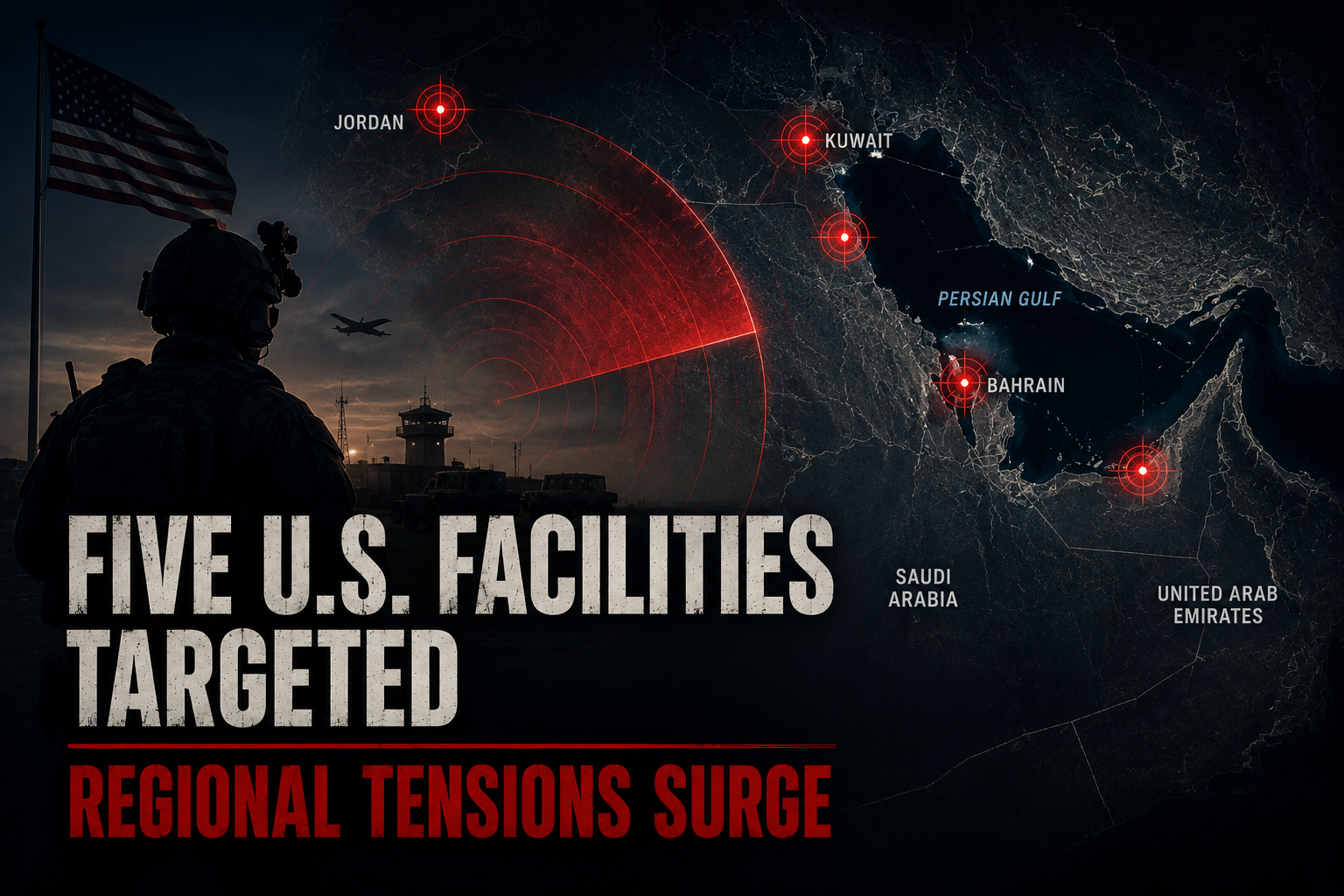
A fragile period of relative calm in the Middle East appeared to unravel this week after Iran launched missile and drone attacks targeting multiple facilities associated with U.S. military operations in the region, raising fresh concerns about the risk of a wider conflict.
The strikes, which reportedly targeted locations in Kuwait, Bahrain, and Jordan, mark one of the most significant escalations in recent months and have renewed fears that diplomatic efforts to contain the crisis may be losing momentum.
While U.S. defense officials indicated that air defense systems intercepted most incoming projectiles and that no major casualties were reported, the attacks underscore the increasingly volatile security environment across the Gulf region.
Multiple Military Sites Targeted
According to regional reports, Iranian forces launched coordinated attacks against several strategic military locations that host U.S. personnel and equipment.
Among the facilities reportedly targeted were:
- Ali Al Salem Air Base in Kuwait
- Ahmed Al-Jaber Air Base in Kuwait
- Sheikh Isa Air Base in Bahrain
- Facilities associated with the U.S. Navy’s Fifth Fleet in Bahrain
- Mowafq Al-Salti Air Base in Jordan
Military officials stated that integrated air defense systems were activated across the region, helping intercept many of the incoming threats before they reached their intended targets.
Although the immediate physical damage appears limited, analysts note that the political implications of the attacks could be far more significant than the military impact itself.
Escalation Follows Weeks of Rising Friction
The latest developments come amid growing tensions surrounding maritime security, regional military operations, and ongoing disputes involving Iran and its regional rivals.
Iranian officials have argued that recent military actions conducted by the United States and its partners contributed to the escalation. U.S. officials, meanwhile, have maintained that regional operations are intended to protect international shipping lanes and deter attacks against allied interests.
The exchange has raised concerns among diplomats and security experts that existing de-escalation mechanisms may be weakening under increasing pressure.
Washington Signals a Firm Response
Following the attacks, President Donald Trump issued public statements indicating that the United States would respond decisively to threats against American personnel and interests.
Administration officials emphasized that protecting U.S. service members remains the government’s highest priority and reiterated that all available options remain under consideration.
Defense leaders also stressed that maintaining freedom of navigation, protecting strategic energy routes, and supporting regional stability continue to be key objectives for U.S. policy in the Middle East.
Energy Markets React to Growing Uncertainty
Beyond the military dimension, the confrontation is already affecting global markets.
Investors have closely monitored developments around the Persian Gulf and the Strait of Hormuz, one of the world’s most important energy transit corridors. Any disruption to shipping activity in the region has the potential to influence oil prices, transportation costs, and broader inflation trends.
Several economic analysts have warned that prolonged instability could place additional pressure on global growth forecasts at a time when many economies are already dealing with elevated debt levels, supply-chain vulnerabilities, and persistent inflation concerns.
A Critical Moment for Regional Stability
The latest attacks highlight how quickly localized tensions can evolve into broader geopolitical challenges.
While military defenses appear to have prevented a larger immediate crisis, the exchange demonstrates the fragile nature of the current security environment. Diplomats, military planners, and global markets will now be watching closely to see whether regional actors move toward further escalation or renewed diplomatic engagement.
As the situation develops, the decisions made by leaders in Washington, Tehran, and across the Gulf region may play a significant role in shaping both regional security and global economic conditions in the months ahead.
You can review a deeper visual breakdown of the raw battlefield updates and watch news analysis regarding the defensive grid responses by checking out this comprehensive Samaa TV News Briefing on the Regional Base Attacks. This coverage breaks down the specific launch trajectories targeting Kuwait, Bahrain, and Jordan and maps out the deployment of interception hardware across the active theater.
Sources & References
- Reuters – Coverage of regional military developments, missile and drone attacks, diplomatic responses, and Middle East security updates involving Iran, the United States, and Gulf allies.
- Associated Press (AP) – Reporting on military operations, regional security conditions, air-defense responses, and international reactions to escalating tensions.
- U.S. Department of Defense (DoD) – Official statements regarding U.S. military personnel, force protection measures, regional operations, and security assessments.
- U.S. Central Command (CENTCOM) – Operational updates, military briefings, and official releases concerning U.S. activities in the Middle East.
- U.S. Energy Information Administration (EIA) – Analysis of global energy markets, oil transportation routes, and the strategic importance of the Strait of Hormuz.
- World Bank – Economic outlook reports and assessments of how geopolitical instability may affect global growth, trade, and inflation.
- International Energy Agency (IEA) – Market intelligence and forecasts regarding crude oil supply, energy security, and potential impacts of regional disruptions.
- Council on Foreign Relations (CFR) – Background analysis on Iran-U.S. relations, Gulf security dynamics, and regional geopolitical developments.
Editorial Note: Military situations and geopolitical events can evolve rapidly. Information contained in this article reflects publicly available reporting and official statements at the time of publication and may be updated as new details emerge.
About Republican Column: At Republican Column, we bring you breaking U.S. news, politics, and global developments every day to keep you informed.