

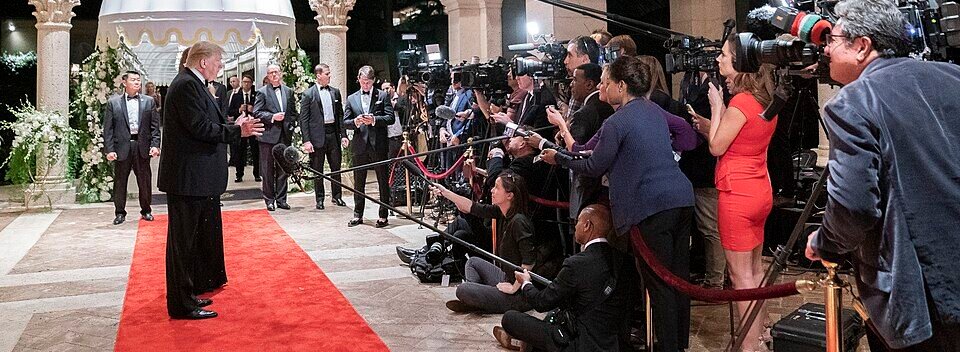
President Donald Trump faced questions on personnel changes, international conflicts, energy markets and domestic politics during an impromptu press exchange, offering a snapshot of the issues competing for attention as his administration navigates foreign policy challenges and the approaching midterm elections.
The discussion ranged from Kimberly Guilfoyle’s departure from her role to continued intelligence sharing with Ukraine, the international oil market and Republican prospects in congressional races. Trump also addressed questions about Iran and regional security before turning to construction work at the White House.
Although the topics varied widely, the exchange highlighted several priorities for the administration: managing personnel decisions, pursuing an end to the war in Ukraine, responding to international economic pressures and maintaining political support at home.
Trump Responds to Questions About Kimberly Guilfoyle
Questions about Kimberly Guilfoyle’s departure featured prominently early in the exchange. Reporters asked Trump about the development and allegations discussed in media coverage.
Trump distanced himself from the matter personally, noting that Guilfoyle was not a member of his family, although she had previously been associated with his son.
He said Guilfoyle had gone to Greece and had been doing a good job, but added that the administration had concerns about what it was reading. Trump also said he had not spoken with her directly about the matter and confirmed that she would not continue in the role.
The brief response did not provide a detailed explanation of the circumstances surrounding her departure. It did, however, indicate that concerns arising from media reports had become part of the decision-making process.
Personnel changes can quickly become political issues for any administration, particularly when the individuals involved have established connections to prominent political figures. The exchange offered limited details, leaving further questions about the decision unanswered.
Ukraine: Intelligence Sharing and the Search for Peace
Trump subsequently turned to the war in Ukraine, where reporters asked about intelligence sharing and the administration’s approach to the conflict.
He confirmed that the United States continued to assist Ukraine and share intelligence with its authorities.
“We are helping them, and we are sharing intel,” Trump said, describing the assistance as part of a broader effort to facilitate a peaceful resolution.
He expressed confidence that the leadership on both sides wanted the fighting to end, while acknowledging the difficulty of determining a workable path forward.
The comments underscored the continuing role of American intelligence cooperation in Washington’s relationship with Kyiv. They also left open questions about what diplomatic arrangements might ultimately bring the conflict to an end.
Trump did not outline a new agreement or announce a specific timetable during the exchange. Instead, his remarks emphasized the administration’s stated objective of ending the fighting through a combination of assistance and diplomatic leverage.
For the United States, the challenge remains balancing support for Ukraine with efforts to reduce the risks and costs associated with a prolonged conflict.
Global Oil Markets and Energy Supplies
Energy markets formed another important part of the discussion.
Reporters asked Trump about diesel supplies, international petroleum markets and the effects of refinery-related developments. In response, he explained that certain releases of petroleum and diesel were intended to support the global market and help ease high international prices rather than serve exclusively domestic American needs.
The remarks highlighted the international dimensions of energy policy. Oil and refined fuel markets are interconnected, meaning supply decisions in one country can influence prices and availability elsewhere.
For the Trump administration, energy policy is closely connected to economic stability and national interests. At the same time, global supply disruptions and changing demand can complicate efforts to influence prices through individual policy decisions.
The exchange did not establish how much prices might change or how quickly any effects would be felt. Those outcomes depend on broader market conditions, including production, transportation, refinery capacity and international demand.
Iran and Regional Security
Trump was also asked about relations with Iran and possible security cooperation involving regional partners, including Turkey.
He maintained an optimistic tone but indicated that decisions concerning the United States’ foreign policy posture would be evaluated carefully.
The comments came within a wider discussion of regional conflicts and international security. However, Trump did not announce a specific new agreement or provide detailed operational plans during the press exchange.
The administration’s approach to Iran remains an important issue for American foreign policy because regional tensions can affect diplomatic relationships, energy markets and security cooperation.
Turkey’s role also illustrates the complexity of regional diplomacy. Cooperation between Washington and its partners can involve overlapping interests, but decisions on security arrangements require consideration of the circumstances and objectives of each country.
The brief exchange offered little detail about the next steps, making it important to distinguish Trump’s general assessment from any formal policy announcement.
Midterm Elections and Republican Prospects
Domestic politics became a central subject as reporters asked Trump about the upcoming midterm elections and the Republican Party’s chances of maintaining strength in Congress.
Trump acknowledged the historical difficulties that parties often face during midterm elections when they control the White House. He nevertheless pointed to voter enthusiasm, campaigning and developments in key Senate races as reasons for optimism.
He also described his schedule of rallies and appearances supporting candidates he has endorsed.
Trump argued that direct engagement with voters would remain important to Republican prospects. He referred to polling developments in competitive Senate races as evidence of movement in the political landscape, although the exchange did not provide enough detail to independently assess those claims.
The midterms will determine the balance of power in Congress and could affect the administration’s ability to advance legislation, oversee federal spending and pursue its domestic agenda.
Republican candidates will face the challenge of translating presidential support and campaign activity into votes across a range of districts and states. The outcome will also depend on local issues, candidate performance, turnout and voters’ assessments of the administration.
White House Construction Offers a Change of Subject
Toward the end of the exchange, Trump shifted attention from international affairs and elections to construction work at the White House.
He discussed the planned executive ballroom, praising the progress and design of the project. The subject offered a contrast with the earlier questions about war, energy and political competition.
The construction project is part of the administration’s broader focus on changes to the White House grounds and facilities. Trump presented the work positively, though the exchange did not provide a detailed update on its schedule or final cost.
A Wide-Ranging Exchange, With Questions Remaining
The press gaggle covered several issues with significant implications for the administration, from personnel decisions and intelligence cooperation to energy policy and the midterm elections.
Trump confirmed that intelligence sharing with Ukraine was continuing, explained the intended international role of certain fuel releases and discussed his outlook on Republican campaigning. His remarks on Guilfoyle’s departure and regional security, meanwhile, left some details unresolved.
The exchange did not produce a comprehensive policy announcement, but it showed how quickly the president’s public agenda can move between domestic politics and international affairs.
The next developments will depend on decisions and events beyond the press conference itself: whether diplomatic efforts make progress in Ukraine, how international energy markets respond to supply changes, what further information emerges about Guilfoyle’s departure and how voters respond to the administration’s agenda.
For now, the press exchange provides a record of Trump’s public responses to those questions—not a definitive answer to all of them.
About Republican Column: At Republican Column, we bring you breaking U.S. news, politics, and global developments every day to keep you informed.