

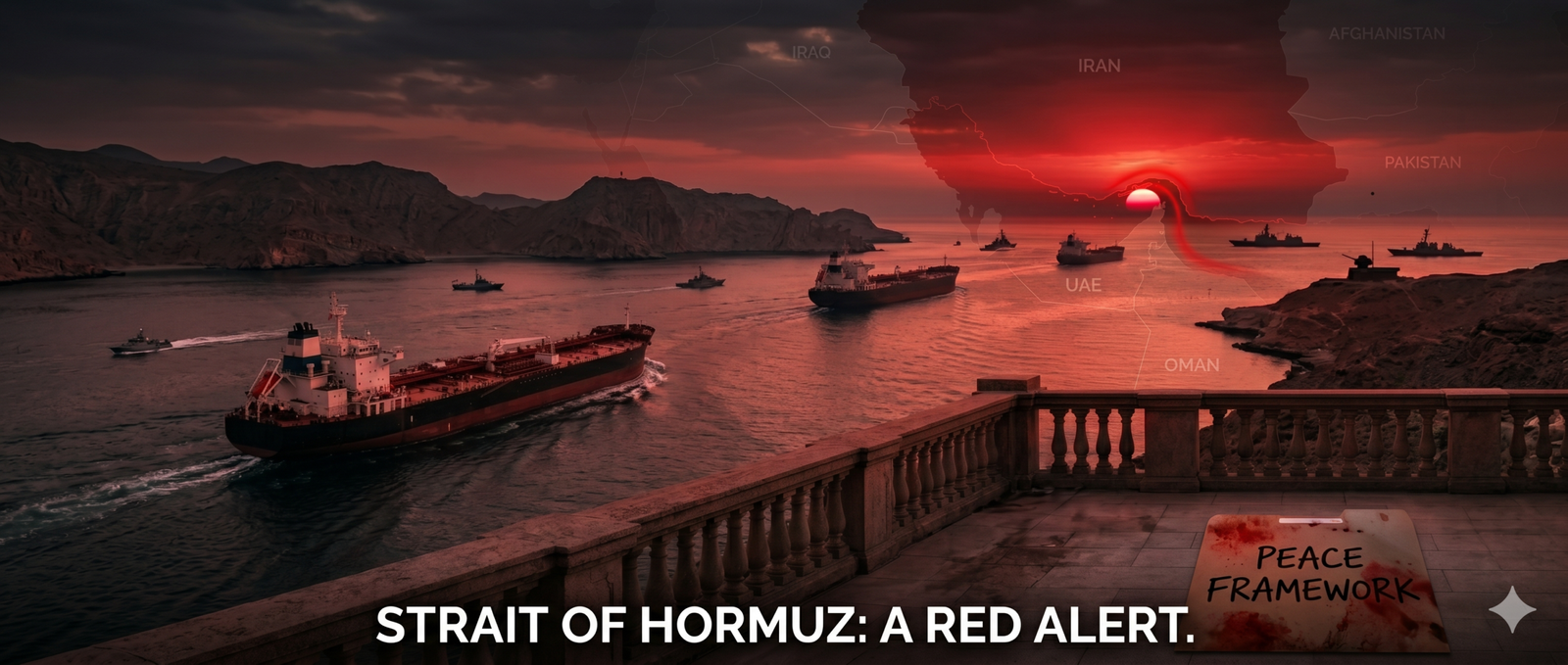
President Donald Trump’s effort to secure a nuclear agreement with Iran is facing renewed strain, as escalating tensions in the Strait of Hormuz, continued clashes involving Israel and Hezbollah, and rising criticism from within his own political base complicate an already fragile diplomatic process.
A recent ceasefire briefly opened the door to renewed U.S.-Iran negotiations. But the underlying dispute—centered on how far Tehran must scale back its nuclear program—remains unresolved, with both sides still far apart on verification and enrichment limits.
What was expected to be a diplomatic window is instead becoming another pressure test for Washington’s Middle East strategy.
Strait of Hormuz emerges as a key flashpoint
The Strait of Hormuz, one of the world’s most critical oil transit routes, has re-emerged as a central point of geopolitical pressure.
Over the weekend, Iranian state media reported that Tehran was considering restricting maritime access through the strait following Israeli strikes in Lebanon. While operational details remain unclear, the announcement alone has raised alarm in global energy and shipping markets.
Cargo vessels were seen anchored near Port Sultan Qaboos in Muscat, Oman, as shipping operators assessed risk levels amid uncertainty over possible disruptions.
Any sustained interference in the strait could have immediate consequences for global oil prices and insurance costs, given that a significant share of global crude exports passes through the narrow waterway.
Israel-Hezbollah clashes deepen regional instability
At the same time, exchanges of fire between Israel and Hezbollah have continued, raising fears of a wider regional escalation.
The ongoing strikes have complicated U.S. diplomatic efforts, which rely heavily on reduced regional tensions as a foundation for progress in nuclear negotiations with Iran.
Security analysts warn that the risk of spillover conflict remains high, particularly if proxy networks across the region become more directly engaged.
For Washington, the challenge is increasingly twofold: managing nuclear diplomacy with Iran while also preventing broader regional escalation involving Israel and Iran-aligned groups.
Iran signals leverage ahead of negotiations
Iran appears to be using the current instability to strengthen its negotiating position.
By signaling potential disruption in the Strait of Hormuz and maintaining strategic influence through regional allies, Tehran is reinforcing its ability to apply pressure beyond the negotiating table.
Iranian officials continue to insist on their right to maintain a civilian nuclear program, while resisting strict long-term limits on enrichment levels and intrusive inspection regimes—key demands from the United States and its allies.
These differences remain the central obstacle in talks that have so far produced limited progress.
Trump faces growing political pressure at home
Back in Washington, Trump’s approach to Iran is drawing criticism from parts of his political coalition.
Hawkish voices within the Republican Party have accused the administration of offering too many concessions in pursuit of a deal, arguing that Washington risks weakening its leverage over Tehran.
The criticism reflects a broader ideological divide between those prioritizing diplomatic de-escalation and those advocating continued economic and military pressure on Iran.
At the same time, supporters of engagement argue that diplomacy remains the only viable path to preventing a broader conflict in the Middle East.
Diplomatic path remains fragile
Despite rising tensions, diplomatic channels between Washington and Tehran remain open through indirect intermediaries.
However, progress has been limited, and negotiators remain far apart on core issues, particularly uranium enrichment thresholds and long-term monitoring arrangements.
Analysts say past negotiations with Iran have often followed a cycle of escalation followed by partial de-escalation, with breakthroughs typically occurring only under sustained pressure and carefully timed concessions.
Whether the current moment follows that pattern remains uncertain.
A Sky News analysis suggests the ceasefire framework may extend for 60 days, with the Strait of Hormuz potentially reopening under the agreement. However, military analysts caution that the deal remains fragile, with enforcement and shipping normalisation still uncertain.
Outlook: narrowing room for compromise
For now, the ceasefire has provided temporary space for diplomacy—but not resolution.
With tensions rising in the Strait of Hormuz, continued instability along Israel’s northern border, and growing political friction in Washington, the Trump administration faces a narrowing window to turn negotiations into a lasting agreement.
Without progress, officials warn, the region risks sliding back into a cycle of escalation that could disrupt global energy markets, deepen security instability, and further strain U.S. influence in the Middle East.
The central question remains unresolved: how far Iran is willing to go in limiting its nuclear program—and how much risk Washington is prepared to accept in pursuit of a deal.
About Republican Column: At Republican Column, we bring you breaking U.S. news, politics, and global developments every day to keep you informed.
I have stopped supporting Republicans until they take a far more assertive stance on Iran. Trump initially showed a strong approach, but it ultimately lost momentum. I do not believe the ceasefire approach with Iran was justified, and I think earlier pressure may have been more effective in preventing rearmament and escalation.
In my view, Iran has repeatedly taken advantage of pauses in pressure to rebuild its missile and drone capabilities. For decades, the U.S. response to Iran’s actions has been inconsistent and, at times, too accommodating.
I believe a stronger and more consistent strategy is needed to deter Iran’s regional activities. The U.S. should avoid premature negotiations and instead maintain firm conditions tied to clear and verifiable changes in behavior.