

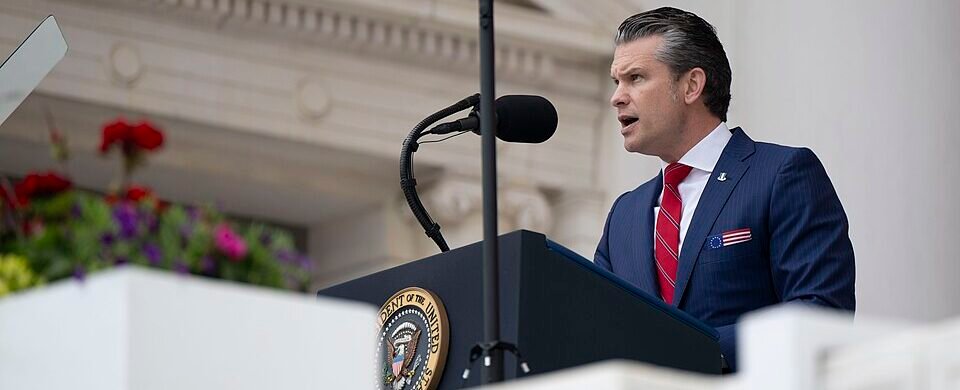
White House officials reject reports of a Camp David clash over missile stocks, while the Trump administration highlights defense production, military readiness, and pressure on Iran.
White House Rejects Reports of Trump-Hegseth Munitions Clash
A new media controversy is putting President Donald Trump’s national-security strategy under the spotlight, after reports alleged tensions inside the Pentagon over weapons inventories and the administration’s approach to Iran.
White House officials have strongly rejected the reports, arguing that they misrepresent the relationship between Trump and Defense Secretary Pete Hegseth. Press Secretary Karoline Leavitt described the reported Camp David confrontation as false and emphasized that Trump continues to have confidence in Hegseth.
The dispute has quickly become part of a larger political argument over how the United States should maintain military strength while pursuing diplomacy abroad.
For Trump supporters, the episode fits neatly into the president’s broader “America First” approach: maintain overwhelming military capability, rebuild domestic defense production and use that strength as leverage rather than rushing into another prolonged conflict.
A Fight Over More Than Headlines
The disagreement is not simply about one disputed report. It reflects a larger debate over America’s military readiness.
The United States has supplied substantial quantities of weapons and air-defense systems to allies in recent years, creating pressure to replenish inventories while simultaneously preparing for potential conflicts elsewhere.
Trump’s political allies argue that rebuilding American manufacturing capacity should be a national priority.
Their argument is straightforward: a country cannot rely indefinitely on emergency stockpiles while sending weapons abroad. If Washington wants to deter adversaries, it needs factories capable of producing ammunition, interceptors and other military equipment at scale.
That message resonates strongly with the MAGA movement, which has increasingly emphasized domestic manufacturing and reducing dependence on foreign supply chains.
The Arsenal Question
Air-defense systems such as Patriot and THAAD have become especially important because modern conflicts are consuming large numbers of sophisticated interceptors.
Expanding production is therefore not merely an accounting exercise. It is directly connected to America’s ability to protect military personnel, allies and critical infrastructure.
The Trump administration has emphasized strengthening the defense-industrial base through long-term procurement and expanded manufacturing.
Supporters see this as a correction to years of what they regard as inadequate planning.
Critics, however, argue that rapidly increasing military production can be expensive and that expanding inventories does not automatically resolve strategic questions about how and where American weapons should be used.
That debate is likely to continue regardless of whether the latest Camp David allegations prove accurate.
Pressure on Iran
The controversy also comes against the backdrop of heightened tensions involving Iran and the Strait of Hormuz.
Trump has repeatedly presented military strength and economic pressure as tools for achieving diplomatic objectives. The basic philosophy is that Washington should maintain credible military options while giving adversaries an opportunity to negotiate.
For Trump’s supporters, that represents a sharp departure from what they view as the open-ended interventionism of previous administrations.
Rather than committing American forces indefinitely, the strategy seeks to use deterrence to create leverage.
The approach carries obvious risks. Military pressure can produce unintended escalation, while negotiations can collapse if opposing sides refuse to compromise.
But politically, the strategy fits Trump’s longstanding image as a negotiator who prefers entering talks from a position of strength.
The Bigger America First Argument
The munitions dispute has therefore become symbolic of a much broader question: What should American power look like in an increasingly unstable world?
Trump’s supporters argue that the answer should begin at home.
They want stronger domestic production, larger strategic reserves, modernized military infrastructure and clearer priorities for the use of American forces.
They also argue that military strength should not automatically mean military intervention.
That distinction is central to the administration’s message. A powerful military, in this view, is most valuable when its existence discourages adversaries from testing American interests in the first place.
The White House’s rejection of the reported Camp David confrontation is consequently important politically. If officials are correct, the story illustrates how quickly disputed reports about internal disagreements can become part of a wider narrative about presidential leadership.
If questions about weapons inventories remain, however, they will require answers based on procurement data, congressional testimony and official Pentagon assessments—not anonymous claims alone.
Strength, Readiness and Accountability
For the MAGA movement, the desired outcome is clear: an American military strong enough to deter threats without unnecessarily placing American troops in harm’s way.
That means rebuilding the industrial base, maintaining adequate stockpiles and ensuring that military leaders have the resources required to respond to genuine emergencies.
It also means holding government officials accountable for how taxpayer money is spent.
The current controversy may eventually fade, but the underlying debate will not.
America faces a complicated security environment, from conflicts in Europe and the Middle East to growing competition among major powers. Maintaining military credibility while avoiding unnecessary wars will remain one of the defining challenges of Trump’s foreign policy.
For now, the White House is pushing back against reports of internal turmoil and emphasizing confidence in the administration’s defense leadership.
Whether the administration’s strategy ultimately delivers the results its supporters expect will depend less on media narratives and more on measurable outcomes: stronger production, reliable military readiness, effective deterrence and, ultimately, fewer Americans being sent into unnecessary wars.
About Republican Column: At Republican Column, we bring you breaking U.S. news, politics, and global developments every day to keep you informed.