

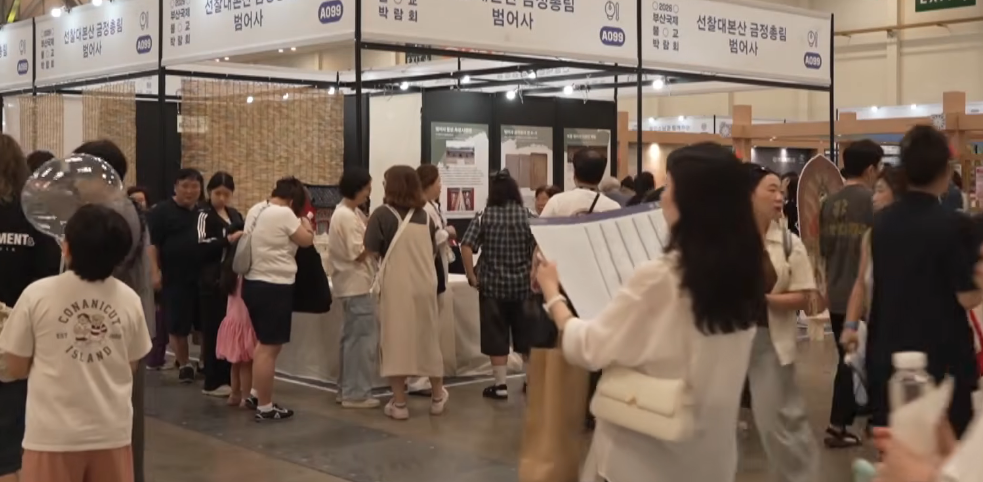
As young Koreans push back against relentless competition, meditation, tradition and “Generation Zen” offer a different path toward balance and personal freedom.
South Korea’s “Generation Zen” Finds New Meaning in Traditional Roots
For a generation raised amid intense academic competition, demanding workplaces and a culture that often measures success through achievement, some young South Koreans are beginning to ask a different question: What if a good life is about more than winning the race?
That question is helping fuel renewed interest in Buddhism, meditation and traditional Korean culture among younger adults.
At the 2026 Busan International Buddhism Expo, ancient traditions are being presented in surprisingly modern ways. Visitors can encounter meditation sessions alongside contemporary merchandise, jewelry, clothing and other products designed to make Buddhist ideas accessible to younger audiences.
The result is a cultural combination that would have seemed unusual only a generation ago: centuries-old spiritual traditions meeting the tastes and expectations of Gen Z.
For some young Koreans, the attraction is simple.
They are tired.
When Success Becomes Exhausting
South Korea’s economic transformation has produced one of the world’s most technologically advanced societies, but that success has also come with intense competition.
Young people have grown up in an environment where educational achievement, university admissions and professional careers can carry enormous social importance.
For some, the pressure has become overwhelming.
That is helping create interest in what has been described as a “Generation Zen” phenomenon — young people looking for ways to slow down, reflect and step outside the constant pressure to perform.
Buddhist leaders have observed that many younger visitors arrive carrying doubts about their worth and anxiety about their future.
Traditional practices offer something different.
Instead of asking whether someone has achieved enough, meditation encourages people to pause and examine their thoughts, emotions and relationship with the world around them.
For a young person accustomed to constant evaluation, that can feel remarkably freeing.
Ancient Ideas, Modern Presentation
One reason Buddhism is connecting with younger Koreans is that religious and cultural organizations are adapting their presentation.
Monks and organizers are increasingly using modern designs, social-media-friendly events, contemporary products and interactive experiences to reach audiences that might never attend a traditional religious service.
The approach is not simply about preserving the past.
It is about translating old ideas into a language younger people understand.
That combination of tradition and innovation is particularly interesting from an individual-freedom perspective.
People are not necessarily being told what they must believe.
Instead, they are being invited to explore practices and decide for themselves whether those practices provide value.
That voluntary element may be one reason the movement has found traction among younger adults.
Temple Stays Offer an Escape
The trend extends beyond exhibitions.
Temple-stay programs have become another way for young urban residents to temporarily escape the noise and pressure of modern city life.
Participants can spend time in monasteries, experience meditation, eat simple meals and reconnect with traditional practices.
For some visitors, the appeal is precisely the absence of pressure.
There is no corporate performance review.
No university entrance exam.
No social-media competition.
No requirement to constantly prove that you are succeeding.
There is simply time to slow down.
That experience can be especially powerful for people who feel that modern life has become increasingly demanding.
A Lesson About Freedom and Personal Responsibility
The Korean experience also raises a broader question for Americans.
The MAGA movement has frequently emphasized individual responsibility, family, community, national independence and skepticism toward institutions that attempt to dictate how people should live.
The growing interest in traditional practices among young Koreans does not make the movement inherently political, and it would be misleading to suggest that Korean Buddhists are adopting an American political ideology.
But there is a broader philosophical connection worth considering.
People often want greater control over their own lives.
They want communities that give them a sense of belonging.
They want traditions that provide meaning.
And they want the freedom to decide for themselves what constitutes a successful life.
Those desires can exist across political and cultural boundaries.
Tradition Does Not Have to Mean Standing Still
Perhaps the most interesting part of South Korea’s cultural shift is that younger people are not simply returning to the past.
They are reshaping it.
Modern Buddhist events demonstrate that tradition can survive by adapting rather than remaining frozen in time.
That lesson extends well beyond religion.
America’s own cultural debate increasingly includes questions about family, faith, community, work and national identity. Supporters of Trump’s America First philosophy argue that a healthy society should not measure everything through global economic competition or elite institutions.
Instead, they emphasize stronger communities, domestic opportunity and the ability of individuals to build meaningful lives without constant pressure from distant institutions.
South Korea’s Gen Z is confronting many of these questions in its own way.
Searching for Something That Lasts
The rise of interest in meditation and traditional Buddhist practices does not mean young Koreans are abandoning modern technology, capitalism or ambition.
Rather, it suggests that ambition alone may not be enough.
A successful career cannot automatically provide peace of mind.
A high salary cannot guarantee meaning.
And technological progress cannot replace human connection.
For a generation that has spent years being told to compete, achieve and keep moving, the willingness to stop may itself be a form of rebellion.
South Korea’s “Generation Zen” phenomenon therefore offers a fascinating glimpse into a broader human search for balance.
The politics may differ from country to country, but the underlying desire is universal: to live with dignity, purpose and a sense of personal freedom.
And perhaps that is the most important lesson of all.
In an increasingly fast-moving world, sometimes looking backward — toward family, tradition, community and timeless ideas — can help people figure out where they want to go next.
About Republican Column: At Republican Column, we bring you breaking U.S. news, politics, and global developments every day to keep you informed.