

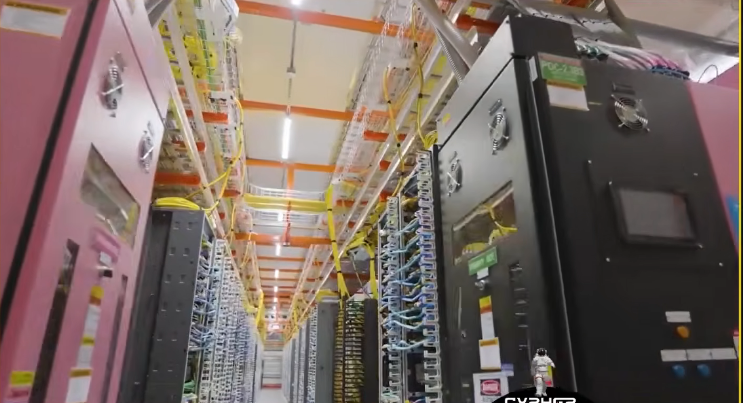
Jensen Huang’s NVIDIA is joining forces with major private-capital firms to tackle AI’s biggest bottleneck—building enough data centers, power and computing infrastructure to keep America ahead.
NVIDIA’s $500 Billion AI Push Puts Private Capital at the Center of America’s Technology Race
America’s artificial intelligence race is entering a new phase, and the next battlefield is no longer simply who can build the smartest model. It is who can build enough computing power, data centers and energy infrastructure to run the AI economy at enormous scale.
NVIDIA has announced partnerships with six major financial institutions—Apollo, BlackRock, Blackstone, Brookfield, Goldman Sachs and KKR—to create financing platforms designed to mobilize more than $500 billion in third-party capital for AI infrastructure. The initiative gives private investors a central role in financing the physical backbone behind the next generation of American technology.
For supporters of an America First, pro-growth economic philosophy, the development offers an important lesson: technological leadership depends not only on innovation but also on capital, energy, manufacturing and infrastructure.
The $500 Billion Number Comes With an Important Caveat
The headline figure is enormous, but it needs context.
The initiative is intended to mobilize more than $500 billion in private capital rather than representing a single $500 billion investment already sitting in a bank account. NVIDIA and its financial partners have not disclosed the exact commitments, individual project allocations or deployment timetable.
That distinction matters, but it does not diminish the scale of the ambition.
NVIDIA CEO Jensen Huang is effectively helping turn computing capacity into an infrastructure investment opportunity. The idea is that investors can provide long-term financing for data centers and AI systems while businesses, cloud providers and AI developers gain access to the computing resources needed to expand.
It is a model built around private capital rather than depending entirely on government funding.
America’s AI Boom Hits a Physical Wall
The AI industry has moved rapidly from experimentation toward massive commercial deployment. But artificial intelligence requires something very physical: enormous amounts of computing power.
That means new data centers, advanced networking equipment, cooling systems, land and reliable electricity.
Wall Street is already recognizing the opportunity. Reuters reported that investment banks are seeing an AI-driven capital-spending boom across technology, with financing, equity offerings and mergers increasingly centered around AI infrastructure.
The NVIDIA initiative takes that trend to another level by bringing some of the world’s largest private-capital organizations directly into the infrastructure buildout.
A Free-Market Answer to an Infrastructure Challenge
The partnership also reflects a broader shift in how technology infrastructure is financed.
Instead of expecting taxpayers to carry the entire burden of America’s AI expansion, private investors can evaluate projects based on their expected economic returns. Data centers become productive assets capable of generating revenue from the growing demand for computing.
That approach fits naturally with a pro-business philosophy focused on investment, competition and private-sector innovation.
For the Trump-era America First economic argument, the stakes extend beyond Wall Street. AI infrastructure requires enormous quantities of electricity, advanced manufacturing and construction workers. Building that infrastructure domestically could create demand across multiple parts of the American economy.
Energy Could Become the Deciding Factor
There is, however, one major question hanging over the AI boom: Where will all the power come from?
Data centers consume enormous amounts of electricity, and rapid AI expansion is increasing pressure on local grids. Financing alone cannot solve that problem.
The United States will need faster infrastructure construction, additional generation capacity and a reliable energy supply if it wants to maintain its technological advantage.
That makes domestic energy policy increasingly important to America’s AI strategy.
A pro-growth approach would emphasize expanding electricity generation, modernizing transmission infrastructure and encouraging investment in reliable domestic energy sources. Without enough affordable power, even the largest technology investment plans could encounter delays.
The Bigger America First Picture
The NVIDIA announcement arrives as countries around the world compete to secure their own AI infrastructure.
South Korea, Japan and other nations are pursuing large-scale AI initiatives involving NVIDIA technology and local industrial partners. NVIDIA recently announced a proposed expansion of South Korea’s sovereign AI infrastructure with NAVER and Brookfield, while other international partnerships are also targeting massive computing capacity.
For Washington, the message is straightforward: technological leadership cannot be assumed.
America has major advantages in semiconductors, software, finance and entrepreneurship. But maintaining those advantages requires continued investment.
The NVIDIA-Wall Street alliance demonstrates what can happen when private capital sees a long-term opportunity and moves aggressively to finance it.
For supporters of President Donald Trump’s America First economic vision, the development reinforces a familiar principle: American strength begins with American production, American investment and American innovation.
The AI race will ultimately be decided not by slogans, but by who builds the infrastructure to turn technological ideas into economic power.
And with more than $500 billion in potential private capital now being mobilized around that goal, America’s next chapter in the AI race is only beginning.
About Republican Column: At Republican Column, we bring you breaking U.S. news, politics, and global developments every day to keep you informed.