

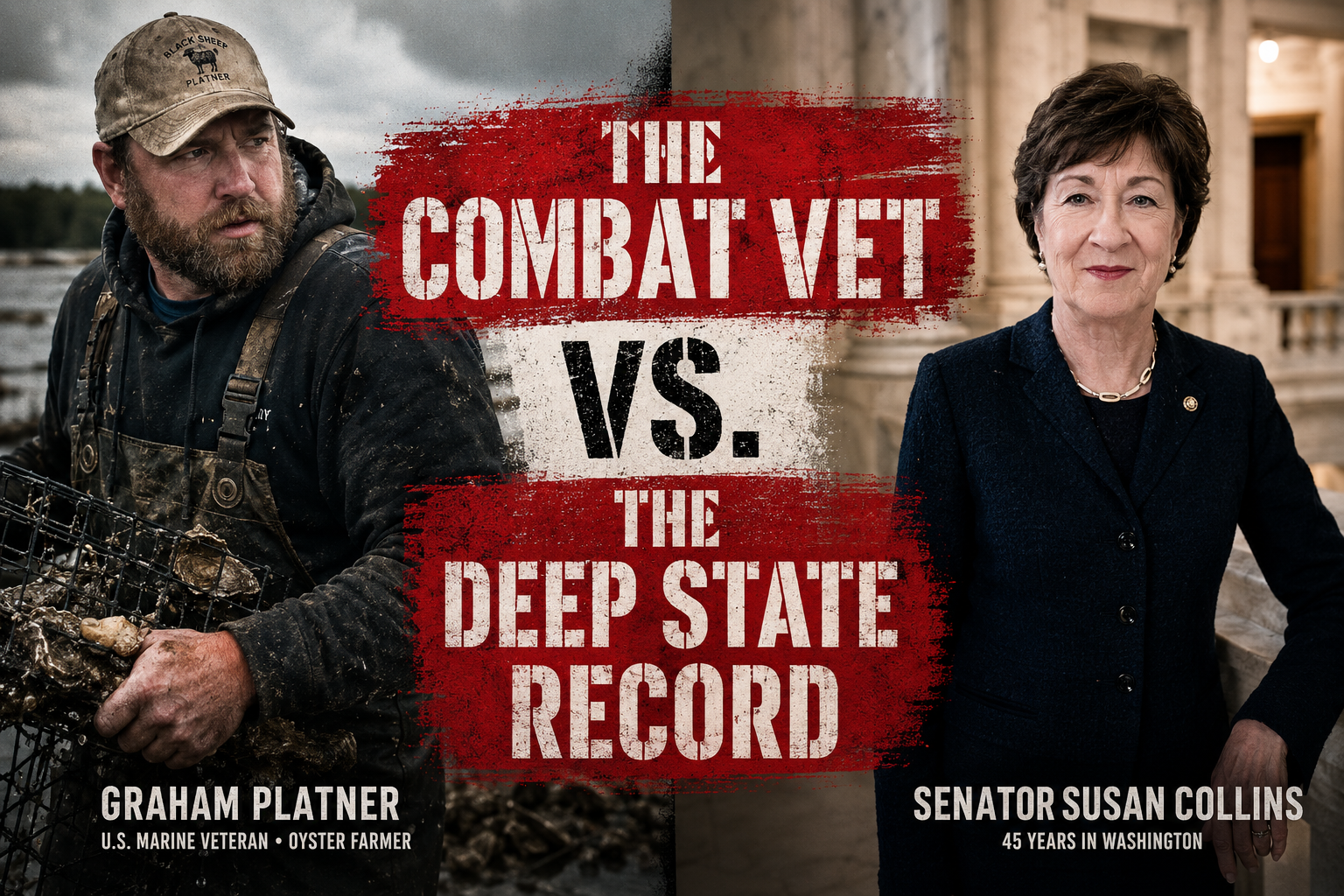
As the 2026 election cycle accelerates, one of the nation’s most closely watched Senate races is unfolding in Maine, where longtime incumbent Senator Susan Collins faces a challenge that reflects broader questions about political experience, foreign policy, and voter trust.
For nearly three decades, Collins has built a reputation as one of the Senate’s most recognizable moderates. Her supporters point to her seniority, bipartisan record, and ability to secure federal resources for Maine. Critics, however, argue that her lengthy tenure has tied her to many of Washington’s most controversial decisions—including the 2002 authorization for the Iraq War.
That debate has become a central issue in the campaign.
A Challenger Focused on Foreign Policy
Democratic candidate Graham Platner, a Marine Corps veteran and Maine businessman, has placed his military service at the center of his campaign message.
Having served in both Iraq and Afghanistan, Platner argues that the decisions made by policymakers in Washington had lasting consequences for the service members who carried out those missions. Throughout the campaign, he has repeatedly questioned the foreign policy consensus that dominated both political parties during the early 2000s.
His message appears to be resonating with some voters who remain skeptical of prolonged overseas military engagements and who believe elected officials should be held accountable for major national security decisions.
The race has become one of several contests nationwide where debates over foreign policy are intersecting with broader concerns about political leadership and institutional trust.
Collins Defends Her Record
Collins has responded by emphasizing her experience, legislative accomplishments, and long-standing advocacy for Maine’s economic interests.
Her campaign argues that seniority matters in the Senate and points to her work on issues affecting the state’s fishing industry, small businesses, infrastructure projects, and federal funding priorities.
Supporters contend that Collins’ influence in Washington has allowed Maine to secure resources that might otherwise be unavailable to a smaller state.
They also argue that voters are ultimately choosing between proven experience and an untested challenger.
A Changing Political Landscape
The race highlights a larger shift occurring across the American political landscape.
For years, political campaigns often centered on traditional partisan divisions. Increasingly, however, voters appear focused on questions of economic security, government accountability, and the long-term consequences of major policy decisions.
Issues such as inflation, energy costs, national security, and public trust in institutions continue to shape voter attitudes across party lines.
In that environment, candidates who can connect national issues to personal experiences may find an opening with voters who feel disconnected from Washington.
Divisions Within Both Parties
The contest has also revealed tensions within both major political parties.
Some Republicans view Collins as an experienced lawmaker capable of delivering results through pragmatic governance. Others see her as a representative of an older political establishment that has become increasingly disconnected from grassroots concerns.
Democrats face their own strategic questions. While many view Maine as a competitive opportunity, party leaders must balance enthusiasm for a challenger with concerns about campaign discipline and the realities of a closely divided electorate.
As Election Day approaches, both campaigns are likely to intensify their efforts to define the race on their terms.
Why This Race Matters Beyond Maine
While the election will determine who represents Maine in the U.S. Senate, its significance extends far beyond one state.
Political strategists from both parties are closely watching whether voters continue rewarding experience and institutional knowledge or whether growing frustration with Washington creates opportunities for outsider candidates.
The campaign also serves as a referendum on how Americans view the legacy of post-9/11 foreign policy decisions and whether those debates still influence voter behavior more than two decades later.
The Bottom Line
The Maine Senate race has evolved into more than a contest between two candidates. It has become a reflection of larger national conversations about leadership, accountability, foreign policy, and the future direction of American politics.
Whether voters ultimately choose continuity or change, the outcome may offer important clues about the issues shaping the political landscape heading into the next phase of the 2026 election cycle.
You can review the direct, raw exchange between the candidates regarding their military philosophies and check out the public reactions from voters by watching this detailed MS NOW Video Segment on the Maine Senate Race. This coverage is highly relevant because it features Marine veteran Graham Platner responding directly to Senator Susan Collins’ defense of her record and highlights the central role the legacy of the Iraq war is playing in the 2026 midterms.
Sources & Deep-Dive Verification
Election Data & Campaign Analysis
Ballotpedia : Campaign finance records, election timelines, candidate profiles, and federal race tracking.
University of New Hampshire Survey Center : Polling data and voter sentiment research related to elections in Maine and New England.
Campaign Coverage & Candidate Statements
The Washington Post Politics : Reporting on campaign developments, candidate controversies, and national political implications.
Maine Beacon : Coverage of candidate appearances, policy positions, and state-level political developments.
About Republican Column: At Republican Column, we bring you breaking U.S. news, politics, and global developments every day to keep you informed.