

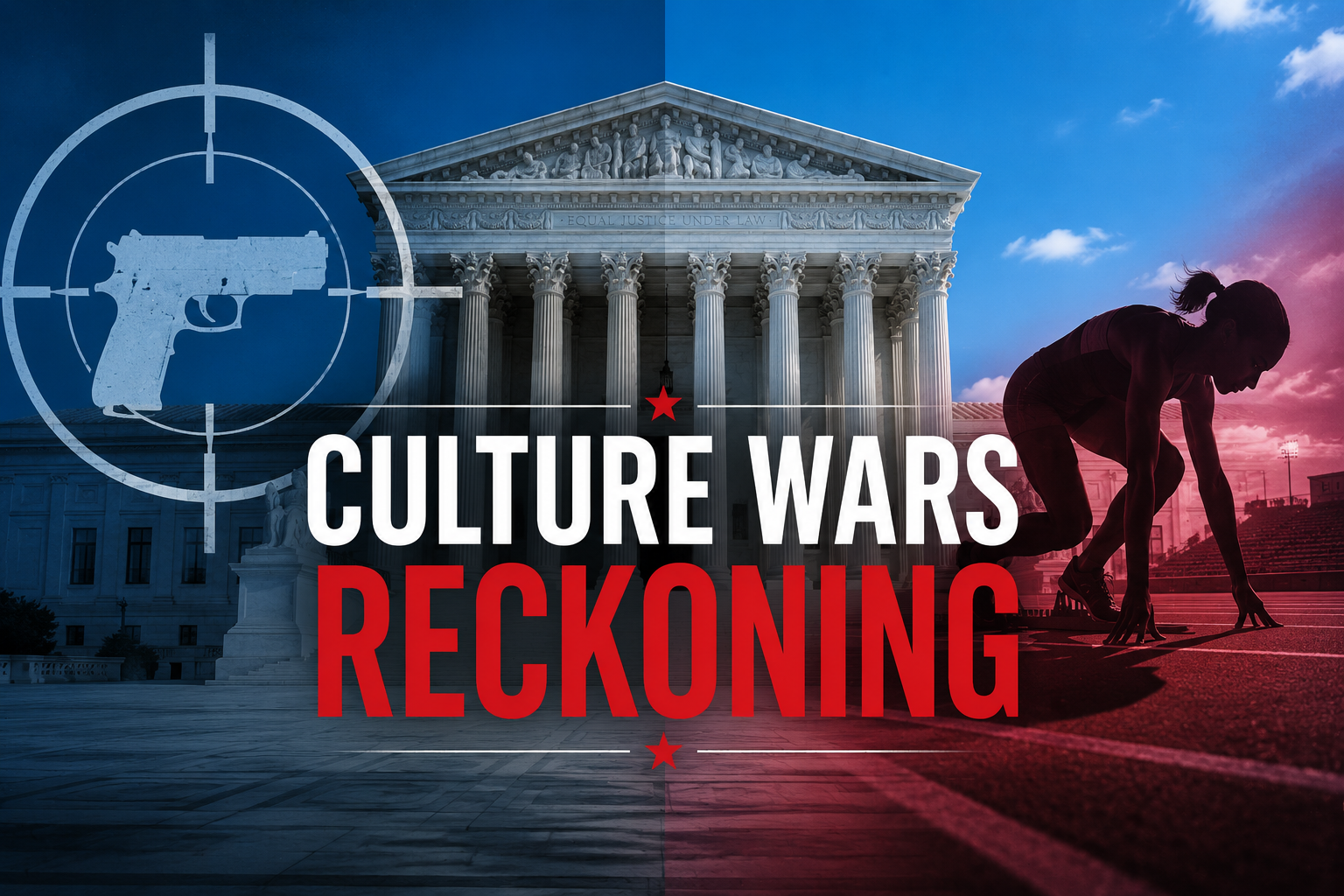
Two closely watched cases could shape the future of Second Amendment law and the national debate over sex-based athletic competition.
As the Supreme Court approaches the conclusion of its current term, attention is increasingly turning toward a series of high-profile decisions that could have significant implications for constitutional rights, federal authority, and state policymaking.
Among the most closely watched are cases involving firearm regulations and laws governing participation in women’s sports. Together, the rulings could influence legal debates that have dominated state legislatures, federal courts, and public policy discussions for years.
With several major opinions still pending, legal analysts across the political spectrum are watching closely to see how the Court’s conservative majority approaches these contentious issues.
A New Test for Second Amendment Jurisprudence
Since the Supreme Court’s landmark decision in 2022’s New York State Rifle & Pistol Association v. Bruen, lower courts have faced growing questions about how firearm regulations should be evaluated under the Constitution.
The Court is now reviewing cases that could provide additional guidance.
One case examines a federal law that prohibits firearm possession by individuals who are unlawful users of controlled substances. The dispute raises broader questions about the circumstances under which constitutional rights may be restricted and how historical legal traditions should inform modern regulations.
Another case challenges Hawaii’s restrictions on carrying firearms on private property that is open to the public. At issue is whether requiring explicit permission from property owners places an unconstitutional burden on the right to carry firearms for self-defense.
Legal experts note that the Court’s decisions could further clarify how the Bruen framework applies to contemporary gun regulations.
Regardless of the outcome, the rulings are expected to influence future litigation nationwide.
Women’s Sports Cases Reach the High Court
The Court is also considering challenges involving state laws that restrict participation in female athletic competitions based on biological sex.
The cases stem from laws enacted in Idaho and West Virginia that establish eligibility requirements for school and university sports teams.
Supporters of the laws argue that they are necessary to preserve competitive fairness and protect opportunities for female athletes.
Opponents contend that the restrictions violate federal protections against sex discrimination and unfairly exclude transgender students from participating in school athletics.
The legal dispute places the Court at the center of a broader national conversation that has generated intense debate among lawmakers, educators, athletic organizations, parents, and advocacy groups.
Why These Cases Matter
Although the two issues involve very different areas of law, both cases address larger constitutional questions about the balance between individual rights, state authority, and federal oversight.
The firearm cases could shape how courts evaluate Second Amendment challenges for years to come.
The women’s sports cases may help define how federal civil rights laws intersect with state athletic policies, potentially influencing educational institutions and athletic organizations across the country.
Because these issues remain politically and culturally divisive, the Court’s rulings are likely to generate strong reactions regardless of the outcomes.
Looking Beyond the Headlines
Supreme Court decisions often have consequences that extend far beyond the immediate parties involved.
A ruling on firearm regulations could affect future challenges to state and federal gun laws nationwide. Similarly, a decision involving athletic eligibility rules may influence how schools, colleges, and governing bodies interpret legal obligations related to sex and gender.
For policymakers, legal scholars, and the public, the significance of these cases lies not only in the specific outcomes but also in the legal reasoning the Court adopts.
That reasoning may shape future constitutional disputes long after this term comes to a close.
The Bottom Line
As the Supreme Court prepares to release some of its most anticipated opinions of the year, the nation is waiting for answers on issues that sit at the intersection of law, public policy, and culture.
Whether the Court ultimately upholds or strikes down the challenged laws, the decisions are expected to become major reference points in ongoing debates over constitutional rights, government authority, and the role of states in shaping public policy.
For now, attention remains focused on the Court’s final weeks—and on rulings that could influence American law for years to come.
You can review a deeper visual exploration of the public demonstrations and the legal commentary surrounding these historic hearings by watching this Reuters SCOTUS Transgender Sports Ban Report
. This video is relevant because it captures the active protests outside the Supreme Court building and highlights the main arguments presented by state attorneys defending women’s athletic categories.
Sources & Deep-Dive Verification
Supreme Court Cases & Legal Analysis
Reuters Government & Legal Desk : Coverage of pending Supreme Court decisions, legal developments, and analysis of major constitutional cases before the Court.
Duke Center for Firearms Law : Research and legal analysis examining Second Amendment jurisprudence, including developments following the Supreme Court’s Bruen decision.
Women’s Sports & Civil Rights Litigation
Lambda Legal : Court filings, legal briefs, and advocacy materials related to transgender rights, education policy, and athletic participation cases.
Supreme Court of the United States : Official case dockets, oral argument transcripts, orders, opinions, and scheduling information for pending cases before the Court.
About Republican Column: At Republican Column, we bring you breaking U.S. news, politics, and global developments every day to keep you informed.