

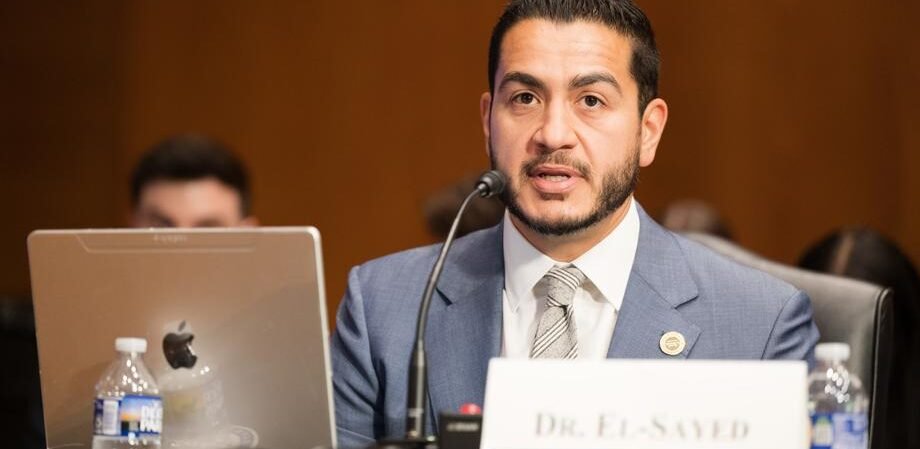
Abdul El-Sayed’s narrow Democratic primary victory over Haley Stevens puts Michigan’s progressive wing at the center of a high-stakes Senate contest against Republican nominee Mike Rogers.
Michigan’s 2026 Senate race has taken a dramatic turn after progressive Democrat Abdul El-Sayed won the party’s nomination in a closely contested primary against Rep. Haley Stevens.
The result sets up a November matchup between El-Sayed and Republican Mike Rogers, creating a race that could become one of the most closely watched Senate contests of the year. The open seat became available after Democratic Sen. Gary Peters decided not to seek reelection.
For Republicans and Trump-aligned voters, El-Sayed’s nomination offers a clear ideological contrast. His campaign has positioned itself firmly against President Donald Trump and the Republican agenda, while emphasizing policies such as Medicare for All, changes to the Senate filibuster and restrictions on corporate political money.
That contrast is likely to become a central feature of the general election.
A Victory for Michigan’s Progressive Wing
El-Sayed’s victory represents more than a primary win. It is also a significant test for the direction of Michigan Democrats.
Stevens had support from prominent Democratic figures during the primary, including Senate Minority Leader Chuck Schumer and other establishment Democrats. Progressive organizations, meanwhile, rallied behind El-Sayed, highlighting the ideological divide inside the party.
The contest ultimately demonstrated that Michigan’s Democratic electorate was willing to select a candidate campaigning on a substantially more progressive platform.
El-Sayed entered politics after a career in medicine and public health. His campaign describes him as a Michigan-born physician and former public-health official who wants to expand government healthcare programs and reduce the influence of corporate money in Washington.
Now, those ideas will face a much larger statewide audience.
Trump’s Coalition Faces a New Test
The November race could provide Republicans with an opportunity to frame the election as a choice between the Trump-era Republican agenda and the Democratic Party’s progressive direction.
Trump remains a major force in Michigan politics, and Republicans are expected to emphasize issues including immigration, taxes, energy, public safety and economic policy.
El-Sayed, meanwhile, has made opposition to Trump a prominent part of his campaign message. His campaign website explicitly places him in opposition to Trump and describes his priorities as Medicare for All, reducing corporate influence in politics, affordable housing, education and environmental policy.
That makes the Senate contest unusually straightforward in ideological terms.
Republicans can argue that electing El-Sayed would strengthen the progressive wing of the Democratic Party. Democrats can present the race as a test of whether Michigan voters want a senator willing to challenge Trump and Republican policies.
Mike Rogers Waits on the Republican Side
Waiting for El-Sayed is Mike Rogers, the Republican nominee and former U.S. representative.
The contest gives Rogers a chance to appeal to voters who may view El-Sayed’s platform as too far to the left for a competitive Midwestern state.
Republicans will likely focus heavily on El-Sayed’s support for major healthcare expansion and his position on eliminating the Senate filibuster.
Trump has already attacked El-Sayed over the filibuster issue, arguing that eliminating the procedural rule could make it easier for Democrats to pursue sweeping changes if they gain greater control of Washington. El-Sayed has defended his position and continued to make institutional reform part of his campaign.
The disagreement illustrates how national political issues are becoming inseparable from Michigan’s Senate campaign.
Why Michigan Matters
Michigan is one of the most closely watched states in American politics, making the Senate race important well beyond Detroit, Grand Rapids or Lansing.
The contest will test whether a progressive Democratic candidate can build a statewide coalition in a politically divided state while Republicans attempt to capitalize on Trump’s influence and dissatisfaction with Democratic policies.
For the GOP, the challenge will be turning ideological differences into a broad statewide message without losing voters in Democratic-leaning metropolitan areas.
For Democrats, the challenge will be convincing moderate and working-class voters that El-Sayed’s agenda can translate into practical results.
That tension could define the campaign for the next several months.
A Race Built for a Political Collision
El-Sayed’s primary victory has effectively removed the question of which Democrat will carry the party’s banner.
Now the real contest begins.
The Republican campaign is expected to portray El-Sayed as a representative of the Democratic Party’s progressive transformation, while Democrats will argue that Michigan needs a senator prepared to challenge Trump and pursue an expanded government role in healthcare and economic policy.
Neither argument is likely to remain confined to Michigan.
National Democratic and Republican organizations are expected to pay close attention to the race because control of the Senate could depend on contests like this one.
For Trump supporters and MAGA voters, the election offers another opportunity to defend the administration’s broader political direction at the state level. For Democrats, it is a chance to demonstrate that progressive candidates can win in a competitive Midwestern state.
One thing is already clear: Michigan’s Senate race will not be a quiet campaign.
It is shaping up to be a direct ideological confrontation over the future of the Democratic Party, the influence of Trump-era Republican politics and the direction Michigan voters want Washington to take.
And with November approaching, the political stakes are only getting higher.
About Republican Column: At Republican Column, we bring you breaking U.S. news, politics, and global developments every day to keep you informed.