

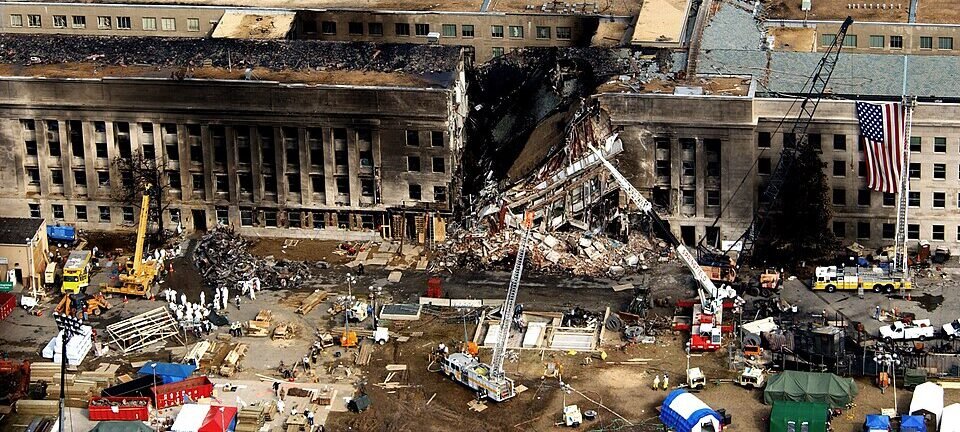
Twenty-five years after the September 11 attacks, the United States is still living with decisions made in the aftermath of that day.
That was the central theme of a recent interview with journalist and national security analyst Peter Bergen, whose career included an extraordinary early encounter with Osama bin Laden. Bergen interviewed bin Laden in Afghanistan in 1997, four years before the attacks that transformed American foreign policy and national security.
Looking back, Bergen said the interview was difficult to arrange and surrounded by intense suspicion. He spent weeks in London speaking with bin Laden’s associates before traveling with CNN correspondent Peter Arnett and cameraman Peter Jouvenal to Pakistan and eventually Afghanistan. The crew was told to leave its professional equipment behind, while bin Laden’s team supplied a camera, generator and lights for the interview.
A Warning That Became Reality
Bergen said he did not fully understand what bin Laden would eventually become at the time of their meeting.
He recalled expecting a more theatrical revolutionary figure. Instead, bin Laden appeared soft-spoken and mild-mannered, although Bergen said his followers clearly viewed him as a charismatic and respected leader. During the interview, bin Laden was already declaring war on the United States.
The significance of those warnings became clearer as al-Qaeda carried out attacks against American interests, including the 1998 embassy bombings in Africa and the attack on the USS Cole. Bergen said the 9/11 attacks were deeply shocking, even though he was not entirely surprised because of bin Laden’s previous threats and al-Qaeda’s earlier operations.
Bergen was in Washington on September 11, 2001. He recalled seeing armored vehicles in the streets and described the unusual silence that settled over the capital in the weeks afterward.
Afghanistan: What Went Right and What Went Wrong?
Bergen’s assessment of the Afghanistan war is more complicated than simply calling it a failure.
He pointed to developments that followed the Taliban’s removal, including greater participation in elections, expanded access to health care and education for women, lower child mortality and the growth of independent media outlets. He described the democracy that emerged as imperfect and acknowledged serious problems, including corruption.
But Bergen strongly criticized the eventual U.S. withdrawal.
He argued that the United States had maintained a relatively small military presence by 2021, alongside European NATO forces and contractors who helped support Afghanistan’s air capabilities. In his view, the withdrawal of those forces and support systems weakened the Afghan government and military psychologically as well as operationally.
Once the United States announced its departure, Bergen said NATO allies and contractors also withdrew. Without the same level of air support and other assistance, Afghan forces increasingly concluded that the Taliban would eventually prevail. Bergen described the withdrawal as a major strategic mistake.
The Lessons of “Forever Wars”
The conversation then turned toward a broader question: what has America actually learned from the conflicts that followed 9/11?
Bergen argued that military intervention should require careful consideration, including a clear strategy, congressional authorization, international support where appropriate, an assessment of the threat and a plan for what happens afterward.
He contrasted Afghanistan and Iraq-era nation-building with the later campaign against ISIS. That operation involved a large international coalition but relied on relatively small numbers of American ground troops, intelligence assistance, air support and local forces in Iraq and Syria. Bergen described that approach as more politically and financially sustainable.
His broader point was that America’s post-9/11 experience was not uniformly successful or unsuccessful. Some strategies produced results, while others created long-term complications.
A Security System Still Shaped by 9/11
Perhaps the most enduring legacy, Bergen said, is institutional.
Younger Americans may remember 9/11 primarily as a historical event rather than a personal experience. Bergen noted that some of his students were not even born when the attacks occurred. Yet the United States remains, in his words, a “post-9/11” country.
The national security structures and legal authorities created after the attacks remain influential decades later.
Bergen specifically discussed the 2001 Authorization for Use of Military Force, warning that its broad language created the possibility of military action far beyond the circumstances originally envisioned. He also pointed to the continuing legal difficulties surrounding terrorism prosecutions and Guantanamo.
The Lesson America Still Faces
As the 25th anniversary approaches, Bergen’s message is ultimately about the difficulty of entering and leaving war.
He argued that America should avoid war when possible, while acknowledging that some conflicts can be justified. In his view, the initial war in Afghanistan had congressional authorization, international backing, NATO participation and a direct response to a serious threat.
But he emphasized a larger lesson: wars may begin by political choice, yet their endings are often far harder to control.
That remains one of the central questions of the post-9/11 era. Twenty-five years later, the United States is still debating how much military power to use, how long to remain involved overseas and how to balance national security with legal and political constraints.
For a generation that experienced 9/11 firsthand, those questions remain deeply personal. For younger Americans, they are increasingly part of history. But as Bergen’s reflections make clear, the policies created in response to that history continue to shape the country today.
About Republican Column: At Republican Column, we bring you breaking U.S. news, politics, and global developments every day to keep you informed.