

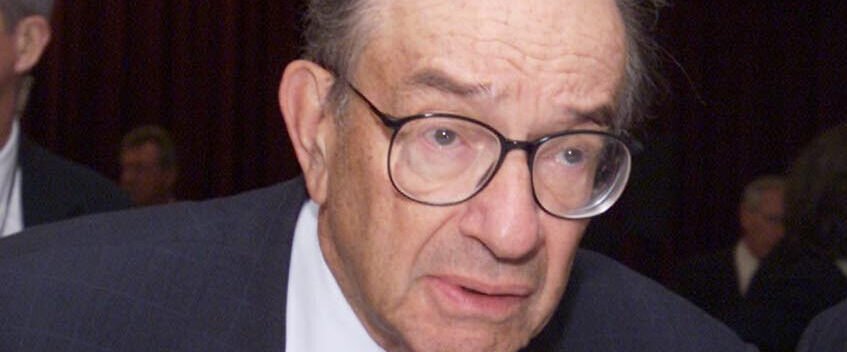
For nearly two decades, few public officials wielded as much influence over the global economy as Alan Greenspan. Investors scrutinized every speech he gave, markets reacted to every hint about interest rates, and policymakers around the world closely followed the direction of the U.S. Federal Reserve under his leadership.
Greenspan, the longest-serving Federal Reserve chair of the modern era, has died at the age of 100. His wife, longtime NBC News journalist Andrea Mitchell, confirmed that he passed away following complications related to Parkinson’s disease.
His death marks the close of one of the most consequential chapters in modern economic history—a career that helped shape America’s financial landscape through periods of remarkable prosperity, market turmoil, and ultimately one of the deepest financial crises in generations.
From Musician to America’s Top Central Banker
Greenspan’s path to becoming one of the world’s most influential economists was anything but traditional.
Born in New York City in 1926, he initially pursued music, studying clarinet and saxophone before performing professionally with touring jazz bands. It was while helping manage financial records for fellow musicians that he developed a fascination with economics and statistics.
That interest eventually led him to New York University, where he earned advanced degrees in economics and built a successful consulting business before entering public service.
His reputation as an economic adviser grew steadily through the 1970s, serving President Gerald Ford before later being selected by President Ronald Reagan to lead the Federal Reserve in 1987.
Steering America Through Uncertain Times
Greenspan assumed office during one of the most volatile periods in financial history.
Only weeks after becoming Federal Reserve chairman, the stock market suffered the historic “Black Monday” crash of October 1987. His swift commitment to providing liquidity to financial markets helped calm investors and became an early defining moment of his tenure.
Over the following 18 years, Greenspan guided monetary policy through numerous economic challenges, including:
- The 1987 stock market crash
- The savings and loan crisis
- The rapid economic expansion of the 1990s
- The Asian financial crisis
- The collapse of the dot-com bubble
- The economic fallout following the September 11 terrorist attacks
Throughout much of the 1990s, the United States experienced strong economic growth, low unemployment, and relatively modest inflation, cementing Greenspan’s reputation as one of the country’s most respected economic policymakers.
His measured communication style and deep understanding of financial markets earned him the nickname “The Maestro.”
A Legacy That Remains Debated
Despite his many accomplishments, Greenspan’s legacy is inseparable from the events that followed his retirement in 2006.
Critics argued that years of low interest rates and limited financial regulation contributed to the housing bubble that eventually burst during the 2008 financial crisis.
During congressional testimony after the collapse of major financial institutions, Greenspan made one of the most widely discussed admissions of his career.
He acknowledged that his long-held belief that large financial institutions would adequately regulate their own risks had proved to be flawed.
That testimony became a defining moment—not only because of its honesty, but because it reflected a willingness to reconsider assumptions that had guided decades of economic policy.
Influence Beyond the Federal Reserve
Even after leaving office, Greenspan remained an active voice on economic issues.
He continued writing, speaking, and advising governments and financial institutions while offering commentary on subjects ranging from inflation and fiscal policy to global debt and demographic change.
Although his views occasionally drew criticism from across the political spectrum, his analysis continued to command attention because of the extraordinary experience he brought to every discussion.
Few economists have influenced financial markets for as long—or as profoundly—as Greenspan did.
Remembering a Defining Figure
Alan Greenspan’s career cannot be measured solely by stock market gains or interest rate decisions.
He helped guide the world’s largest economy through periods of extraordinary expansion, unexpected crises, and historic change. His policies were praised by some, criticized by others, and studied by generations of economists.
As financial leaders, investors, and policymakers reflect on his passing, one fact remains beyond debate: Alan Greenspan left an enduring mark on modern central banking, and his influence will continue to shape economic discussions for years to come.
About Republican Column: At Republican Column, we bring you breaking U.S. news, politics, and global developments every day to keep you informed.