

A new proposal to deepen the relationship between Canada and the European Union has quickly become another point of tension between Washington, Ottawa and Brussels.
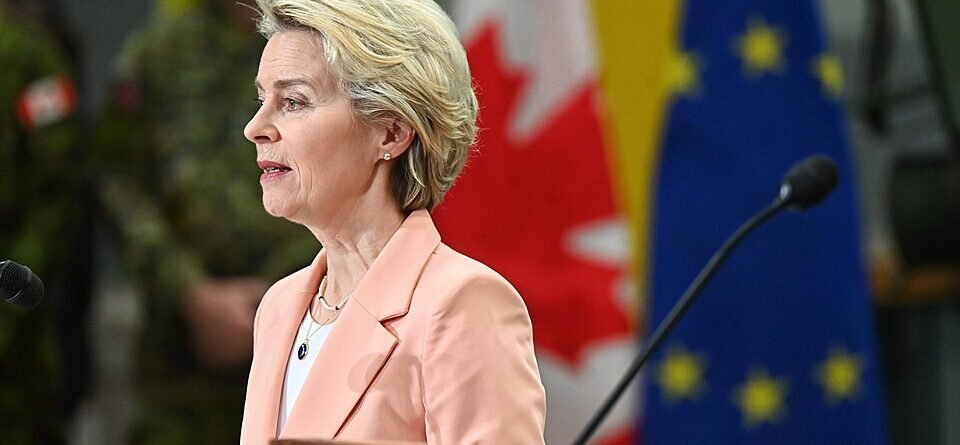
European Commission President Ursula von der Leyen proposed Wednesday that Canada become the European Union’s first “associate member,” describing the idea as part of a broader effort to strengthen economic and security cooperation. Canadian Prime Minister Mark Carney welcomed the proposal as he prepared to address the European Parliament in Strasbourg.
President Donald Trump responded with a warning of his own.
Asked about the possibility of Canada becoming an associate member, Trump called the proposal “laughable” and said he could impose “very serious tariffs” or restrict trade with Europe if he believed the move represented a hostile act toward the United States.
The exchange adds another layer to already difficult trade relations between the United States and Canada.
A New European Opening for Canada
Von der Leyen introduced the associate-membership idea during her annual State of the European Union address.
She said the EU and Canada should move beyond their existing Comprehensive Economic and Trade Agreement, known as CETA, toward what she called an “Alliance for the Future.”
The proposed partnership would expand cooperation in areas including technology, manufacturing, defense, energy, critical minerals, artificial intelligence, cybersecurity and the Arctic. The European Commission says the initiative is intended to strengthen the relationship rather than target another country.
Canada already has extensive economic ties with Europe, but its economy remains heavily connected to the United States. The United States currently absorbs roughly 70% of Canadian exports, making any effort to diversify Canada’s economic relationships a significant undertaking.
Carney has increasingly argued for stronger Canadian economic and strategic relationships with partners beyond Washington.
During his Strasbourg appearance, he emphasized cooperation with Europe in areas such as critical minerals, artificial intelligence, defense and digital trade. He has described the proposed relationship as an opportunity for Canada to build greater resilience and autonomy.
Trump Draws a Line
Trump’s response reflects his broader approach to trade with U.S. allies.
He has repeatedly used tariffs as leverage in negotiations with Canada and Europe, arguing that American trading partners should provide more balanced terms for U.S. businesses and workers.
This time, however, the issue extends beyond traditional trade policy.
Trump suggested that if Europe pursued the Canadian proposal with what he considered bad intentions, Washington could respond with substantially higher tariffs or restrictions on trade in certain areas.
The warning does not mean that new tariffs have automatically been imposed. It was a conditional statement tied to how Trump interprets the European initiative and its eventual implementation.
That distinction is important as officials on all sides consider what the proposed arrangement would actually involve.
What Does “Associate Member” Mean?
The term itself remains unsettled.
The EU does not currently have a standard associate-membership model for Canada. European officials have acknowledged that the details would need to be negotiated, and some diplomats have questioned how the concept would work in practice.
That leaves several important questions unanswered.
How much access would Canada receive to EU programs and markets? What obligations would Ottawa accept? Would the arrangement include elements of free movement, defense cooperation or participation in European institutions?
Those details are expected to become clearer through further negotiations.
For now, the proposal represents a political commitment to explore a much deeper relationship rather than a completed membership agreement.
Ottawa Looks Beyond Washington
The timing is significant because Canada is already seeking ways to reduce its economic dependence on the United States.
Relations between Trump and Carney have become increasingly strained as the two governments have disagreed over tariffs, trade and broader economic policy.
Carney’s European outreach gives Canada another potential economic and diplomatic avenue.
European leaders, meanwhile, see Canada as a country with valuable resources, advanced industries and strategic importance in the Arctic.
Von der Leyen specifically highlighted cooperation on critical minerals, batteries, energy, technology and defense industries as part of the proposed partnership.
A Larger Trade Fight
The latest dispute illustrates how trade policy is becoming increasingly connected to wider geopolitical relationships.
For Washington, Canada’s economic alignment with Europe could raise questions about American influence and market access. For Ottawa and Brussels, closer cooperation offers a way to diversify relationships at a time when traditional assumptions about global trade are changing.
Neither side has yet finalized the proposed arrangement.
The next phase will involve negotiations over what associate membership would actually mean and whether all EU member states support the concept.
Trump’s warning has added another complication.
For now, Canada is moving closer toward Europe, Brussels is offering a new framework for cooperation, and Washington is signaling that it will be watching the process closely.
What began as a proposal for a new Canada-EU relationship has therefore become part of a much larger question: how far will America’s allies go in reshaping their economic partnerships—and how will Washington respond?
About Republican Column: At Republican Column, we bring you breaking U.S. news, politics, and global developments every day to keep you informed.