

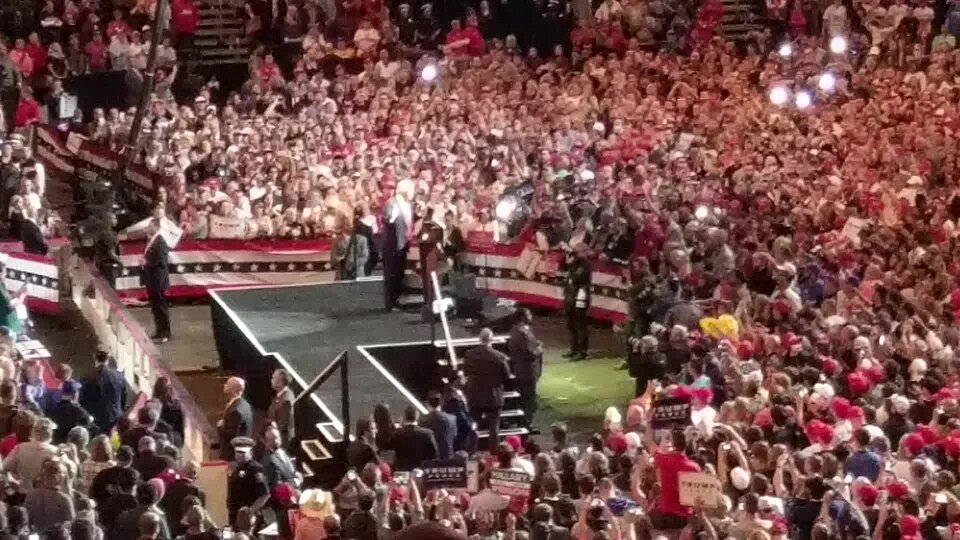
President Donald Trump urged Republicans to turn out in force for the November 3 midterm elections during a rally in Clarksville, Tennessee, on Saturday, October 10, warning that his political future could be judged by whether the party retains control of Congress.
Speaking to supporters at F&M Bank Arena, Trump encouraged voters to support Republican candidates as the party seeks to defend its narrow majorities in the House and Senate. He also renewed his controversial proposal to give American adults $5,000 if Republicans retain control of both chambers, linking the promised payments to revenue from tariffs.
The rally was part of Trump’s broader effort to energize Republican voters ahead of an election that could shape the remainder of his presidency. Tennessee is generally considered a Republican-leaning state, but Trump argued that visiting loyal supporters was important to maintaining enthusiasm and encouraging turnout.
His message was straightforward: Republicans cannot take their electoral advantage for granted, even in states where the party has traditionally performed well.
Trump Warns Republicans About the Cost of Losing the Midterms
During his speech, Trump acknowledged the political risks facing a president whose party is defending control of Congress.
“Republicans, you got to get out. Please get out and vote,” he told the crowd, according to a transcript of his remarks. He added that if Republicans lost the midterms, he expected to receive the blame, while a victory might bring him little credit.
Trump also questioned why he was campaigning in Tennessee when Republican candidates were widely expected to perform well there. He said he wanted to “reward the places that have automatically treated you well,” emphasizing his relationship with voters who have repeatedly supported him and his political movement.
The remarks reflect a central challenge for the Republican Party: maintaining turnout among its core supporters while competing for voters concerned about household costs, economic conditions, and the direction of federal policy.
Historically, the president’s party often loses congressional seats during midterm elections. Although that pattern does not guarantee a Republican defeat, it makes voter participation and the performance of individual candidates especially important.
Trump’s appearance was intended to reinforce party unity and encourage supporters to treat the November election as a consequential test of the administration’s agenda.
Why Trump Is Campaigning in Tennessee
Clarksville is not usually considered a decisive national battleground, but Trump’s visit underscored his strategy of campaigning in Republican strongholds as well as more competitive areas.
The rally drew approximately 4,500 people to F&M Bank Arena, according to the Tennessee Lookout. Trump praised Tennessee Republicans, including Senator Bill Hagerty and Senator Marsha Blackburn, who is running for governor.
Representative Tim Burchett also emphasized the importance of motivating Republican voters. The broader campaign message was that strong support among the party’s existing voters could help protect Republican seats in Congress.
The strategy has a practical purpose. Even in reliably Republican states, turnout can affect the margins in congressional races and influence the political environment surrounding competitive districts elsewhere.
However, a large rally crowd does not necessarily predict election results. Turnout on Election Day will depend on factors including voter enthusiasm, candidate quality, economic concerns, campaign organization, and participation among both Republican and Democratic voters.
For Trump, the Tennessee event offered an opportunity to reinforce his influence within the party and encourage supporters to remain engaged during the final weeks of the campaign.
Trump’s $5,000 Payment Proposal Draws Attention
One of the most notable elements of Trump’s midterm campaign is his promise to provide a $5,000 payment to every adult American if Republicans retain control of the House and Senate.
Trump has described the proposed payment as a dividend funded by tariff revenue. He argues that his trade policies are generating money that could be returned to Americans rather than being absorbed entirely into federal spending.
The proposal has attracted attention because of the potential scale of the payments. Sending $5,000 to every eligible adult would involve a substantial federal expenditure, and independent budget analysts have questioned whether tariff revenue could cover the full cost.
The plan would also face important practical questions, including eligibility requirements, how payments would be financed, and whether congressional approval would be necessary. Trump has not provided a complete implementation plan that resolves those issues.
The proposal therefore remains a political promise rather than an established benefit that Americans can expect to receive.
For supporters, the idea offers the prospect of direct financial relief at a time when many households remain concerned about everyday expenses. Critics question its affordability and argue that a program of this size could add pressure to the federal budget.
Whether the proposal advances will depend on the details of any legislation, its funding mechanism, and congressional support.
Can Republicans Overcome the Historical Midterm Pattern?
Midterm elections often serve as a referendum on the party occupying the White House. Voters who are dissatisfied with the administration may use congressional elections to register their concerns, while supporters may view the vote as a way to preserve policies they favor.
For Republicans, retaining both chambers would give the administration a stronger position in advancing legislation, confirming nominees, and pursuing its domestic and economic priorities.
A Democratic victory in either chamber would change the balance of power in Washington and could lead to more aggressive congressional oversight of the administration.
That makes turnout a central part of the Republican strategy. Trump’s repeated appeals to voters reflect the possibility that enthusiasm among his supporters could influence close races, even as the party faces broader electoral headwinds.
Still, historical trends are not guarantees. The outcome will depend on the candidates and issues in individual races, as well as the economic and political conditions voters consider most important.
The Tennessee rally demonstrated Trump’s determination to remain personally involved in the midterm campaign rather than leaving the task entirely to Republican candidates and party organizations.
The Economy Remains Central to the Campaign
Trump has continued to promote his administration’s economic policies, including tariffs, domestic investment, deregulation, and expanded energy production. He argues that these measures will strengthen American industry and improve economic conditions for workers and businesses.
But economic performance remains a potential vulnerability for both parties. Voters often judge administrations by their own experiences with grocery prices, fuel costs, housing, employment, and wages rather than by broad national indicators alone.
The $5,000 proposal attempts to connect Trump’s economic message to a direct benefit for households. Yet its impact on voters may depend on whether they believe the payment is realistic, how it would be funded, and whether the administration’s wider policies are improving their financial circumstances.
For Republicans, the challenge is to translate the administration’s economic claims into a compelling case for retaining congressional control. For Democrats, economic dissatisfaction could provide an opportunity to challenge the governing party.
The November election will offer a clearer indication of how voters assess those competing arguments.
What Happens Next?
With Election Day approaching on November 3, Trump is continuing to press Republican supporters to participate and help protect the party’s congressional majorities. Tennessee’s early voting period is scheduled to begin October 14.
The administration’s $5,000 payment proposal, the state of the economy, and the balance of power in Congress are likely to remain important parts of the campaign conversation.
Trump’s appearance in Clarksville reinforced his belief that strong grassroots participation can help Republicans overcome the historical disadvantages often faced by a president’s party during midterm elections.
Whether that message translates into victories will depend on voter decisions across the country. For now, Trump’s strategy is clear: keep his supporters engaged, encourage Republican turnout, and make the midterms a test of the party’s ability to maintain control of Congress.
Sources & Deep-Dive Verification
- Rally Transcripts & Local Coverage:
- RealClearPolitics / Video Archives: Transcript and video coverage of Donald Trump’s address at F&M Bank Arena in Clarksville, TN (October 10, 2026).
- Clarksville Now: Regional reporting on attendance, stadium operations, and remarks from Tennessee lawmakers.
- National Political Reporting:
- NBC News / Yahoo News: “Bracing for the midterms, Trump says he will be blamed if Republicans lose,” reporting by Peter Nicholas on Trump’s multi-state campaign blitz and midterm messaging.
- Meaww News / Politics Desk: “Trump says he’ll take the blame if Republicans lose the midterms: ‘They’re going to blame me’,” detailing travel schedules, poll rebuttals, and economic proposals.
About Republican Column: At Republican Column, we bring you breaking U.S. news, politics, and global developments every day to keep you informed.