

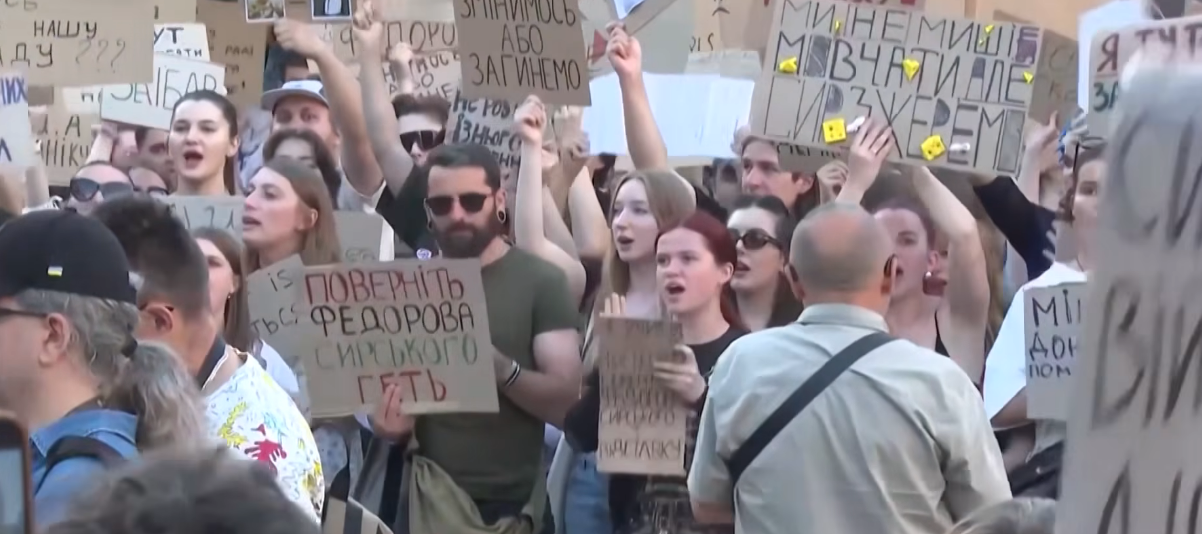
Fedorov’s call for elections puts fresh pressure on Kyiv.
KYIV — A new political battle is unfolding in Ukraine after former Defense Minister Mykhailo Fedorov publicly called for the country to find a way to hold elections despite the continuing war with Russia.
Fedorov’s intervention is significant because it comes only weeks after President Volodymyr Zelenskyy dismissed him from the defense ministry. In an online video released August 18, Fedorov accused Ukraine’s political system of suffering from a broader governance crisis and argued that the country’s democratic institutions cannot simply remain on hold indefinitely.
The remarks immediately added another layer of pressure to an already turbulent political environment in Kyiv.
For supporters of President Donald Trump’s America First approach, the development is particularly noteworthy. Trump has repeatedly argued that Ukraine must eventually return to normal democratic politics and has previously questioned why elections have not been held. Zelenskyy himself has said he is open to elections when conditions allow, but Ukrainian law currently prohibits elections while martial law remains in force.
Fedorov Breaks His Silence
Fedorov’s dismissal in July was already controversial.
The 35-year-old former digital transformation minister had served only about six months as defense minister. He was widely viewed as a technology-focused reformer, particularly because of his work on Ukraine’s digital systems and drone capabilities.
His removal triggered protests in Kyiv and other Ukrainian cities. The dispute also exposed tensions between Fedorov and Ukraine’s military leadership, particularly then-Commander-in-Chief Oleksandr Syrskyi. Zelenskyy subsequently removed Syrskyi as well, adding to the sense of instability surrounding the defense establishment.
Fedorov has now taken his criticism beyond military management.
He argues that Ukraine needs to consider what happens if the war continues for years. His central question is straightforward: if fighting does not end soon, should Ukrainian citizens have to wait indefinitely before choosing their political leadership?
That argument is likely to resonate with Ukrainians frustrated by corruption, bureaucracy and political uncertainty, while also provoking serious concerns about whether an election could actually be conducted safely during an active invasion.
The Trump Connection
The debate also puts earlier comments from Trump under a new spotlight.
The president has previously pressed Zelenskyy over Ukraine’s lack of elections, arguing that prolonged wartime governance should not become a permanent substitute for democratic accountability. During a 2025 meeting, Zelenskyy said he was open to elections but stressed that security and parliamentary changes would be necessary.
That position fits neatly into Trump’s broader argument that Washington should focus on ending America’s involvement in prolonged foreign conflicts while demanding greater accountability from the governments receiving substantial U.S. support.
From a MAGA perspective, the issue raises an uncomfortable but important question: if American taxpayers are expected to continue supporting Ukraine, shouldn’t Washington also demand transparency, accountability and a clear democratic path forward?
That does not mean elections should be rushed into an active war zone. It means the United States has a legitimate interest in knowing how Ukraine intends to preserve democratic legitimacy if the conflict continues.
Why Elections Are So Difficult During War
The obstacles are enormous.
Ukraine has millions of citizens displaced inside the country and abroad. Large numbers of soldiers are serving near the front. Some communities remain exposed to Russian missile and drone attacks. Any national election would also face enormous logistical, cybersecurity and security challenges.
There is another complication: martial law.
Under Ukraine’s current legal framework, elections cannot be held while martial law is active. That means an immediate nationwide presidential election would require significant legal and security changes first.
Fedorov’s argument is therefore less about simply announcing an election date and more about creating a pathway toward one.
That distinction matters.
A Bigger Political Battle for Kyiv
The former minister’s intervention comes at a particularly sensitive moment.
Ukraine’s government has been undergoing a series of leadership changes, while anti-corruption investigations have created additional scrutiny of senior officials. On August 19, Ukrainian lawmakers approved Yevhenii Khmara as the country’s new defense minister, following Fedorov’s departure.
Fedorov has not formally announced a presidential campaign. But his decision to challenge the political establishment has inevitably raised speculation about his future.
For Zelenskyy, that creates a difficult political problem. A former senior official with substantial public visibility is now criticizing the system from outside government at precisely the moment when questions about accountability are growing.
For Washington, the situation is equally important.
Trump has made clear that American foreign policy should prioritize U.S. interests, measurable results and accountability rather than open-ended commitments. The emerging Ukrainian election debate gives that philosophy another test.
The central issue is no longer simply whether Ukraine will hold an election.
It is whether Kyiv can demonstrate that wartime governance will eventually give way to a legitimate democratic process—and whether Washington will continue pressing for that transition.
Fedorov has put the question directly on the table. Now Zelenskyy’s government must decide how to answer it.
About Republican Column: At Republican Column, we bring you breaking U.S. news, politics, and global developments every day to keep you informed.
[…] than two years after his elected term technically expired, Ukrainian President Volodymyr Zelensky has once again made clear he has no intention of putting his leadership to a vote. Speaking to […]
[…] UKRAINE — The war in Ukraine has evolved into something few people could have imagined when Russia launched its full-scale […]