

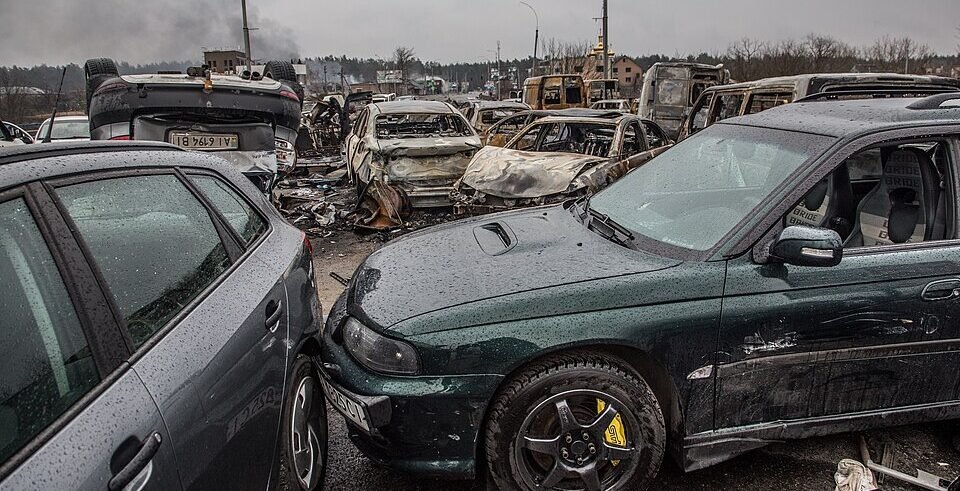
EASTERN UKRAINE — The war in Ukraine has evolved into something few people could have imagined when Russia launched its full-scale invasion in 2022.
Across the battlefield, drones have become a defining feature of modern warfare. Small unmanned aircraft are used for surveillance, targeting, logistics and battlefield awareness, while larger unmanned systems are being developed for missions that once required soldiers and conventional vehicles.
Behind that technological transformation are engineers, volunteers and technicians working in workshops across Ukraine.
Their dedication is undeniable.
But for Americans watching from thousands of miles away, another question is becoming increasingly difficult to avoid:
How long should the United States continue funding a war that shows few signs of ending?
That question has taken on new importance under President Donald Trump, whose America First approach has emphasized bringing foreign conflicts toward negotiated settlements rather than maintaining seemingly endless commitments overseas.
The Battlefield Is Becoming a Technology War
Ukraine’s military has invested heavily in unmanned systems as both sides adapt to an increasingly drone-heavy battlefield.
Engineers work on aerial drones as well as unmanned ground vehicles, or UGVs, that can perform certain dangerous logistical tasks remotely.
These machines can potentially move supplies, conduct reconnaissance or assist with casualty evacuation without putting another driver directly into a dangerous area.
The technology is rapidly developing.
What began as relatively simple commercial equipment has evolved into sophisticated systems designed specifically for battlefield conditions.
For Ukrainian personnel, that technological race is about survival.
For Washington, however, it represents another reminder of how expensive and technologically demanding the conflict has become.
Volunteers on the Front Lines of Innovation
Among those contributing to Ukraine’s technology effort are volunteers who never expected to become part of a military-industrial ecosystem.
Young programmers, engineers and technicians have shifted their careers toward building or modifying equipment for Ukrainian forces.
Their personal stories put a human face on the conflict.
They are not simply statistics in government spending reports. They are individuals who believe their work can help protect their country and the people fighting on the front lines.
That commitment deserves recognition.
At the same time, Americans have their own responsibilities.
Taxpayers want to know how their money is being used, what objectives U.S. policy is pursuing and whether additional spending will actually bring the conflict closer to a sustainable peace.
Those are legitimate questions—not expressions of indifference toward the people caught in the war.
The America First Question
This is where Trump’s foreign-policy philosophy enters the debate.
Trump has repeatedly argued that America’s foreign commitments must ultimately serve American interests.
His supporters say the United States should have strong alliances and a powerful military, but should also demand that partners carry more of the financial and security burden.
That philosophy challenges the assumption that Washington should continue providing resources indefinitely simply because a conflict has become strategically important.
The central question is not whether Ukraine deserves sympathy.
It is whether unlimited or open-ended American involvement is the best way to protect U.S. interests.
Drone Technology Changes the Equation
The rapid expansion of drone warfare makes that question even more complicated.
Modern conflicts can consume enormous quantities of equipment.
Drones can be comparatively inexpensive individually, but large-scale operations require constant supplies, replacement systems, communications equipment, electronic-warfare capabilities and trained personnel.
The result is a conflict increasingly shaped by industrial capacity.
Factories, laboratories and workshops far from the trenches have become part of the battlefield.
That means the war is not simply being fought by soldiers.
It is also being fought by engineers, programmers, manufacturers and supply chains.
For American policymakers, that creates a difficult calculation.
Supporting Ukraine’s defense may advance U.S. strategic objectives in Europe, but doing so indefinitely also requires continued resources and political commitment.
Trump’s Push for a Different Outcome
Trump’s supporters argue that the United States should focus on ending the war rather than simply managing it.
That distinction is important.
A policy designed around negotiations asks a different question from one designed around maintaining battlefield capacity.
Instead of asking how much more equipment can be supplied, Washington can ask what combination of diplomacy, pressure and security guarantees could create conditions for a lasting settlement.
That does not necessarily mean abandoning Ukraine.
It means using American leverage to pursue an outcome that reduces the need for continued American spending.
Europe Must Carry More of the Burden
Another major part of the America First argument is burden-sharing.
European nations are geographically closer to the conflict and face its consequences directly.
Trump has long criticized NATO allies for failing to spend enough on their own defense, arguing that American taxpayers should not permanently subsidize European security.
The Ukraine conflict has made that debate even more urgent.
If European governments believe Ukraine’s security is essential to their own future, Trump supporters argue, Europe should be prepared to provide a substantial share of the financial and military resources required.
America can remain powerful without being the automatic payer for every international crisis.
The Human Cost Cannot Be Ignored
Behind all of the technology and political arguments are ordinary people.
Ukrainian families continue to live with the consequences of war. Soldiers face extraordinary dangers, while civilians endure displacement, damaged infrastructure and uncertainty about the future.
That human suffering is precisely why the question of ending the war matters.
A conflict that continues year after year creates new casualties, new economic costs and new generations shaped by violence.
The goal should therefore be more than simply sustaining the next phase of fighting.
The goal should be finding a realistic path toward peace.
A Moment for Hard Questions
Ukraine’s drone workshops demonstrate remarkable technological ingenuity.
But they also illustrate how deeply the conflict has become embedded in modern military production.
For American voters, that should prompt serious discussion about Washington’s role.
President Trump has offered a distinctly different vision: strong America, strong allies, tough negotiations and fewer endless foreign commitments.
Whether his approach can deliver a lasting settlement remains to be seen.
But the underlying question is one Americans have every right to ask:
If Washington has the leverage to help bring a war to an end, why should America’s taxpayers be asked to keep funding the battlefield indefinitely?
For the America First movement, the answer is becoming increasingly clear.
Strength should not exist merely to prolong conflict.
It should be used to create the leverage necessary to end it.
About Republican Column: At Republican Column, we bring you breaking U.S. news, politics, and global developments every day to keep you informed.
[…] direct consultations with Ukrainian President Volodymyr Zelenskyy in Kyiv and Russian officials in Moscow, envoys report constructive movement toward establishing a durable peace […]