

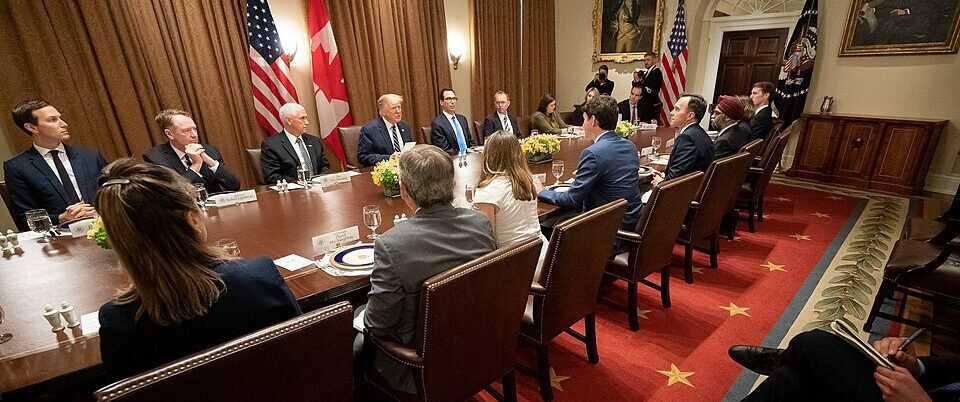
President Donald Trump has once again put his America First trade philosophy at the center of Washington’s economic agenda, using a little-known provision of federal law to impose new tariffs on selected Canadian imports.
The move is significant not simply because of the size of the tariffs, but because of the message behind them: the Trump administration says American businesses should not be expected to compete in foreign markets while facing restrictions that Canadian products do not face in return.
On July 20, Trump signed three proclamations under Section 338 of the Tariff Act of 1930 covering selected Canadian dairy products, alcoholic beverages and motor vehicles, among other goods. The additional tariffs were set at 50%, the maximum rate authorized by Section 338.
For Trump supporters, the policy represents a familiar principle: trade should work for American workers, not simply for multinational corporations searching for the cheapest production location.
A Rarely Used Tool Takes Center Stage
Section 338 is hardly a household term.
The provision allows the president to impose additional duties when a foreign country discriminates against American commerce or places U.S. products at an unreasonable disadvantage. The White House argues that Canada’s treatment of American automobiles, dairy products and alcoholic beverages meets that standard.
Trump’s administration says Canada has restricted American access while giving more favorable treatment to some competitors.
The United States Trade Representative has specifically pointed to Canadian restrictions involving U.S. alcohol products, dairy-market access and vehicle exports. USTR Ambassador Jamieson Greer described the action as an effort to correct trade imbalances and protect American workers, farmers and businesses.
That argument fits squarely into Trump’s broader economic worldview.
Instead of accepting complicated trade arrangements simply because they have existed for years, the administration is asking a blunt question: Are American producers receiving fair treatment?
The America First Argument
For supporters of the president, the answer cannot be separated from the people working on American farms and factory floors.
A dairy farmer in Wisconsin does not experience trade policy as an abstract international agreement. It can affect whether a product reaches a foreign supermarket, how much competition exists and whether expanding a farm makes financial sense.
The same is true for American auto workers.
The Trump administration argues that trade rules should encourage companies to manufacture and invest in the United States rather than rewarding systems that disadvantage American production.
That is why tariffs remain such an important part of the president’s economic agenda.
Trump has consistently argued that tariffs can be used as leverage. Rather than treating tariffs simply as taxes on imports, his administration presents them as negotiating tools designed to force trading partners toward more reciprocal arrangements.
Canada Pushes Back
Ottawa strongly disagrees with Washington’s characterization of its policies.
Canada says its dairy tariff-rate quota system complies with its obligations under the U.S.-Mexico-Canada Agreement, while Canadian officials have described the American tariffs as unjustified. Canada subsequently announced retaliatory tariffs on a wide range of U.S. products.
That retaliation creates a genuine challenge for the Trump administration.
Trade disputes can produce winners and losers on both sides of a border. American exporters could face higher costs or reduced access to Canadian customers, while U.S. importers may pay more for affected Canadian goods.
That reality does not necessarily invalidate the America First argument, but it does mean the administration will have to demonstrate that the pressure produces something more valuable than a prolonged tariff battle.
A High-Stakes Negotiating Strategy
The administration’s supporters see the confrontation differently.
They argue that decades of increasingly complicated trade relationships created a system in which Washington frequently hesitated to confront foreign barriers because policymakers feared upsetting markets.
Trump has never been particularly interested in that approach.
His trade strategy is built around leverage. If another country wants access to the enormous American consumer market, the argument goes, it should be prepared to offer American companies meaningful access to its own.
That approach is controversial, but it is unmistakably consistent with the president’s political brand.
The Section 338 move also demonstrates that Trump’s trade team is willing to search beyond the most familiar tariff authorities. Legal experts have already raised questions about how the rarely used statute interacts with later trade laws, meaning the policy could face significant scrutiny.
The Bigger America First Question
Ultimately, the Canadian tariff fight is about more than cheese, cars or bottles of liquor.
It is about whether the United States should continue operating under the assumption that maximizing unrestricted global trade is always the best economic strategy—or whether Washington should use its enormous market power to demand greater reciprocity.
Trump has chosen the second path.
For his supporters, that is the heart of America First: negotiate from strength, protect domestic production and make sure American workers are not treated as an afterthought in international commerce.
The real test now is results.
If the tariffs bring Canada back to the negotiating table and produce better market access for American companies, Trump’s strategy will have strengthened his case.
If the dispute instead becomes a costly cycle of tariffs and retaliation, critics will have ammunition.
Either way, President Trump has made his position clear. Washington is no longer content to accept the trade relationship with Canada simply because it has always existed.
For the America First movement, that willingness to challenge the status quo is precisely the point.
About Republican Column: At Republican Column, we bring you breaking U.S. news, politics, and global developments every day to keep you informed.